
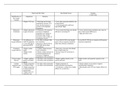
High Land Deer Mice Bar-Headed Geese Sculpins
(+other fish)
Modification on Adaptations Plasticity
the oxygen
Cascade
• Higher VO2 max • Both high and lowland • Lower than expected metabolic rate
populations increase VO2 at high altitude
max, but the increase in • Avoid energetically inefficient
greatest in the highland high-altitude flight
population
Pulmonary • Higher pulmonary • Pulmonary O2 extraction • Cross-current bird lungs are already • Lower routine/resting metabolic rates (may be
Ventilation oxygen extraction increases in highland efficient at extracting O2 due to behavioural differences)
population (no change in • High gill surface area
lowland); lung volume
increases with no effect of
acclimation alveoli
Pulmonary • No difference in • No effect on blood %Hb- • Lower Hb-O2 P50 in bar-headed Lower Hb-O2 P50 due to variation in Hb protein
oxygen diffusion %Hb-O2 saturation O2 saturation geese is due to sequence mutations structure/composition
• Lower P50 due to Decrease in Hb-O2 P50 in rather than allosteric modulators
decreased [DPG] both high and lowland
populations
Circulatory • Higher cardiac • Cardiac output increases • Heart rate is lowered with altitude
oxygen delivery output with acclimation due to flight behaviour
• Higher stroke • Stroke volume increases in • Increase tissue O2 extraction in
volume lowland populations but hypoxia
increases in highland
populations with acclimation
Tissue oxygen • Higher capillary • NO effect with acclimation • Higher capillary density in the Higher aerobic and anaerobic capacity in the
delivery density in skeletal • NO effect with acclimation muscle and heart brain
muscle
Cellular • Higher proportion • No effect with acclimation • Higher proportion of • Greater reliance on succinate to support
respiration and of oxidative fibers • No effect with acclimation subsarcolemmal mitochondria mitochondrial respiration
ATP supply • Higher proportion • Cytochrome c oxidase has a higher • Mitochondria and COX have higher affinity for
of subsarcolemmal affinity for cytochrome c O2
mitochondria
• Higher state of 3
respiration rate
, ATP Demand ATP Supply
Reduced Activity High Capacity of • Under anoxia in the turtle, the liver and
Anaerobic ATP glycogen stores are not greatly affected by
production anoxia exposure
• Under anoxia, the heart and muscle glycogen
is depleted during anoxia
• The glycogen usage in the liver is temperature
dependent such that when the temperature is
colder, the turtle is able to use less glycogen
Inhibition of tissue and cellular ATP PROBLEM Mechanisms to manage PROBLEM:
consuming pathways • Mammalian brain is extremely sensitive to metabolic waste • Blood osmolarity increases
anoxia exposure as it leads to a rapid decline in • Under anoxia, the depletion of glycogen is
cellular ATP due to the inhibition of oxidative associated with lactate accumulation. Lactate
phosphorylation. The loss of ATP leads to a accumulates at high levels in the blood and it
cascade of events that results in the failure of turns and muscles turn acidotic (can get up to
the brain; ATP controls many ATPases 200nM in ventricular blood); lactate load
• Increase in [K+] extracellular => membrane increases a negative charge in the blood so H+
potential (and other divalent cations = Mg2+, Ca2+)
• Increase in [Ca2+]intracellular => muscle and increase in blood so total charge balances.
vesicles • Blood Na+ doesn’t change (under
• Neurons more permeability to ions, submergence)
destabilization of in membrane potential —> • Blood K+ increases but total concentration is
decreased in neuronal electrical activity relatively low
• Decrease in adenosine (inhibitory), increase in • Blood Cl- decreases
glutamate (excitatory), decrease in GABA • The shell
(inhibitory), and a decrease in cerebral blood SOLUTION:
flow • Shell and bone help to manage acidosis
- Buffers (CaCo3) are released into the
SOLUTION: ECF to enhance the buffering capacity
• Anoxia-tolerant turtles prevent the depletion of of the ECF during anoxia
cellular ATP (maintain ATP) and down- - Lactate is sequestered into the shell
regulation of neural activity through a and bone during anoxia and released
mechanism during recovery from anoxia.
- The shell acts as a source of Ca2+,
• Turtles also reduce metabolic responses by Mg2+, and buffer and sink for lactate
suppressing BMR under anoxia. Hepatocytes and protons during anoxia
and neurons reduce ATP turnover by >10 fold
(+other fish)
Modification on Adaptations Plasticity
the oxygen
Cascade
• Higher VO2 max • Both high and lowland • Lower than expected metabolic rate
populations increase VO2 at high altitude
max, but the increase in • Avoid energetically inefficient
greatest in the highland high-altitude flight
population
Pulmonary • Higher pulmonary • Pulmonary O2 extraction • Cross-current bird lungs are already • Lower routine/resting metabolic rates (may be
Ventilation oxygen extraction increases in highland efficient at extracting O2 due to behavioural differences)
population (no change in • High gill surface area
lowland); lung volume
increases with no effect of
acclimation alveoli
Pulmonary • No difference in • No effect on blood %Hb- • Lower Hb-O2 P50 in bar-headed Lower Hb-O2 P50 due to variation in Hb protein
oxygen diffusion %Hb-O2 saturation O2 saturation geese is due to sequence mutations structure/composition
• Lower P50 due to Decrease in Hb-O2 P50 in rather than allosteric modulators
decreased [DPG] both high and lowland
populations
Circulatory • Higher cardiac • Cardiac output increases • Heart rate is lowered with altitude
oxygen delivery output with acclimation due to flight behaviour
• Higher stroke • Stroke volume increases in • Increase tissue O2 extraction in
volume lowland populations but hypoxia
increases in highland
populations with acclimation
Tissue oxygen • Higher capillary • NO effect with acclimation • Higher capillary density in the Higher aerobic and anaerobic capacity in the
delivery density in skeletal • NO effect with acclimation muscle and heart brain
muscle
Cellular • Higher proportion • No effect with acclimation • Higher proportion of • Greater reliance on succinate to support
respiration and of oxidative fibers • No effect with acclimation subsarcolemmal mitochondria mitochondrial respiration
ATP supply • Higher proportion • Cytochrome c oxidase has a higher • Mitochondria and COX have higher affinity for
of subsarcolemmal affinity for cytochrome c O2
mitochondria
• Higher state of 3
respiration rate
, ATP Demand ATP Supply
Reduced Activity High Capacity of • Under anoxia in the turtle, the liver and
Anaerobic ATP glycogen stores are not greatly affected by
production anoxia exposure
• Under anoxia, the heart and muscle glycogen
is depleted during anoxia
• The glycogen usage in the liver is temperature
dependent such that when the temperature is
colder, the turtle is able to use less glycogen
Inhibition of tissue and cellular ATP PROBLEM Mechanisms to manage PROBLEM:
consuming pathways • Mammalian brain is extremely sensitive to metabolic waste • Blood osmolarity increases
anoxia exposure as it leads to a rapid decline in • Under anoxia, the depletion of glycogen is
cellular ATP due to the inhibition of oxidative associated with lactate accumulation. Lactate
phosphorylation. The loss of ATP leads to a accumulates at high levels in the blood and it
cascade of events that results in the failure of turns and muscles turn acidotic (can get up to
the brain; ATP controls many ATPases 200nM in ventricular blood); lactate load
• Increase in [K+] extracellular => membrane increases a negative charge in the blood so H+
potential (and other divalent cations = Mg2+, Ca2+)
• Increase in [Ca2+]intracellular => muscle and increase in blood so total charge balances.
vesicles • Blood Na+ doesn’t change (under
• Neurons more permeability to ions, submergence)
destabilization of in membrane potential —> • Blood K+ increases but total concentration is
decreased in neuronal electrical activity relatively low
• Decrease in adenosine (inhibitory), increase in • Blood Cl- decreases
glutamate (excitatory), decrease in GABA • The shell
(inhibitory), and a decrease in cerebral blood SOLUTION:
flow • Shell and bone help to manage acidosis
- Buffers (CaCo3) are released into the
SOLUTION: ECF to enhance the buffering capacity
• Anoxia-tolerant turtles prevent the depletion of of the ECF during anoxia
cellular ATP (maintain ATP) and down- - Lactate is sequestered into the shell
regulation of neural activity through a and bone during anoxia and released
mechanism during recovery from anoxia.
- The shell acts as a source of Ca2+,
• Turtles also reduce metabolic responses by Mg2+, and buffer and sink for lactate
suppressing BMR under anoxia. Hepatocytes and protons during anoxia
and neurons reduce ATP turnover by >10 fold


