100% satisfaction guarantee Immediately available after payment Both online and in PDF No strings attached 4.2 TrustPilot
logo-home
Exam (elaborations)

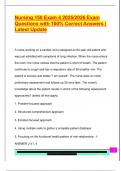
NURS 340 Leadership Quiz 1 (Ch 1.2.3) Questions and Answers,100% CORRECT

Rating
-
Sold
-
Pages
19
Grade
A+
Uploaded on
06-03-2023
Written in
2022/2023

NURS 340 Leadership Quiz 1 (Ch 1.2.3) Questions and Answers Arts and Humanities English Linguistics Leadership Quiz 1 (Ch 1.2.3) Terms in this set (61) Self-aware Courageous Successful Decision Makers Sensitive Energetic Creative Marquis-Huston Critical Thinking Teaching Model This is the critical thinking, continually going on, continually assessing to see if there is a way to improve it Experiential Learning Provides mock life experiences to learn from Allows learners to apply leadership and management theory Promotes whole-brain thinking and improved problem-solving skills Principles for Effective Use of Case Studies There must be an adequate number of cases to draw generalizations or recognize patterns. There is no right or wrong answer to a case study. The goal is to produce a number of solutions, although some may be more successful than others. Group process is a vital component and increases the chance that the best possible solution will be identified. To Solve Cases Successfully State a clear objective. Assess all the information given (don't use faulty data gathering). Be self-aware. Watch for faulty logic. Always make a final choice. Always identify a means for evaluation. Utilize group process in some way to increase solutions. Which is NOT a factor in solving a case successfully? a) Being self-aware b) Doing all work independently c) Assessing all information given d) Watching for faulty logic Answer: B. Doing all work independently. Rationale: It is important to use group process in some way to increase solutions. Problem-Solving vs. The Traditional Problem-Solving Process Identify the problem. Gather data to identify the causes and consequences of the problem. Explore alternative solutions. Evaluate each alternative. Select appropriate solution. Implement solution. Evaluate results. Decision-Making Models Managerial Decision-Making Model Determine the decision and the desired outcome (set objectives). Research and identify options. Compare and contrast these options and their consequences. Make a decision. Implement an action plan. Evaluate results. What is the first step in managerial decision-making model? a) Identify the problem b) Evaluate alternatives c) Gather data d) Set objectives Answer: D. Set objectives Rationale: While the traditional model begins with identifying the problem, in managerial decision- making model one approaches the issue by first deciding on the objectives. Assess Nursing Process: A Diagnose Problem- Solving and Plan Decision-Making Model Implement Evaluate Identify the problem. Define the context. Enumerate choices. IDEALS Model Analyze options. List reasons explicitly. Self-correct. Why the critical thinking Serious decline in the ability of young adults to movement? problem solve/do inferential reasoning (Recognition-Primed Decision We've been busy teaching facts, not how to think (RPD) Model for Intuitive Decision Making ) Information becomes obsolete quickly. Why Is Critical Thinking Complexity of the profession Especially Important to Limited number of hours for theory and clinical in Nurses? education Information overload Conflicting responsibilities True or False: Answer:True Information in nursing Rationale: Information in nursing is constantly becomes obsolete quickly. changing, which is why critical thinking is such an important skill for nurses. Critical Thinking "the mental process of actively and skillfully conceptualizing, applying, analyzing, synthesizing, and evaluating information to reach an answer or conclusion Energy—action-oriented Courage—willing to take risks Characteristics of a Successful Sensitivity Thinker Creativity—innovative Good track record Self-awareness Which is a characteristic of a Answer: B. Courage successful thinker? Rationale: A successful thinker should be willing to a) Impulsiveness take risks. b) Courage c) Decisiveness d) Whimsy Recurrent and routine problem solving Satisficing- someone that is pretty much happy with Types of Decision Making status quo, really just want to settle for whatever is familiar, very happy with the way things are Maximizing or optimal mode No clear objective or goal for decision Faulty data gathering Always know what your objectives are and have good data gathering. No faulty logic, be very specific and identify what the problem is. Always Frequent Errors in Decision have good Alternatives and think outside of the box. Making Faulty logic or "crooked thinking" Too much time spent identifying the problem Not considering enough alternatives Lack of self-awareness Refusal to act Using outcome only for evaluation "the process of shared decision-making between practitioner, patient, and others significant to them Evidence-based Nursing based on research evidence, the patient's Practice experiences and preferences, clinical expertise or know-how, and other available robust sources of information." Understands Gender Personal individual values Successful Decision Maker Life experience Preferences Willingness to take risks Brain hemisphere dominance Predominant thinking style Planning Management Organizing Functions/process Staffing Directing Controlling Now more than ever, there is a greater emphasis on Business of Health Care the business of health care, with managers being involved in the financial and marketing aspects of their respective departments. Have an assigned position within the formal organization Have a legitimate source of power due to the delegated authority that accompanies their position Are expected to carry out specific functions, duties, and responsibilities Emphasize control, decision making, decision Characteristics of Managers analysis, and results Manipulate people, the environment, money, time, and other resources to achieve organizational goals Have a greater formal responsibility and accountability for rationality and control than leaders Direct willing and unwilling subordinates What should managers E. All of the above emphasize? a) Decision making Rationale: Control, decision making, analysis, and b) Analysis results are all crucial elements of successful c) Results management. d) Control e) All of the above Often do not have delegated authority, but obtain their power through other means Have a wider variety of roles than managers Are frequently not part of the formal organization Focus on group process, information gathering, feedback, and empowering others envision the future communicate their visions Leaders motivate followers lead the way influence others to accomplish goals inspire confidence take risks empower followers master change Leadership increases productivity by maximizing workforce effectiveness. Managers Are always assigned a position within an organization Have a legitimate source of power due to the delegated authority that accompanies their position Are expected to carry out specific functions Emphasize control, decision making, decision analysis, and results coordinate resources optimize resource use meet organizational goals and objectives follow rules plan, organize, control, and direct use reward and punishment effectively to achieve organizational goals Management emphasizes control—control of hours, costs, salaries, overtime, use of sick leave, inventory, and supplies. Which is a characteristic of a Answer: C. Focus on group process, information leader? gathering, and feedback A) Always assigned a position of authority Rationale: While managers are more often part of a b) Usually part of a formal formal organization and focus more on results- organization oriented tasks, leaders tend to focus more on things c) Focus on group process, such as group process. information gathering, and feedback d) Focus on decision making and results Management Theory T—scientific management Development W—bureaucratic functions Taylor F—management organizations Weber G—activities of management Fayol Fo—participative management Gulick Ma—Hawthorne effect Follett Mc—theory X and theory Y Mayo A—employee participation McGregor Argyris Which theory did Weber develop? a) Bureaucratic organizations b) Management functions c) Scientific management d) Activities of management Answer: A. Bureaucratic organizations Rationale: Weber developed the theory of bureaucratic organizations. Management functions theory was developed by Fayol. Taylor developed scientific management theory and Gulick developed activities of management theory. Planning Encompasses determining philosophy, goals, objectives, policies, procedures, and rules; carrying out long- and short-range projections; determining a fiscal course of action; and managing planned change Organizing Includes establishing the structure to carry out plans, determining the most appropriate type of patient care delivery, and grouping activities to meet unit goals. Other functions involve working within the structure of the organization and understanding and using power and authority appropriately Staffing Consists of recruiting, interviewing, hiring, and orienting staff. Scheduling, staff development, employee socialization, and team building are also often included as staffing functions Controlling Includes performance appraisals, fiscal accountability, quality control, legal and ethical control, and professional and collegial control True or False: True Team building is an aspect of Rationale: While recruiting, interviewing, and hiring staffing. are the tasks most often associated with staffing, team building is also an important aspect of the job. Human Relations Era: Participatory and Humanistic Participatory management- best people to be doing the problem solving are including the people actually doing the job Humanistic management-relying on the human aspect as opposed to machines Leadership Leadership is the art of getting work done through others willingly. Leaders are in the front, moving forward, taking risks and challenging the status quo. A job title alone does not make a person a leader. Only a person's behavior determines if he or she occupies a leadership position. Leadership Requires Getting very clear about your values, taking risks, and having a willingness to seek partners and collaborators who will commit to the common good Can Leadership Be Taught? Leadership cannot be taught because: Leaders are born and not made American culture holds that leadership is an elitist and thus an anti-American phenomenon Leadership training would be too focused on the skills and techniques to get work done, rather than on the means Leadership can only be learned on the job, from experience Leadership requires manipulation or a "killer instinct" To teach leadership is an act of arrogance Society rewards the specialist, not the generalist Leadership is an elusive commodity—can't be proven Leadership at best comes close to creativity. Can creativity be taught? Contingency Leadership Styles Autocratic or Authoritarian Democratic or Participative Laissez-Faire, Permissive, or Free Rein Contingency Leadership Contingency leadership suggests that no one leadership style is ideal for every situation. Great Man Trait Theories The autocratic leader The democratic leader The laissez-faire leader Theory Z—Characteristics Consensus decision making Fitting employees to their jobs Job security Slower promotions Examining the long-term consequences of management decision making Quality circles Guarantee of lifetime employment Establishment of strong bonds of responsibility between superiors and subordinates A holistic concern for the workers People motivated to work and they enjoy their work People tend to stay a very long time because they are happy there Don't want to leave where theyre working Focuses on management tasks Is a caretaker Concerned with day to day Build confidence In the mix of things Transactional Leader Worried about staff development Want to earn trust Inspires others with vision Has long-term vision Looks at effects Empowers others True or False: A characteristic of leadership management is to use trade- offs to meet goals. true Transformational Leader Identifies common values Is committed Uses trade-offs to meet goals Does not identify shared values Examines causes Uses contingency reward Integrated Leader/Managers Think longer term Look outward, toward the larger organization Influence others beyond their own group Emphasize vision, values, and motivation Are politically astute Think in terms of change and renewal Servant Leadership Followers influence leaders in both positive and negative ways Principal Agent Theory followers may have an informational (expertise or knowledge) advantage over the leader as well as their own preferences, which may deviate from the principal's. This may lead to a misalignment of goals. Human and Social Capital Theory Human capital represents the capability of the individual. Social capital represents what a group can accomplish together. Emotional Intelligence (EI) Emotional intelligence refers to the ability to use emotions effectively and is required by leaders/managers in order to enhance their success. Emotional intelligence is critical for building a cooperative and effective team. Leadership Quiz 1 (Ch 1.2.3) Self-awareness Self-regulation Five Components of Emotional Motivation Intelligence Empathy Social skills Which is a Component of emotional intelligence? a) Self-reliance b) Assertiveness c) Self-regulation d) Charisma C. Self-regulation Rationale: The five components of emotional intelligence are self-awareness, self-regulation, motivation, empathy, and social skills. Self-reliance, assertiveness, and charisma are not components of emotional intelligence. Authentic leadership suggests that in order to lead, Authentic Leadership leaders must be true to themselves and their values and act accordingly. Williams (2005 transparent integrity calls this willingness to stick with one's values and principles about work and people, despite pressure to deliver results What is the definition of B. Standing by one's values in the face of pressure transparent integrity? a) Holding one's employees Rationale: While the pressure to deliver results can accountable be intense, those possessed of transparent integrity b) Standing by one's values at refuse to compromise their principles in the the time of pressure process. c) Willingly following the rules of one's organization Leadership Quiz 1 (Ch 1.2.3) Thought Leadership Thought leadership refers to any situation whereby one individual convinces another to consider a new idea, product, or way of looking at things. Thought leaders attract followers not by any promise of representation or empowerment, but by their risk taking and vision in terms of being innovative. To be recognized as a thought leader, McGinity (2006) suggests that individuals must choose ideas that make a significant difference versus those that have marginal impact. True or False. False Thought leaders attract followers by the promise of Rationale: Thought leaders attract followers by their representation or risk taking and vision in terms of being innovative. empowerment Quantum Leadership suggests that the environment and context in which people work is complex and dynamic and that this has a direct impact on organizational productivity. Diversity The new role of leader/managers as a cultural bridge has become a requirement as our society becomes more diverse. Many foreign nurses must be supported through a period of cultural, professional, and psychological dissonance that is associated with anxiety, homesickness, and isolation. Generational diversity is occurring in all health care organizations. Leadership Quiz 1 (Ch 1.2.3) What are some struggles faced D. All of the above by foreign nurses? Rationale: Foreign nurses often face numerous a) Cultural acclimation difficulties, including cultural, professional, and b) Professional dissonance psychological dissonance. It is especially important c) Isolation that they receive sufficient support during this d) All of the above adjustment period.

Show more Read less
Institution
Course


Whoops! We can’t load your doc right now. Try again or contact support.

Written for

Course

Document information

Uploaded on
March 6, 2023
Number of pages
19
Written in
2022/2023
Type
Exam (elaborations)
Contains
Questions & answers

Subjects

Content preview

8/4/22, 12:29 Leadership Quiz 1 (Ch 1.2.3) Flashcards |
AM Quizlet


NURS 340 Leadership Quiz 1 (Ch 1.2.3) Questions and Answers


Arts and Humanities English Linguistics


Leadership Quiz 1 (Ch 1.2.3)

Terms in this set (61)


Self-aware
Courageous
Successful Decision Makers Sensitive
Energetic
Creative


Marquis-Huston This is the critical thinking, continually going on,
Critical Thinking Teaching continually assessing to see if there is a way to
Model improve it


Provides mock life experiences to learn from
Allows learners to apply leadership and
Experiential Learning management theory
Promotes whole-brain thinking and improved
problem-solving skills


Leadership Quiz 1 (Ch
1.2.3) 1/17

,8/4/22, 12:29 Leadership Quiz 1 (Ch 1.2.3) Flashcards |
AM Quizlet

There must be an adequate number of cases
to draw generalizations or recognize patterns.
There is no right or wrong answer to a case
Principles for Effective Use of study. The goal is to produce a number of
Case Studies solutions,
although some may be more successful than others.
Group process is a vital component and increases
the chance that the best possible solution will be
identified.

State a clear objective.
Assess all the information given (don't use
faulty data gathering).
Be self-aware.
To Solve Cases Successfully Watch for faulty logic.
Always make a final choice.
Always identify a means for evaluation.
Utilize group process in some way to increase
solutions.


Which is NOT a factor in Answer: B. Doing all work independently.
solving a case successfully? Rationale: It is important to use group process in
a)Being self-aware some way to increase solutions.
b) Doing all work
independently
c)Assessing all
information given
d) Watching for faulty logic


Leadership Quiz 1 (Ch
1.2.3) 2/17

, 8/4/22, 12:29 Leadership Quiz 1 (Ch 1.2.3) Flashcards |
AM Quizlet

The Traditional Problem-Solving Process
Identify the problem.
Gather data to identify the causes and
consequences of the problem.
Problem-Solving vs. Explore alternative solutions.
Evaluate each alternative.
Select appropriate solution.
Implement solution.
Evaluate results.


Managerial Decision-Making Model
Determine the decision and the desired outcome
(set objectives).
Research and identify options.
Decision-Making Models Compare and contrast these options and their
consequences.
Make a decision.
Implement an action plan.
Evaluate results.


What is the first step in Answer: D. Set objectives
managerial decision-making Rationale: While the traditional model begins with
model? identifying the problem, in managerial decision-
a)Identify the problem making model one approaches the issue by first
b) Evaluate alternatives deciding on the objectives.
c) Gather data
d) Set objectives


Assess
Nursing Process: A Diagnose
Problem- Solving and Plan
Decision-Making Model Implement
Evaluate


Leadership Quiz 1 (Ch
1.2.3) 3/17

Get to know the seller

Seller avatar
Reputation scores are based on the amount of documents a seller has sold for a fee and the reviews they have received for those documents. There are three levels: Bronze, Silver and Gold. The better the reputation, the more your can rely on the quality of the sellers work.
ElonMusk Yale School Of Medicine
Follow You need to be logged in order to follow users or courses
Sold
186
Member since
3 year
Number of followers
163
Documents
1345
Last sold
4 weeks ago
chemistry

FOR THE BEST ASSIGNMENTS AND HOMEWORKS ,TO HELP AND TUTORING ALL KIND OF EXAMS I have done papers of various topics and complexities. I am punctual and always submit work on-deadline. I write engaging and informative content on all subjects. Send me your research papers, case studies, psychology papers, etc, and I’ll do them to the best of my abilities. Writing is my passion when it comes to academic work. I’ve got a good sense of structure and enjoy finding interesting ways to deliver information in any given paper. I love impressing clients with my work, and I am very punctual about deadlines. Send me your assignment and I’ll take it to the next level. I strive for my content to be of the highest quality. Your wishes come first— send me your requirements and I’ll make a piece of work with fresh ideas, consistent structure, and following the academic formatting rules. I'm an expert on major courses especially; All AQA, OCR, A & AS LEVELS AND GCSE, Chemistry, Psychology, Nursing, Mathematics. Human Resource Management. Quality work is my priority. I ensure scholarly standards in my documents. Use my work for GOOD GRADES. In requirement of case studies, test banks, exams and many other studies document our site helps in acquiring them all. If in need of any revision document you can go to the inbox and you will be attended to right away. SUCCESS and BEST OF LUCK.

Read more Read less
4.2

42 reviews

5
27
4
7
3
3
2
1
1
4

Recently viewed by you

Why students choose Stuvia

Created by fellow students, verified by reviews

Quality you can trust: written by students who passed their tests and reviewed by others who've used these notes.

Didn't get what you expected? Choose another document

No worries! You can instantly pick a different document that better fits what you're looking for.

Pay as you like, start learning right away

No subscription, no commitments. Pay the way you're used to via credit card and download your PDF document instantly.

Student with book image

“Bought, downloaded, and aced it. It really can be that simple.”

Alisha Student

Frequently asked questions