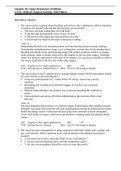
Chapter 26: Upper Respiratory Problems Lewis: Medical-Surgical Nursing, 10th Edition
MULTIPLE CHOICE 1. The nurse teaches a patient about discharge instructions after a rhinoplasty. Which statement, if made by the patient, indicates that the teaching was successful? a. “My nose will look normal after 24 to 48 hours.” b. “I can take 800 mg ibuprofen every 6 hours for pain.” c. “I will remove and reapply the nasal packing every day.” d. “I will elevate my head for 48 hours to minimize swelling.” ANS: D Maintaining the head in an elevated position will decrease the amount of nasal swelling. Nonsteroidal antiinflammatory drugs, such as ibuprofen, increase the risk for postoperative bleeding and should not be used postoperatively. The patient would not remove or reapply nasal packing, which is usually removed by the surgeon on the day after surgery. Although return to a preinjury appearance is the goal of the surgery, it is not always possible to achieve this result, especially in the first few weeks after surgery. DIF: Cognitive Level: Apply (application) REF: 476 TOP: Nursing Process: Implementation MSC: NCLEX: Physiological Integrity 2. The nurse plans to teach a patient how to manage allergic rhinitis. Which information should the nurse include in the teaching plan? a. Using oral antihistamines for 2 weeks before the allergy season may prevent reactions. b. Identifying and avoiding environmental triggers are the best way to prevent symptoms. c. Frequent hand washing is the primary way to prevent spreading the condition to others. d. Corticosteroid nasal sprays will reduce inflammation, but systemic effects limit their use. ANS: B The most important intervention is to assist the patient in identifying and avoiding potential allergens. Intranasal corticosteroids (not oral antihistamines) should be started several weeks before the allergy season. Corticosteroid nasal sprays have minimal systemic absorption. Acute viral rhinitis (common cold) can be prevented by washing hands, but allergic rhinitis cannot. DIF: Cognitive Level: Apply (application) REF: 477 TOP: Nursing Process: Planning MSC: NCLEX: Physiological Integrity 3. The nurse discusses management of upper respiratory infections (URIs) with a patient who has acute sinusitis. Which statement by the patient indicates that additional teaching is needed? a. “I will drink lots of juices and other fluids to stay well hydrated.” b. “I can use nasal decongestant spray until the congestion is gone.” c. “I can take acetaminophen (Tylenol) to treat my sinus discomfort.” d. “I will watch for changes in nasal secretions or the sputum that I cough up.” ANS: B The nurse should clarify that nasal decongestant sprays should be used for no more than 3 days to prevent rebound vasodilation and congestion. The other responses indicate that the teaching has been effective. DIF: Cognitive Level: Apply (application) REF: 480 TOP: Nursing Process: Evaluation MSC: NCLEX: Physiological Integrity 4. The nurse has just auscultated coarse crackles bilaterally on a patient with a tracheostomy tube in place. If the patient is unsuccessful in coughing up secretions, what action should the nurse take? a. Encourage increased incentive spirometer use. b. Encourage the patient to increase oral fluid intake. c. Put on sterile gloves and use a sterile catheter to suction. d. Preoxygenate the patient for 3 minutes before suctioning. ANS: C This patient needs su
École, étude et sujet
- Établissement
-
Brightwood College
- Cours
-
NURSING 119
Infos sur le Document
- Publié le
- 2 mars 2023
- Nombre de pages
- 10
- Écrit en
- 2022/2023
- Type
- Examen
- Contient
- Inconnu
Sujets
- 10th edition
- medical surgical nursing
- 10th edition
- nursing 119
-
chapter 26 upper respiratory problems lewis medical surgical nursing

Document également disponible en groupe