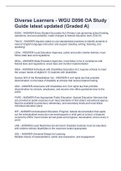
Diverse Learners - WGU D096 OA Study Guide latest updated (Graded A)
ESSA - ANSWER-Every Student Succeeds Act; Primary Law governing school funding, operations, and accountability; made changes to federal education laws (Title III) Title III - ANSWER-requires states to use standardized practices to identify students in need of English language instruction and support (reading, writing, listening, and speaking) LEAs - ANSWER-Local Education Agencies; public and public charter districts; must follow state laws and regulations SEAs - ANSWER-State Education Agencies; must follow or be in compliance with federal laws and regulations; enact laws and monitor implementation IDEA - ANSWER-Individuals with Disabilities Education Act; requires schools to meet the unique needs of eligible K-12 students with disabilities Section 504 of the Rehabilitation Act - ANSWER-A civil rights law that prohibits discrimination on the basis of disability at schools that receive federal funding ADA - ANSWER-Americans with Disabilities Act; Civil rights law that prohibits discrimination by schools, employees, and anyone who offers goods/services to the public FAPE - ANSWER-Free Appropriate Public Education- Special Education Services that are provided at public expense must meet standards of that state's educational agency. Must be available to preschool, elementary, and secondary levels and must follow individual education plans IEP - ANSWER-Individualized Education Program; federal documentation that spells out the individualized instruction services/supports a child gets at school; a blueprint covered by IDEA; must include annual goals and progress; reevaluation occurs every 3 years LRE - ANSWER-Least Restrictive Environment: Disabled students must be educated with children without disabilities to the maximum extent appropriate UDL - ANSWER-Universal Design for Learning Multiple means of representation, action and expression, and engagement Teacher delivers content in multiple ways, active learners, explore content, demonstrate skills and knowledge in several ways Representation (UDL) - ANSWER-Present information in multiple forms; perception and comprehension; the "What?" Action and Expression (UDL) - ANSWER-offering learners diverse ways to express their understanding and skill development; executive function; the "How?" Engagement (UDL) - ANSWER-diverse ways for learners to be involved with course content, their peers, and teacher; recruit interest; the "Why?" Why use differentiated instruction? - ANSWER-differentiating content, process, product, and learning environment can help students of diverse abilities to respond to a variety of course content process (differentiated instruction) - ANSWER-providing textbooks for visual leaners, audio books for auditory learners, interactive assignments for kinesthetic learners product - ANSWER-reading and writing learners write a book report, visual learners use graphic organizers, auditory learners give oral reports, and kinesthetic learners design a diorama environment - ANSWER-Break students up into groups to discuss assignment; allow individual reading for those who prefer it, create quiet space with little distractions content - ANSWER-matching vocabulary, read passage/answer questions, create powerpoint that summarizes lesson dual language learners - ANSWER-defined by the U.S. Department of Education as national-origin-minority students who are limited-English-proficient; often abbreviated as DLLs; two way immersion; AKA bilingual education WIDA Standards - ANSWER-Are lists of the major abilites students should be beginning at each level. Manifestation Determination - ANSWER-A determination that a student's inappropriate behavior is not a result, or manifestation, of his or her disability. This is usually determined in a hearing and is required when a student's behavior violates school rules and before the school can undertake disciplinary action that might result in a student's suspension from school. Functional Behavior Assessment (FBA) - ANSWER-Systematic process of gathering information about the functions a problem behavior serves for an individual. Behavior Intervention Plan - ANSWER-Plan used to reinforce or teach positive behavior skills. Specific Learning Disability - ANSWER-Dyslexia/ dysgraphia Giftedness - ANSWER-Unusually high ability in one or more areas, to the point where students require special educational services to help them meet their full potential. Evaluating Gifted Students is... - ANSWER-Dynamic, not static. Represented through all racial, ethnic, financial, and exceptionality groups. Identified through screening, selection, nomination, identification, and placement Product-Based learning - ANSWER-A type of assessment that evaluates a students holistic understanding through a specific outcome or project Interest-based selection - ANSWER-Student chooses a writing assignment option from a range of topics relating most to his/her area of interest mixed ability groups - ANSWER-Arrangement of students into groups whose members are performing at various levels on the skills targeted for instruction Tiered Lessons - ANSWER-different extensions of the same basic lesson for groups of students with differing abilities multitiered system of support (MTSS) - ANSWER-A system-wide approach to providing evidence-based instruction using a three-tiered model based on the needs of each child. It involves continuous monitoring of student progress in making decisions regarding the frequency and intensity of instruction. Tier 1 - ANSWER-General education- whole class instruction Tier 2 - ANSWER-Small group intervention in addition to tier 1 support Tier 3 - ANSWER-Most intensive in addition to tier 1; geared toward skill growth and acquisition; narrowly focused Response to Intervention (RTI) - ANSWER-An educational strategy that uses early intervention to help children who demonstrate below-average achievement. Only children who are not helped are designated for more intense measures. Positive Behavior Intervention Support (PBIS) - ANSWER-A proactive framework used to establish a positive social environment and provide behavioral supports for all students to succeed socially, emotionally, and academically. English Language Learner Strengths - ANSWER--Strong literacy skills -Strong Family support -Strong interest in education -High levels of personal responsibility and commitment to success English Language Learner Weaknesses - ANSWER--Little to no formal schooling -High levels of mobility -Lack of access to effective, consistent language instruction -Personal responsibilities Stages of Second Language Acquisition - ANSWER-1. Preproduction 2. Early Production 3. Speech Emergence 4. Intermediate Fluency 5. Advanced Fluency Preproduction - ANSWER-Minimal comprehension, does not verbalize, uses nonverbal means of communication (nods, points, draws); similar to 9 month old baby Early Production - ANSWER-Students speak using one or two words or short phrases. Lessons expand receptive vocabulary. Activities are designed to activate students to produce vocabulary which they already understand. Students can: listen, point, select, move, mime, act, match, circle, draw, choose, group, gesture, label, list, and categorize. Similar to 12 month old baby [FIRST WORDS] Speech Emergence - ANSWER-stage of second language acquisition in which the learner speaks more frequently using longer words and sentences The learner is still relying heavily on context clues and familiar topics. Does not often understand jokes Intermediate Fluency - ANSWER-Communicates using simple sentences, Overgeneralizes because of intralingual and interlingual interferences, Becomes more acculturated and feels more comfortable in school. Excellent comprehension and production of many sentences with limited grammatical and pronunciation errors Advanced Fluency - ANSWER-stage of second language acquisition in which the learner has reached a level of near-native proficiency The learner refines accuracy and continues to develop an academic vocabulary. Cultural Fatigue - ANSWER-The physical and emotional exhaustion that almost invariably results from the infinite series of minute adjustments required for long-term survival in an unfamiliar culture. Language Shock - ANSWER-ELs realize how limited they are in their English Language abilities and that learning English is NOT an easy task role shock - ANSWER-major differences between expectations and experiences in relation to school/social life Education Shock - ANSWER-ELs experiences this form of school when they begin to adjust to life in an academic environment Acculturation - ANSWER-The adoption of cultural traits, such as language, by one group under the influence of another. Co-teaching - ANSWER-A special educator teaching side-by-side with a general educator in a classroom with both teachers providing instruction to all students. One Teach, One Assist - ANSWER-One teacher teaches, the other circulates the room providing unobtrusive assistance. One Teach, One Observe - ANSWER-One teacher teaches and another observes to collect data. Afterwards the two teachers review together. Station Teaching - ANSWER-teachers divide content and students. Each teacher then teaches the content to one group and subsequently repeats the instruction for the other group. If appropriate, a third "station" could require that students work independently. Parallel Teaching - ANSWER-The teachers are both covering the same information, but they divide the class into two groups and teach simultaneously Alternative Teaching - ANSWER-one teacher takes responsibility for the large group while the other works with a smaller group. Team Teaching - ANSWER-Teachers share the responsibility for two or more classes, dividing up the subject areas between them. Explicit Instruction - ANSWER-systematic instruction of concepts, strategies, and skills that builds from simple to complex. Compacting - ANSWER-Eliminating some material that students already know Progress Monitoring - ANSWER-the frequent and systematic assessment of a pupil's academic progress; linked to RTI Curriculum Based Measurement - ANSWER-frequent measurement comparing a student's actual progress with an expected rate of progress equity pedagogy - ANSWER-Teaching techniques that facilitate the academic success of students from different ethnic and social class groups. Redistribution - ANSWER-Considering how socioeconomics may effect students access/opportunity in the classroom hidden curriculum - ANSWER-the informal teaching done in schools that socializes children to societal norms Equity vs. Equality - ANSWER-Equity is giving everyone what they need to be successful. Equality is treating everyone the same. achievement gap - ANSWER-disparity on a number of educational measures between the performance of groups of students, especially groups defined by gender, race, ethnicity, ability, and socioeconomic status Stephen Krashen - ANSWER-Krashen's theory of second language acquisition consists of five main hypotheses: Acquisition-Learning hypothesis, Monitor hypothesis, Natural Order hypothesis, Input hypothesis, Affective Filter hypothesis. Acquisition-Learning Hypothesis - ANSWER-Acquisition is rough-tuned and unconscious, and used to communicate messages. It is not consciously attended to. Learning, however, is very fine-tuned and refers to a learner‟s knowledge of rules and their ability to talk abut them. The Natural Approach values the former. Monitor Hypothesis - ANSWER-Krashen-learning is a concious process and used to monitor spoken or written output Input Hypothesis - ANSWER-students acquire language by understanding input that is just above their current level of proficiency Affective Filter Hypothesis - ANSWER-describes external factors that can act as a filter that impedes acquistion, such as motivation level, self-confidence level, and anxiety Natural Order Hypothesis - ANSWER-Krashen- grammatical structures aquired in a predictable order, independent of the order grammar is taught Basic Interpersonal Communication Skills (BICS) - ANSWER-The language ability needed for casual conversation. This usually applies to the interpersonal conversation skills of CLD students (i.e, playground language). It's everyday, straightforrward communication skills that are helped by contextual supports such as gestures. Cognitive Academic Language Proficiency (CALP) - ANSWER-a student's ability to comprehend academic vocabulary in English Due Process in education - ANSWER-Schools are required to provide due process (legal steps and proceedings designed to protect individual's constitutional rights) safeguards to protect rights of children with disabilities and their parents Example: parent consent to testing and evaluations, confidentiality of records, private testing at public expense when disagreements on testing arise between parents and schools SPED teacher - ANSWER-Organizes IEP meetings, communicated what is on the IEP classroom teacher - ANSWER-Reports how student performs on a day to day basis, assist in scheduling IEP meetings, participates in annual review Paraeducator - ANSWER-Works closely with the student and provides support principal - ANSWER-Responsible for ensuring that everyone understands their role and importance of attendance
Written for
- Institution
- WGU D096
- Course
- WGU D096
Document information
- Uploaded on
- March 1, 2023
- Number of pages
- 7
- Written in
- 2022/2023
- Type
- Exam (elaborations)
- Contains
- Questions & answers
Subjects
- wgu d096
- operations
-
diverse learners wgu d096 oa study guide latest updated graded a
-
essa every student succeeds act primary law governing school funding
-
and accountability made changes to fed

Also available in package deal