100% satisfaction guarantee Immediately available after payment Both online and in PDF No strings attached 4.2 TrustPilot
logo-home
Exam (elaborations)

WGU C180 Intro to Psychology, Exam Questions and answers, 100% Accurate, graded A+

Rating
3.0
(1)
Sold
7
Pages
14
Grade
A+
Uploaded on
25-02-2023
Written in
2022/2023

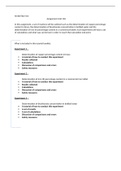
WGU C180 Intro to Psychology, Exam Questions and answers, 100% Accurate, graded A+ Structuralism Wilhelm Wundt Functionalism William James Psychodynamic Sigmund Freud Behaviorism John B. Watson and B. F. Skinner Gestalt Max Wertheimer Humanistic Abraham Maslow and Carl Rogers Key mental strategies and goals are inborn through adaptation of the species, the result of natural selection. Evolutionary Psychology Uses computer as a model for the human mind. Cognitive Psychology Belief that people have positive values, free will, and deep inner creativity; inspired the positive psychology movement. Humanistic "The whole is more than the sum of its parts." Gestalt Behavior is the appropriate focus of psychology. Behaviorism Conflicts among conscious and unconscious forces underlie many thoughts, feelings, and behaviors. Psychodynamic Studies why thoughts, feelings, and behavior occur and how they are adaptive. Functionalism Uses introspection to discover the elements of the mind and rules for combining them. Structuralism The goal of this type of research is to conduct observations, examinations, and then a description. Descriptive The goal of this type of research is to study the relationship of two or more variables Correlational Research The goal of this type of research is to conduct controlled situations in which the researcher observes how one variable may cause changes in another Experimental Research A researcher goes, observes, and records behavior in it's natural setting Naturalistic Observation A researcher focuses on a single participant and examines that person in great detail Case Study A researcher asks people a set of questions to determine their thoughts, feelings, or behaviors Survey The variable that the researcher manipulates Independent Variable The variable that the researcher measures Dependent Variable The group that receives the complete procedure that defines the experiment Experimental Group A group that is treated exactly the same way as the experimental group, except that the independent variable is not manipulated Control Group Assigning participants randomly to experimental and control groups so that the two groups are similar Random Assignment Receive signals from axons and other neurons Dendrites Release chemicals into the spaces between neurons when activated by their neuron Terminal Buttons A long, cable-like structure that send signals to other neurons, muscles, or organs Axon The place between two neurons where sending and receiving signals take place Synapse The central part of the neuron; it contains the nucleus Cell Body Protects the cell body Cell Membrane An insulating layer around the axon that helps electrical impulses transmit quickly Myelin The lobes at the back of the head concerned entirely with vision Occipital Lobes The lobes under the temples that process sound, work on memory, and comprehend language Temporal Lobes The lobes at the top rear of the brain, involved in attention, arithmetic, touch, and registering special location Parietal Lobes The lobes located behind the forehead, involved in planning, memory search, motor control, speech control, reasoning, and emotions Frontal Lobes At the base of the brain and manages balance and coordination Cerebellum Plays a key role in allowing new information into your brain's memory banks Hippocampus Relays impulses, especially sensory impulses, to and from the cerebral cortex Thalamus Plays a role in controlling eating, drinking; and regulating body temperature, blood pressure, heart rate, sexual behavior, and hormones Hypothalamus Relays information to the spinal cord Brainstem Plays a role in strong emotions such as fear and anger Amygdala A similar but nonidentical stimulus elicits the conditioned response Stimulus Generalization Achieved by repeatedly presenting the conditioned stimulus without the unconditioned stimulus Extinction Automatic response elicited by the unconditioned stimulus Unconditioned Response A stimulus that elicits an automatic response not dependent on prior learning Unconditioned Stimulus An originally neutral stimulus that comes to produce a response evoked by an unconditioned stimulus after it has been paired enough times with that unconditioned stimulus. Conditioned Stimulus A response that depends (is conditional) on pairing the conditioned stimulus with an unconditioned stimulus; once learned, the response to the unconditioned stimulus now occurs when the conditioned stimulus is presented alone. Conditioned Response Miss Jane's 3rd grade class did very well on their end-of-year exams, so she threw them a pizza party. Positive Reinforcement If Jack's factory employees meet their production goal, he reduces their work hours for the final week of the month. Negative Reinforcement Amy speeds through a construction zone, and is pulled over and given a ticket by a police officer. Positive Punishment Joe came home after his curfew three times in a row, so his parents took away his access to his car for one month. Negative Punishment Memories that can be voluntarily accessed Explicit Memory A type of explicit memory - it is personal memories of the past Episodic Memory A type of explicit memory - it is memories for the meaning of words, concepts, or facts about the world Semantic Memory Memories that are unconscious and cannot be voluntarily accessed; include habits and skills Implicit Memory Ages 0-1: mouth (sucking and biting), successful weaning from mother's breast or bottle Oral Stage Ages 1-3: anus (retaining and expelling feces) successful toilet training Anal Stage Ages 3-6: clitoris or penis, successful identification with same-sex parent Phallic Stage Ages 6-puberty: no particular locus of pleasure, sexual impulses are repressed; successful transformation of repressed sexual urges into socially acceptable activities Latency Stage Puberty and onward: vagina or penis; successful formation of mature sexual love relationship Genital Stage Marge tends to be depressed and self-conscious, and often anxious High in Neuroticism (also called emotionality) Jess excels at organization and can be relied on to make sure she gets the job done well and on time. High in Conscientiousness (also called dependability) Mark is gregarious, assertive, and likes exciting activities with others High in Extraversion (also called sociability) Anna is imaginative, creative, and enjoys trying new things High in Openness Greg is seen as very trustworthy, and always kind and helpful to others High in Agreeableness A belief or a set of beliefs about people from a particular category (e.g., race, sex, religion). Stereotype An attitude that is generally negative toward members of a group. Prejudice A negative behavior toward individuals from a specific group that arises from unjustified negative attitudes about that group. Discrimination The strong tendency to interpret other people's behavior (disposition) as arising from internal causes rather than external ones (situation). Fundamental Attribution Error The inclination to attribute your own failures to external causes and your successes to internal ones, but to attribute other people's failures to internal causes and their successes to external causes. Self-Serving Bias The assumption that people get what they deserve. Belief in a just world Adults seek closeness and interdependence in relationships and are not worried about possibly losing the relationship because they feel secure in it. Secure Attachment Style Adults are uncomfortable with intimacy and closeness. Avoidant Attachment Style Adults want but simultaneously fear a relationship. Anxious-Ambivalent Attachment Style The tendency of group members' opinions to become more extreme (in the same direction as their initial opinions) after group discussion. Group Polarization The group process that arises when people who try to solve problems together accept on another's information and ideas without subjecting them to critical analysis. Groupthink Occurs when some members don't contribute as much to a shared group task as do others and instead let other members work proportionally harder. Social Loafing The increase in performance that can occur simply as a result of being part of a group or in the presence of other people. Social Facilitation

Show more Read less
Institution
Course


Whoops! We can’t load your doc right now. Try again or contact support.

Written for

Course

Document information

Uploaded on
February 25, 2023
Number of pages
14
Written in
2022/2023
Type
Exam (elaborations)
Contains
Questions & answers

Subjects

Content preview

WGU C180 Intro to Psychology, Exam
Questions and answers, 100% Accurate,
graded A+

Structuralism
Wilhelm Wundt
Functionalism
William James
Psychodynamic
Sigmund Freud
Behaviorism
John B. Watson and B. F. Skinner
Gestalt
Max Wertheimer
Humanistic
Abraham Maslow and Carl Rogers
Key mental strategies and goals are inborn through adaptation of the species, the result of natural
selection.
Evolutionary Psychology
Uses computer as a model for the human mind.
Cognitive Psychology
Belief that people have positive values, free will, and deep inner creativity; inspired the positive
psychology movement.
Humanistic
"The whole is more than the sum of its parts."
Gestalt
Behavior is the appropriate focus of psychology.
Behaviorism
Conflicts among conscious and unconscious forces underlie many thoughts, feelings, and behaviors.
Psychodynamic
Studies why thoughts, feelings, and behavior occur and how they are adaptive.

, Functionalism
Uses introspection to discover the elements of the mind and rules for combining them.
Structuralism
The goal of this type of research is to conduct observations, examinations, and then a description.
Descriptive
The goal of this type of research is to study the relationship of two or more variables
Correlational Research
The goal of this type of research is to conduct controlled situations in which the researcher observes
how one variable may cause changes in another
Experimental Research
A researcher goes, observes, and records behavior in it's natural setting
Naturalistic Observation
A researcher focuses on a single participant and examines that person in great detail
Case Study
A researcher asks people a set of questions to determine their thoughts, feelings, or behaviors
Survey
The variable that the researcher manipulates
Independent Variable
The variable that the researcher measures
Dependent Variable
The group that receives the complete procedure that defines the experiment
Experimental Group
A group that is treated exactly the same way as the experimental group, except that the independent
variable is not manipulated
Control Group
Assigning participants randomly to experimental and control groups so that the two groups are similar
Random Assignment
Receive signals from axons and other neurons
Dendrites
Release chemicals into the spaces between neurons when activated by their neuron
Terminal Buttons
A long, cable-like structure that send signals to other neurons, muscles, or organs
Axon

$9.49
Get access to the full document:

100% satisfaction guarantee
Immediately available after payment
Both online and in PDF
No strings attached


Also available in package deal

Reviews from verified buyers

Showing all reviews
8 months ago

3.0

1 reviews

5
0
4
0
3
1
2
0
1
0
Trustworthy reviews on Stuvia

All reviews are made by real Stuvia users after verified purchases.

Get to know the seller

Seller avatar
Reputation scores are based on the amount of documents a seller has sold for a fee and the reviews they have received for those documents. There are three levels: Bronze, Silver and Gold. The better the reputation, the more your can rely on the quality of the sellers work.
QuickPass Chamberlain College Of Nursing
Follow You need to be logged in order to follow users or courses
Sold
410
Member since
3 year
Number of followers
304
Documents
6372
Last sold
4 days ago
Get all Documents you need at discount.

All nursing docs available: question banks, summaries, study guide and test banks

3.8

97 reviews

5
52
4
11
3
10
2
10
1
14

Recently viewed by you

Why students choose Stuvia

Created by fellow students, verified by reviews

Quality you can trust: written by students who passed their tests and reviewed by others who've used these notes.

Didn't get what you expected? Choose another document

No worries! You can instantly pick a different document that better fits what you're looking for.

Pay as you like, start learning right away

No subscription, no commitments. Pay the way you're used to via credit card and download your PDF document instantly.

Student with book image

“Bought, downloaded, and aced it. It really can be that simple.”

Alisha Student

Frequently asked questions