ATI Hemodynamic Monitoring Exam 2023 Questions and Answers Graded A
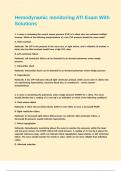
1. A nurse is evaluating the central venous pressure (CVP) of a client who has sustained multiple traumas. Which of the following interpretations of a low CVP pressure should the nurse make? A. Fluid overload Rationale: The CVP is the pressure in the vena cava, or right atrium, and is reflective of preload. A client who has fluid overload would have a high CVP value. B. Left ventricular failure Rationale: Left ventricular failure can be detected by an elevated pulmonary artery wedge pressure. C. Intracardiac shunt Rationale: Intracardiac shunt can be detected by an elevated pulmonary artery wedge pressure. D. Hypovolemia Rationale: A low CVP indicates reduced right ventricular preload, which can be seen in clients who are experiencing hypovolemia, excessive blood loss, or over diuresis - D. Hypovolemia 2. A nurse is monitoring the pulmonary artery wedge pressure (PAWP) for a client. The nurse should identity that a reading of 15 mm Hg is an indication of which of the following conditions? A. Fluid volume deficit Rationale: A client who has fluid volume deficit is more likely to have a decreased PAWP. B. Right ventricular failure Rationale: An increased right atrium (RA) pressure can indicate right ventricular failure. A decreased RA pressure usually indicates hypovolemia. C. Mitral regurgitation Rationale: Hemodynamic monitoring allows the nurse to monitor the pressures within the heart and the great vessels. The PAWP reflects left atrial pressure. A reading of 15 mm Hg is above the expected reference range, which can indicate mitral regurgitation, hypervolemia, or left ventricular failure. The nurse should monitor for trends in value, which can be more reliable than individual values. D. Afterload reduction Rationale: A client who has afterload reduction is more likely to have a decreased PAWP. - C. Mitral regurgitation PAWP. 3. A nurse is monitoring the cardiac output of a client who has left-sided heart failure using pulse pressure analysis. Which of the following findings can compromise the readings? A. The client is experiencing premature atrial contractions. Rationale: Pulse pressure devices require the presence of optimal arterial waveforms in order to capture accurate data. Therefore, a dysrhythmia, such as premature atrial contractions, will compromise the readings. B. The client has a decreased oxygen saturation level. Rationale: Decreased oxygen saturation is a manifestation of heart failure that does not compromise cardiac output readings. C. The client has bilateral wheezes. Rationale: Bilateral wheezes are a manifestation of heart failure that do not compromise cardiac output readings. D. The client has lower leg edema. Rationale: Lower leg edema is a manifestation of heart failure that does not compromise cardiac output readings. - A. The client is experiencing premature atrial contractions. 4. A nurse is teaching a client who has septic shock about the development of disseminated intravascular coagulation (DIC). Which of the following statements should the nurse make? A. "DIC is controllable with lifelong heparin usage." Rationale: DIC is not controlled with lifelong heparin usage. Heparin is administered to minimize the formation of microthrombi, which improves tissue perfusion. B. "DIC is characterized by an elevated platelet count." Rationale: DIC causes bleeding in part due to a decreased platelet count, rather than an elevated platelet count. C. "DIC is caused by abnormal coagulation involving fibrinogen." Rationale: DIC is caused by abnormal coagulation involving the formation of multiple small clots that consume clotting factors and fibrinogen faster than the body can produce them, increasing the risk for hemorrhage. D. "DIC is a genetic disorder involving a vitamin K deficiency." Rationale: DIC is not a genetic disorder and does not involve vitamin K deficiency. The effect of vitamin K is to prolong bleeding time. - C.DIC is caused by abnormal coagulation involving fibrinogen. 5. A nurse is caring for a client who has hypovolemic shock. Which of the following should the nurse recognize as an expected finding? A. Hypertension Rationale: Hypovolemic shock occurs when there is a large amount of blood loss or there is massive vasodilation resulting in decreased perfusion and oxygenation. This client would be hypotensive. B. Flushing of the skin Rationale: Pallor is a sign of hypovolemic shock. The client may also appear cyanotic or mottled. C. Oliguria Rationale: Oliguria is present in hypovolemic shock as a result of decreased blood flow to the kidneys. D. Bradypnea Rationale: Tachypnea is a sign of hypovolemic shock. - C. Oliguria 6. A nurse is caring for a client who is in the compensatory stage of shock. Which of the following findings should the nurse expect? A. Mottled skin Rationale: Shock progresses along a continuum beginning with the compensatory stage, in which the body is still able to maintain hemodynamic stability. Vasoconstriction and shunting of blood ensure perfusion to vital organs. However, the skin becomes cool, pale, and diaphoretic. As shock progresses into the progressive stage, the skin begins to mottle. B. Blood pressure 115/68 mmHg Rationale: The sympathetic nervous system is stimulated, resulting in the release of epinephrine and norepinephrine. These catecholamines help maintain the client's blood pressure remains within normal limits during the compensatory stage of shock. C. Heart rate 160/min Rationale: During the compensatory stage of shock, the heart and blood pressure generally remain only slightly altered. A heart rate of 100-150/min with only a slight increase in diastolic blood pressure is seen in this stage. D. Metabolic acidosis Rationale: An increased respiratory rate removes large amounts of carbon dioxide from the body resulting in respiratory alkalosis. - B.BP of 115/68 7. A nurse is caring for a client who is at risk for shock. Which of the following findings is the earliest indicator that this complication is developing? A. Hypotension Rationale: In the first stage of shock, the body is able to maintain homeostasis and blood pressure remains within normal limits. A slight increase in diastolic blood pressure may be noted. B. Anuria Rationale: In the compensatory (initial) stage of shock vasoconstriction and the shunting of blood supports the vital organs, the heart, brain, and lungs. Decreased perfusion to the kidneys along with release of aldosterone and ADH results in a decrease in urine output. Anuria occurs in the last, or irreversible, stage of shock. C. Narrowing pulse pressure Rationale: Pulse pressure is the difference between the systolic and diastolic blood pressures. In the initial stage of shock there is a slight increase in the diastolic blood pressure, which narrows the pulse pressure. D. Decreased level of consciousness Rationale: The client who is in the compensatory stage of shock may feel anxious or confused. As shock progresses the client becomes lethargic and finally becomes unconscious in the irreversible stage - Narrowing pulse pressure 8. A nurse assessing a client determines that he is in the compensatory stage of shock. Which of the following findings support this conclusion? A. Confusion Rationale: Confusion is a manifestation of the compensatory stage of shock. Other manifestations include decreased urinary output, cold and clammy skin, and respiratory alkalosis. B. Blood pressure 84/50 mm Hg Rationale: A decrease in the systolic blood pressure to less than 90 mm Hg is a manifestation of the progressive stage of shock. C. Anuria Rationale: Anuria is a manifestation of the irreversible stage of shock. D. Petechiae Rationale: Petechiae is a manifestation of the progressive stage of shock. - A. Confusion 9. A nurse in the emergency department is assessing a client who has internal injuries from a car crash. The client is disoriented to time and place, diaphoretic, and his lips are cyanotic. The nurse should anticipate which of the findings as an indication of hypovolemic shock? A. Increased heart rate Rationale: The nurse should anticipate an increased heart rate as an early indication of shock because the body attempts to compensate for decreased circulatory volume. B. Widening pulse pressure Rationale: The nurse should anticipate narrowing of the pulse pressure because systolic blood pressure and diastolic blood pressure increases. C. Increased deep tendon reflexes Rationale: The nurse should anticipate skeletal muscle changes, including decreased tendon reflexes. D. Pulse oximetry 96% Rationale: A pulse of 96% is within the expected reference range. The nurse should anticipate the pulse oximetry reading to be below 95%. - A. Increased heart rate
Written for
Document information
- Uploaded on
- February 23, 2023
- Number of pages
- 9
- Written in
- 2022/2023
- Type
- Exam (elaborations)
- Contains
- Questions & answers
Subjects
-
ati hemodynamic monitoring exam 2023 questions and answers graded a
-
1 a nurse is evaluating the central venous pressure cvp of a client who has sustained multiple traumas which of the following in