WGU PATHOPHYSIOLOGY D236 EXAM 2022/2023
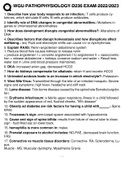
1. Describe how your body responds to an infection.: T cells produce cytokines, which stimulate B cells. B cells produce antibodies. 2. Identify role of DNA changes in congenital abnormalities.: Mutations in genes or chromosomal abnormalities 3. How does development disrupts congenital abnormalities?: Alterations of DNA 4. Describes factors that disrupt homeostasis and how disruptions affect wellbeing.: (ex) Fluid and electrolyte shifts can cause n/v or dysrhythmias. 5. Explain RAAS: Renin-angiotensin-aldosterone system 1. Reduce blood flow causes kidneys to release renin > produce angiotensin I > converts angiotensin I to angiotensin II > vasoconstriction > release aldosterone > kidneys conserve sodium and water > Result less water lost in urine and blood pressure maintained. 6. DKA: increased anion gap, decreased HCO3 7. How do kidneys compensate for alkalosis: retain H and excrete HCO3 8. Untreated acidosis leads to an increase in which electrolyte?: Potassium 9. West Nile Virus: Transmitted through the bite of an infected mosquito. Severe signs and symptoms; high fever, headache and stiff neck 10. Lyme disease: Tick-borne disease caused by the spirochete Borrelia burgdorferi. 11. Erythema infectiosum: a febrile upper respiratory illness in a child followed by the sudden appearance of red, flushed cheeks, "fifth disease" 12. Obesity ad diabetes are risk factors for having a child with .: Spina bifida 13. Trousseau's sign: arm/carpal spasm associated with hypocalcemia 14. Cause and sign of spina bifida: results from failure of neural tube to close. sign - fluid filled sac on lower back. 15. hemophilia is more common in: males 16. Prenatal exposure to alcohol includes: ND-PAE, decreased brain function, FAS 17. Connective vs muscle tissue disorders: Connective- RA, Scleroderma, Lupus Muscle - MS, Muscular dystrophy, Myasthenia Gravia WGU PATHOPHYSIOLOGY D236 EXAM 2022/2023 2 / 12 18. Describe Lupus: Inflammatory disorder characterized by joint pain and butterfly rash 19. Describe Myasthenia Gravis: It is an autoimmune disorder where antibodies attack own Ach receptors. This causes weakness of skeletal muscles over the course of the day, along with ptosis, double vision, and difficulty swallowing. 20. dermatitis: inflammation of the skin 21. eczema: noninfectious, inflammatory skin disease characterized by redness, blisters, scabs, and itching 22. decubitus ulcer: sore caused by lying down for long periods of time 23. Fungal infections: superficial, localized skin conditions or deep tissue infections caused by exposure to spores may or may not be transmitted 24. benign neoplasm: noncancerous growths, stationary, distinct borders 25. malignant neoplasm: uncontrolled new tissue growth, irregular borders, spreads 26. Osteoporosis: The loss of bone mass often due to age, causing the bones to become porous, brittle, and easily fractured. 27. osteomalacia: disease marked by softening of the bone caused by calcium and vitamin D deficiency 28. myoglobin: red pigment that stores oxygen in muscle cells 29. Bursa: fluid-filled sac that allows for easy movement of one part of a joint over another 30. Rickets: a vitamin D deficiency in children, resulting in soft bones 31. Degenerative disk disease: A condition in which an intervertebral disk loses its normal structural integrity as a result of wear and tear, acute or repeated injuries or aging 32. Paget disease: Chronic inflammation of bones, resulting in thickening and softening of bones, that can occur in any bone but most commonly affects the long bones of the legs, the lower s
Written for
- Institution
- WGU PATHOPHYSIOLOGY D236
- Course
- WGU PATHOPHYSIOLOGY D236
Document information
- Uploaded on
- February 21, 2023
- Number of pages
- 12
- Written in
- 2022/2023
- Type
- Exam (elaborations)
- Contains
- Questions & answers
Subjects
-
wgu pathophysiology d236 exam 20222023

Also available in package deal