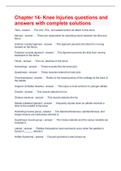
Chapter 14- Knee Injuries questions and answers with complete solutions
Chapter 14- Knee Injuries questions and answers with complete solutions Tibia The ACL, PCL, and patella tendon all attach to this bone Menisci These are responsible for absorbing shock between the tibia and femur. Anterior cruciate ligament This ligament prevents the tibia from moving forward on the femur. Posterior cruciate ligament This ligament prevents the tibia from moving backward on the femur Fibula The LCL attaches to this bone. Hamstrings These muscles flex the knee joint Quadriceps These muscles extend the knee joint Chondromalacia Refers to the wearing away of the cartilage at the back of the patella Osgood- Schlatter disorder This injury is most common in younger athlete Gracilis This muscle adducts the hip Gluteus maximus This muscle abducts the hip Medial collateral ligament frequently injured when an athlete receives a blow to the outside of the knee. Hamstring muscle group The Semimembranosus, semitendinosus, and biceps femoris are collectively referred to Quadriceps muscle group The Vastus lateralis and the vastus medialis are included in Lateral Patellar dislocations most commonly occur when the patellar is forced in ______ direction Hoffas Syndrome Fat pad syndrome is also known as Jumpers knee Patellar Tendinitis injury to the knee that connects your kneecap to your shin bone Meniscectony Removal of the entire meniscus arthoscopic surgery Small surgical instruments are inserted into the body through tiny holes Hinge joint What type of joint is the knee? Tibiofemoral is the movement of knee occurs at the articulation of the tibia and femur Patellofemoral s knee flexes and extends, the patella glides up and down on the front of the femur. MCL Medial Collateral Ligament LCL Lateral Collateral Ligament ACL Anterior Cruciate Ligament PCL Posterior Cruciate Ligament Iliotibial Band What's the name of the tough connective tissue that is on the lateral aspect of the knee? Neuromuscular training What does the current research say is an effective way to prevent knee injuries, especially to the ACL? Gastrocnemius, and Popliteus What other muscles besides the hamstrings help to flex the knee? Neuromuscular training involve Teaching athletes how to land from a jump, how to change directions while maintaining appropriate lower-extremity alignment (keep the knee over the foot), and how to flex the knee and hip during movements. It also involves balance training and proper deceleration of activities involving knee flexion.
Written for
- Institution
- Acl
- Course
- Acl
Document information
- Uploaded on
- February 21, 2023
- Number of pages
- 2
- Written in
- 2022/2023
- Type
- Exam (elaborations)
- Contains
- Questions & answers
Subjects
- tibia the acl
- pcl
- lcl lateral collatera
-
chapter 14 knee injuries questions and answers with complete solutions
-
and patella tendon all attach to this bone
-
hinge joint what type of joint is the knee

Also available in package deal