- All definitions and formulas in booklet given by Dr.Raj
- System: Area of interest (eg. beaker and its contents)
- Can be open or closed (whether you trap the reaction or not)
- OPEN: exchange of energy and matter (eg. HCl + Mg→ MgCl2 + H2, releases or
absorbs heat and H2 which is matter)
- CLOSED: Only exchange of energy, no exchange of matter (a reaction with a
capping, heat as energy exchanged, no matter released)
- Surroundings: everything outside the system
- Enthalpy: Amount of energy stored in a chemical (eg. when you burn smt, the amount of
energy released)
- Can only measure changes in energy, enthalpy can not be measured, only the change
- Kj / mol
- Substances with lower enthalpy are more stable than those with higher enthalpy
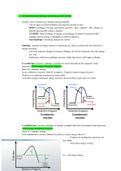
- In exothermic reactions, enthalpy of product is lower than that of the reactants, temp
increases (Write energy released as negative)
- Delta H = enthalpy change
- In an exothermic reaction, Delta H is negative. Negative means energy released
- Products in exothermic reactions are more stable
- Activation energy (minimum energy need for chem reaction to take place) is small
-
- In endothermic reactions, enthalpy of product is higher than that of reactants, temp decreases
(write energy absorbed as positive)
- Delta H = enthalpy change
- In an endothermic reaction, Delta H is positive, means energy taken in
- Products in endothermic reactions are
less stable
- Activation energy is large
Ea = activation energy
, - In the exothermic reaction, we see on graph, first it absorbs energy, and then it releases
energy. Bonds must first be broken and then new bonds are formed
- To break bond, energy is needed, to make bond energy is released
- Eg. Reactant= 12 Kj then it goes up to 14, then drops to 6
- In endothermic stronger bonds are made and weaker bonds are formed. It absorbs energy, eg
from 6 to 14 and then down to 12. Exact opposite of exothermic reactions
Temperature is the measure of the average kinetic energy of the particles
- Higher the kinetic energy, the higher the temperature
- Not all the particles have the same kinetic energy
- Temp depends on: mass, amount of heat added, specific heat capacity
Specific heat capacity: The amount of energy required to raise the temperature of gram by one kelvin
Unit: JK^-1 g ^-1
Substance Specific Heat
Capacity
J K-1 g-1
Water 4.18
Ethanol 2.44
Air 1.00
Iron 0.450
Copper 0.385
SATP: In data booklet formula
- 298k or 25°C
- Pressure: 100 kPa (1atm)
- Concentration: 1 mol dm^-3
Different enthalpy
- Enthalpy of combustion (delta H small c)
- Enthalpy change when one mole of substance is burned in excess oxygen under
standard conditions (298k, 1 atm)
- Enthalpy of neutralisation (delta H small n)
- Neutralisation means acid and base react
- The enthalpy change when a solution of acid and alkali react together to produce one
mole of water under standard conditions (298k, 1atm)
- NaOH + HCl → NaCl + H2O
- In a neutralisation reaction, it can only produce one mole of water to fit the definition
- System: Area of interest (eg. beaker and its contents)
- Can be open or closed (whether you trap the reaction or not)
- OPEN: exchange of energy and matter (eg. HCl + Mg→ MgCl2 + H2, releases or
absorbs heat and H2 which is matter)
- CLOSED: Only exchange of energy, no exchange of matter (a reaction with a
capping, heat as energy exchanged, no matter released)
- Surroundings: everything outside the system
- Enthalpy: Amount of energy stored in a chemical (eg. when you burn smt, the amount of
energy released)
- Can only measure changes in energy, enthalpy can not be measured, only the change
- Kj / mol
- Substances with lower enthalpy are more stable than those with higher enthalpy
- In exothermic reactions, enthalpy of product is lower than that of the reactants, temp
increases (Write energy released as negative)
- Delta H = enthalpy change
- In an exothermic reaction, Delta H is negative. Negative means energy released
- Products in exothermic reactions are more stable
- Activation energy (minimum energy need for chem reaction to take place) is small
-
- In endothermic reactions, enthalpy of product is higher than that of reactants, temp decreases
(write energy absorbed as positive)
- Delta H = enthalpy change
- In an endothermic reaction, Delta H is positive, means energy taken in
- Products in endothermic reactions are
less stable
- Activation energy is large
Ea = activation energy
, - In the exothermic reaction, we see on graph, first it absorbs energy, and then it releases
energy. Bonds must first be broken and then new bonds are formed
- To break bond, energy is needed, to make bond energy is released
- Eg. Reactant= 12 Kj then it goes up to 14, then drops to 6
- In endothermic stronger bonds are made and weaker bonds are formed. It absorbs energy, eg
from 6 to 14 and then down to 12. Exact opposite of exothermic reactions
Temperature is the measure of the average kinetic energy of the particles
- Higher the kinetic energy, the higher the temperature
- Not all the particles have the same kinetic energy
- Temp depends on: mass, amount of heat added, specific heat capacity
Specific heat capacity: The amount of energy required to raise the temperature of gram by one kelvin
Unit: JK^-1 g ^-1
Substance Specific Heat
Capacity
J K-1 g-1
Water 4.18
Ethanol 2.44
Air 1.00
Iron 0.450
Copper 0.385
SATP: In data booklet formula
- 298k or 25°C
- Pressure: 100 kPa (1atm)
- Concentration: 1 mol dm^-3
Different enthalpy
- Enthalpy of combustion (delta H small c)
- Enthalpy change when one mole of substance is burned in excess oxygen under
standard conditions (298k, 1 atm)
- Enthalpy of neutralisation (delta H small n)
- Neutralisation means acid and base react
- The enthalpy change when a solution of acid and alkali react together to produce one
mole of water under standard conditions (298k, 1atm)
- NaOH + HCl → NaCl + H2O
- In a neutralisation reaction, it can only produce one mole of water to fit the definition