Oxidation Number
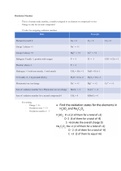
- This is a human made number, a number assigned to an element or compound or ions
- Charge is only for an ionic compound
- 10 rules for assigning oxidation numbers
Rule Example
Element by itself: 0 Xe = 0 O2 = 0 Cl2 = 0
Group 1: always +1 Na+ = +1
Group 2: always +2 Mg2+ = +2 Ca2+ = +2
Halogens: Usually -1, positive with oxygen F- = -1 Cl- = -1 ClO- = Cl is +1
Fluorine: always -1 F- = -1
Hydrogen: +1 with non-metals, -1 with metals CH4 = H is +1 NaH = H is -1
O: Usually -2, -1 in peroxide (H2O2) H2O = O is -2 H2O2 = O is -1
Monatomic ion: ion charge Na+ = +1 Mg2+ = +2 Cr3+ = +3
Sum of oxidation number for a Polyatomic ion: ion charge MnO4- = -1 Cr2O72- = -2
Sum of oxidation number for a neutral compound: 0 CH4 = 0 KMnO4 = 0
- For writing
- Charge = 3+
- Oxidation state = +3
- Oxidation number = 3
, Reduction and oxidation
1st definition (Traditional definition)
- Gain in oxygen or loss in hydrogen is oxidation
- Reduction is loss of oxygen or gain of hydrogen
2nd definition
- Oxidation is loss of the electrons (atom gets more positive)
- Reduction is gaining electrons (atom gets more negative)
3rd definition
- Increase in oxidation number is oxidation
- Decrease in oxidation number is reduction
Oxidation and reduction agents
- Oxidation agent causes oxidation, reduction agent causes reduction
- The compound undergoing oxidation is the reducing agent
- The compound undergoing reduction is the oxidation agent
• Identify the oxidising and reducing agents in the following equation.
2Al + 3PbCl2 → 2AlCl3 + 3Pb
Look at reduction and oxidation sheet
Disproportionation reaction:
Reaction where the same type of atom is oxidised and reduced
Eg. CO2 + C → 2CO
Carbon both reduced and increased
Usually, double displacement reaction is not redox, no changes in oxidation state
- This is a human made number, a number assigned to an element or compound or ions
- Charge is only for an ionic compound
- 10 rules for assigning oxidation numbers
Rule Example
Element by itself: 0 Xe = 0 O2 = 0 Cl2 = 0
Group 1: always +1 Na+ = +1
Group 2: always +2 Mg2+ = +2 Ca2+ = +2
Halogens: Usually -1, positive with oxygen F- = -1 Cl- = -1 ClO- = Cl is +1
Fluorine: always -1 F- = -1
Hydrogen: +1 with non-metals, -1 with metals CH4 = H is +1 NaH = H is -1
O: Usually -2, -1 in peroxide (H2O2) H2O = O is -2 H2O2 = O is -1
Monatomic ion: ion charge Na+ = +1 Mg2+ = +2 Cr3+ = +3
Sum of oxidation number for a Polyatomic ion: ion charge MnO4- = -1 Cr2O72- = -2
Sum of oxidation number for a neutral compound: 0 CH4 = 0 KMnO4 = 0
- For writing
- Charge = 3+
- Oxidation state = +3
- Oxidation number = 3
, Reduction and oxidation
1st definition (Traditional definition)
- Gain in oxygen or loss in hydrogen is oxidation
- Reduction is loss of oxygen or gain of hydrogen
2nd definition
- Oxidation is loss of the electrons (atom gets more positive)
- Reduction is gaining electrons (atom gets more negative)
3rd definition
- Increase in oxidation number is oxidation
- Decrease in oxidation number is reduction
Oxidation and reduction agents
- Oxidation agent causes oxidation, reduction agent causes reduction
- The compound undergoing oxidation is the reducing agent
- The compound undergoing reduction is the oxidation agent
• Identify the oxidising and reducing agents in the following equation.
2Al + 3PbCl2 → 2AlCl3 + 3Pb
Look at reduction and oxidation sheet
Disproportionation reaction:
Reaction where the same type of atom is oxidised and reduced
Eg. CO2 + C → 2CO
Carbon both reduced and increased
Usually, double displacement reaction is not redox, no changes in oxidation state