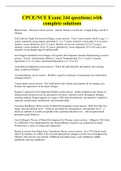
CPCE/NCE Exam| 244 questions| with complete solutions
Behaviorism - Theorists correct answer: John B. Watson, Ivan Pavlov, Joseph Wolpe, and B. F. Skinner. Erik Erikson's Eight Psychosocial Stages correct answer: Trust versus mistrust (birth to age 1 ½ years); autonomy versus shame and doubt (1 ½ to 3 years); initiative versus guilt (3 to 6 years); industry versus inferiority (6 to 11 years): identity versus role confusion (12 to 18 years); intimacy versus isolation (18 to 35 years); generativity versus stagnation (35 to 60 years); and integrity versus despair (age 65 and beyond). Jean Piaget's Qualitative Four Stages of Cognitive Development (Genetic Epistemology) correct answer: Theory: Sensorimotor (birth to 2 years); Preoperational (2 to 7 years); Concrete Operations (7 to 12 years); and Formal Operations (11/ 12 to 16). Assimilation/Adaptation correct answer: When the individual fits information into existing ideas. (reinforces beliefs) Accommodation correct answer: Modifies cognitive schemata to incorporate new information. (changes beliefs) Conservation correct answer: The child knows that volume and quantity do not change, just because the appearance of an object changes. Kegan's Constructive Developmental Model correct answer: model emphasizes the impact of interpersonal interaction and our perception of reality; construct reality throughout lifespan; meaning making; Kegan suggests six stages of life span development: incorporative, impulsive, imperial, interpersonal, institutional, and interindividual. Lawrence Kohlberg's Three Levels of Moral Development correct answer: Each level has two stages: preconventional level— behavior governed by consequences; conventional level— a desire to conform to socially acceptable rules; postconventional level— self-accepted moral principles guide behavior. Carol Gilligan's Theory of Moral Development for Women correct answer: Gilligan's 1982 book In a Different Voice illuminated the fact that Kohlberg's research was conducted on males. Women have a sense of caring and compassion. Daniel Levinson Four Major Eras/ Transitions Theory correct answer: In a 1978 classic book titled The Seasons of a Man's Life Levinson depicted the changes in men's lives throughout the lifespan. The four key eras include: childhood and adolescence, early adulthood, middle adulthood, and later adulthood. Lev Vygotsky () correct answer: zone of proximal development William Perry's Three Stage Theory of Intellectual and Ethical Development in Adults/ College Students (dualistic thinking) correct answer: Dualism in which students view the truth as either right or wrong. Relativism is the notion that a perfect answer may not exist. There is a desire to know various opinions. Commitment to relativism— in this final stage the individual is willing to change his or opinion based on novel facts and new points of view. James W. Fowler's Prestage Plus Six Stage Theory of Faith and Spiritual Development correct answer: Stage 0 undifferentiated (primal) faith (infancy, birth to 4 years); Stage 1 intuitive-projective faith (2 to 7 years, early childhood); mythic-literal faith (childhood and beyond); synthetic-conventional faith (adolescence and beyond) a stage of conformity); individuative-reflective faith (young adulthood and beyond); conjunctive faith (midthirties and beyond) openness to other points of view, paradox, and appreciation of symbols and metaphors; and universalizing faith (midlife and beyond) few reach this stage of enlightenment. Ethnocentrism correct answer: means that a given group sees itself as the standard by which other ethnic groups are measured Emic versus etic correct answer: In the emic approach the counselor helps the client understand his or her culture. In the etic approach the counselor focuses on the similarities in people; treating people as being the same. autoplastic- alloplastic dilemma correct answer: Autoplastic implies that the counselor helps the client change to cope with his or her environment. Alloplastic occurs when the counselor has the client try to change the environment. Social comparison theory correct answer: Popularized by early research conducted by Leon Festinger, simply postulates that we evaluate our behaviors and accomplishments by comparing ourselves to others. The five-stage Atkinson, Morten, and Sue Racial/ Cultural Identity Development Model (R/ CID) aka the Minority Identity Model correct answer: (1) Conformity (lean toward dominant culture and prefer a counselor from the dominant culture); (2) Dissonance (question and confusion, prefer a counselor from a minority group); (3) Resistance and Immersion (reject the dominant culture while accepting one's own culture); (4) Introspection (mixed feelings related to the previous stage, prefer a counselor from one's own racial/ ethnic group) and (5) Synergetic Articulation and Awareness (stop racial and cultural oppression, prefers a counselor with a similar attitude or worldview over merely a counselor who is the same race/ ethnicity, but has different beliefs). Not everyone goes through all stages and
Written for
- Institution
-
Liberty University
- Module
-
CPCE
Document information
- Uploaded on
- February 18, 2023
- Number of pages
- 16
- Written in
- 2022/2023
- Type
- Exam (elaborations)
- Contains
- Questions & answers
Subjects
-
cpcence exam| 244 questions| with complete solutions

Also available in package deal