TEST BANK
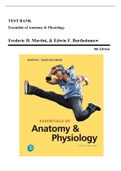
Essentials of Anatomy & Physiology
Frederic H. Martini, & Edwin F. Bartholomew
8th Edition
,Table of Contents
Chapter 1 An Introduction to Anatomy and Physiology 1
Chapter 2 The Chemical Level of Organization 29
Chapter 3 Cell Structure and Function 58
Chapter 4 The Tissue Level of Organization 96
Chapter 5 The Integumentary System 121
Chapter 6 The Skeletal System 152
Chapter 7 The Muscular System 211
Chapter 8 The Nervous System 241
Chapter 9 The General and Special Senses 280
Chapter 10 The Endocrine System 312
Chapter 11 The Cardiovascular System Blood 338
Chapter 12 The Cardiovascular System The Heart 360
Chapter 13 The Cardiovascular System Blood Vessels and Circulation 390
Chapter 14 The Lymphatic System and Immunity 421
Chapter 15 The Respiratory System 448
Chapter 16 The Digestive System 475
Chapter 17 Metabolism and Energetics 508
Chapter 18 The Urinary System 529
Chapter 19 The Reproductive System 559
Chapter 20 Development and Inheritance 589
,______________________________________________________________________________________________
Test Bank - Essentials of Anatomy & Physiology, 8th Edition (Martini, 2020)
Essentials of Anatomy & Physiology, 8e (Martini)
Chapter 1 An Introduction to Anatomy and Physiology
1.1 Multiple-Choice Questions
1) Characteristics of living organisms include the ability to
A) repair and completely restore itself during any type of injury.
B) respond and adapt to their environment.
C) control the external environment.
D) form positive feedback loops.
E) create a protective covering over themselves.
Answer: B
Learning Outcome: 1-1
Bloom's Taxonomy: Remembering
2) The waste products of metabolism are eliminated through the process of
A) assimilation.
B) absorption.
C) excretion.
D) digestion.
E) resorption.
Answer: C
Learning Outcome: 1-1
Bloom's Taxonomy: Remembering
3) Humans have specialized organ systems compared to smaller organisms because
A) we have to interact with our environment and smaller organisms do not.
B) smaller organisms do not need as many nutrients.
C) our cells are larger.
D) small organisms do not do the same processes than humans do.
E) there is multicellularity and increased size in larger organisms.
Answer: E
Learning Outcome: 1-1
Bloom's Taxonomy: Understanding
4) Think about the definitions of anatomy and of physiology. The relationship between these two
fields is best described by the following statement:
A) Anatomy is the study of function.
B) All structures are derived from an ancestral structure.
C) Physiology becomes more complex over time.
D) Structure follows function.
E) Organs that have similar function also have similar structure.
Answer: D
Learning Outcome: 1-2
Bloom's Taxonomy: Understanding
______________________________________________________________________________________________
1|Page
https://www.stuvia.com/en-us/user/AllStudyGuides
,______________________________________________________________________________________________
Test Bank - Essentials of Anatomy & Physiology, 8th Edition (Martini, 2020)
5) Diseases such as diabetes and cardiovascular disease would be covered in the specialty area of
physiology called
A) hyperbaric physiology.
B) pathophysiology.
C) gross anatomy.
D) regional anatomy.
E) systemic anatomy.
Answer: B
Learning Outcome: 1-2
Bloom's Taxonomy: Understanding
6) Studying all the superficial and internal features in one specific area of the body is called
A) gross anatomy.
B) surface anatomy.
C) systemic anatomy.
D) regional anatomy.
E) surgical anatomy.
Answer: D
Learning Outcome: 1-2
Bloom's Taxonomy: Remembering
7) One difference between a gross anatomist and a histologist would be
A) the use of a microscope.
B) the need to use sophisticated diagnostic imaging methods.
C) one studies physiology and the other studies anatomy.
D) which organ systems one studies.
E) which diseases are seen.
Answer: A
Learning Outcome: 1-2
Bloom's Taxonomy: Understanding
8) The study of cells and cellular structures is called
A) gross anatomy.
B) cytology.
C) histology.
D) organology.
E) microbiology.
Answer: B
Learning Outcome: 1-2
Bloom's Taxonomy: Remembering
______________________________________________________________________________________________
2|Page
https://www.stuvia.com/en-us/user/AllStudyGuides
,______________________________________________________________________________________________
Test Bank - Essentials of Anatomy & Physiology, 8th Edition (Martini, 2020)
9) Biopsy samples from organs are sent to your lab for staining and then viewing in a
microscope. Your area of expertise would be
A) regional physiology.
B) gross anatomy.
C) regional anatomy.
D) systemic anatomy.
E) histology.
Answer: E
Learning Outcome: 1-2
Bloom's Taxonomy: Understanding
10) The study of body structure is called
A) physiology.
B) homeostasis.
C) anatomy.
D) positive feedback.
E) negative feedback.
Answer: C
Learning Outcome: 1-2
Bloom's Taxonomy: Remembering
11) The branch of biological science that deals with how the kidney functions is called
A) endocrine physiology.
B) histology.
C) adrenal anatomy.
D) cytology.
E) renal physiology.
Answer: E
Learning Outcome: 1-2
Bloom's Taxonomy: Remembering
12) Which division of anatomy focuses on the form and structure of the heart, blood, and blood
vessels?
A) regional anatomy
B) surface anatomy
C) cytology
D) histology
E) systemic anatomy
Answer: E
Learning Outcome: 1-2
Bloom's Taxonomy: Understanding
______________________________________________________________________________________________
3|Page
https://www.stuvia.com/en-us/user/AllStudyGuides
,______________________________________________________________________________________________
Test Bank - Essentials of Anatomy & Physiology, 8th Edition (Martini, 2020)
13) Which statement about anatomy and physiology is true?
A) Physiology is the study of structure.
B) Anatomy is the study of structure and function.
C) Both anatomy and physiology are needed to understand organ systems and organisms.
D) There is only one area of anatomy, whereas there are many subdivisions of physiology.
E) Special physiology focuses on a particular organ system.
Answer: C
Learning Outcome: 1-2
Bloom's Taxonomy: Understanding
14) A cardiologist studies the human body mainly with an approach resembling
A) gross anatomy.
B) surface anatomy.
C) microscopic anatomy.
D) systemic anatomy.
E) regional anatomy.
Answer: D
Learning Outcome: 1-2
Bloom's Taxonomy: Understanding
15) Which of the following is an organ?
A) blood
B) heart
C) peritoneum
D) connective tissue
E) mitochondrion
Answer: B
Learning Outcome: 1-3
Bloom's Taxonomy: Remembering
16) A collection of cells that work together designates a(n)
A) chemical.
B) organ.
C) tissue.
D) organ system.
E) molecule.
Answer: C
Learning Outcome: 1-3
Bloom's Taxonomy: Remembering
______________________________________________________________________________________________
4|Page
https://www.stuvia.com/en-us/user/AllStudyGuides
,______________________________________________________________________________________________
Test Bank - Essentials of Anatomy & Physiology, 8th Edition (Martini, 2020)
17) Which of the following is the simplest level of organization?
A) cellular
B) chemical
C) organ
D) system
E) tissue
Answer: B
Learning Outcome: 1-3
Bloom's Taxonomy: Remembering
18) The heart, blood, and blood vessels combine to form which of the following?
A) a group of cells
B) an organ system
C) the smallest level of organization
D) an organ
E) an individual living entity
Answer: B
Learning Outcome: 1-3
Bloom's Taxonomy: Remembering
19) Which statement is true?
A) An organ will likely be composed of different tissues.
B) Organs are composed of organ systems.
C) Many molecules come together to form atoms.
D) All organs in an organ system have the same function.
E) The smallest living unit in the body is an atom.
Answer: A
Learning Outcome: 1-3
Bloom's Taxonomy: Understanding
20) Which of the following is an accurate description of the cellular level of organization?
A) Cells consist of two or more different tissues working together to perform specific functions.
B) Cells are considered to be the largest living units in the body.
C) Cells are comprised of different molecules that interact to form larger structures, each type of
which has a specific function.
D) Cells combine to form molecules with complex shapes, which determine their function(s).
E) Cardiac muscle is an example of the cellular level of organization.
Answer: C
Learning Outcome: 1-3
Bloom's Taxonomy: Understanding
______________________________________________________________________________________________
5|Page
https://www.stuvia.com/en-us/user/AllStudyGuides
,______________________________________________________________________________________________
Test Bank - Essentials of Anatomy & Physiology, 8th Edition (Martini, 2020)
21) The fact that a single defective protein causes cystic fibrosis, a multisystemic illness, proves
that
A) all organisms are composed of cells.
B) all levels of organization within an organism are interdependent.
C) chemical molecules make up cells.
D) all cells are independent of each other.
E) congenital defects can be life threatening.
Answer: B
Learning Outcome: 1-3
Bloom's Taxonomy: Applying
22) The production of another human organism is the function of which of the following
systems?
A) skeletal
B) reproductive
C) respiratory
D) lymphoid
E) cardiovascular
Answer: B
Learning Outcome: 1-4
Bloom's Taxonomy: Understanding
23) How are the endocrine organ system and nervous organ system alike?
A) They both send nerve impulses.
B) Each of the systems regulates different activities.
C) Together, they both regulate most of the activities of the body.
D) They both have many disorders associated with them.
E) One system is more involved with young life, whereas the other becomes more important later
in life.
Answer: C
Learning Outcome: 1-4
Bloom's Taxonomy: Understanding
24) The trachea and lungs are components of the
A) endocrine system.
B) digestive system.
C) respiratory system.
D) urinary system.
E) lymphoid system.
Answer: C
Learning Outcome: 1-4
Bloom's Taxonomy: Remembering
______________________________________________________________________________________________
6|Page
https://www.stuvia.com/en-us/user/AllStudyGuides
,______________________________________________________________________________________________
Test Bank - Essentials of Anatomy & Physiology, 8th Edition (Martini, 2020)
25) The pituitary and thyroid glands are components of the
A) endocrine system.
B) cardiovascular system.
C) respiratory system.
D) lymphoid system.
E) digestive system.
Answer: A
Learning Outcome: 1-4
Bloom's Taxonomy: Remembering
26) Gas exchange is a function of the
A) cardiovascular system.
B) lymphoid system.
C) respiratory system.
D) urinary system.
E) endocrine system.
Answer: C
Learning Outcome: 1-4
Bloom's Taxonomy: Remembering
27) Which structure(s) is/are a component of the digestive system?
A) pituitary gland
B) ligaments
C) urethra
D) arteries
E) liver
Answer: E
Learning Outcome: 1-4
Bloom's Taxonomy: Remembering
28) Covering, protection, and control of body temperature are functions of which organ system
of the human body?
A) integumentary
B) muscular
C) skeletal
D) nervous
E) endocrine
Answer: A
Learning Outcome: 1-4
Bloom's Taxonomy: Understanding
______________________________________________________________________________________________
7|Page
https://www.stuvia.com/en-us/user/AllStudyGuides
, ______________________________________________________________________________________________
Test Bank - Essentials of Anatomy & Physiology, 8th Edition (Martini, 2020)
29) The thymus is associated with which organ system?
A) nervous
B) respiratory
C) digestive
D) urinary
E) endocrine
Answer: E
Learning Outcome: 1-4
Bloom's Taxonomy: Understanding
30) All of these organ systems have exchange of materials as a main function.
A) urinary and digestive
B) respiratory and cardiovascular
C) cardiovascular and endocrine
D) digestive and respiratory
E) lymphatic and bone
Answer: B
Learning Outcome: 1-4
Bloom's Taxonomy: Understanding
31) What is/are the primary function(s) of the skeletal system?
A) protection from environment
B) internal transport of materials
C) support, protection, and mineral storage
D) delivery of air for gas exchange
E) locomotion and heat production
Answer: C
Learning Outcome: 1-4
Bloom's Taxonomy: Understanding
______________________________________________________________________________________________
8|Page
https://www.stuvia.com/en-us/user/AllStudyGuides
Essentials of Anatomy & Physiology
Frederic H. Martini, & Edwin F. Bartholomew
8th Edition
,Table of Contents
Chapter 1 An Introduction to Anatomy and Physiology 1
Chapter 2 The Chemical Level of Organization 29
Chapter 3 Cell Structure and Function 58
Chapter 4 The Tissue Level of Organization 96
Chapter 5 The Integumentary System 121
Chapter 6 The Skeletal System 152
Chapter 7 The Muscular System 211
Chapter 8 The Nervous System 241
Chapter 9 The General and Special Senses 280
Chapter 10 The Endocrine System 312
Chapter 11 The Cardiovascular System Blood 338
Chapter 12 The Cardiovascular System The Heart 360
Chapter 13 The Cardiovascular System Blood Vessels and Circulation 390
Chapter 14 The Lymphatic System and Immunity 421
Chapter 15 The Respiratory System 448
Chapter 16 The Digestive System 475
Chapter 17 Metabolism and Energetics 508
Chapter 18 The Urinary System 529
Chapter 19 The Reproductive System 559
Chapter 20 Development and Inheritance 589
,______________________________________________________________________________________________
Test Bank - Essentials of Anatomy & Physiology, 8th Edition (Martini, 2020)
Essentials of Anatomy & Physiology, 8e (Martini)
Chapter 1 An Introduction to Anatomy and Physiology
1.1 Multiple-Choice Questions
1) Characteristics of living organisms include the ability to
A) repair and completely restore itself during any type of injury.
B) respond and adapt to their environment.
C) control the external environment.
D) form positive feedback loops.
E) create a protective covering over themselves.
Answer: B
Learning Outcome: 1-1
Bloom's Taxonomy: Remembering
2) The waste products of metabolism are eliminated through the process of
A) assimilation.
B) absorption.
C) excretion.
D) digestion.
E) resorption.
Answer: C
Learning Outcome: 1-1
Bloom's Taxonomy: Remembering
3) Humans have specialized organ systems compared to smaller organisms because
A) we have to interact with our environment and smaller organisms do not.
B) smaller organisms do not need as many nutrients.
C) our cells are larger.
D) small organisms do not do the same processes than humans do.
E) there is multicellularity and increased size in larger organisms.
Answer: E
Learning Outcome: 1-1
Bloom's Taxonomy: Understanding
4) Think about the definitions of anatomy and of physiology. The relationship between these two
fields is best described by the following statement:
A) Anatomy is the study of function.
B) All structures are derived from an ancestral structure.
C) Physiology becomes more complex over time.
D) Structure follows function.
E) Organs that have similar function also have similar structure.
Answer: D
Learning Outcome: 1-2
Bloom's Taxonomy: Understanding
______________________________________________________________________________________________
1|Page
https://www.stuvia.com/en-us/user/AllStudyGuides
,______________________________________________________________________________________________
Test Bank - Essentials of Anatomy & Physiology, 8th Edition (Martini, 2020)
5) Diseases such as diabetes and cardiovascular disease would be covered in the specialty area of
physiology called
A) hyperbaric physiology.
B) pathophysiology.
C) gross anatomy.
D) regional anatomy.
E) systemic anatomy.
Answer: B
Learning Outcome: 1-2
Bloom's Taxonomy: Understanding
6) Studying all the superficial and internal features in one specific area of the body is called
A) gross anatomy.
B) surface anatomy.
C) systemic anatomy.
D) regional anatomy.
E) surgical anatomy.
Answer: D
Learning Outcome: 1-2
Bloom's Taxonomy: Remembering
7) One difference between a gross anatomist and a histologist would be
A) the use of a microscope.
B) the need to use sophisticated diagnostic imaging methods.
C) one studies physiology and the other studies anatomy.
D) which organ systems one studies.
E) which diseases are seen.
Answer: A
Learning Outcome: 1-2
Bloom's Taxonomy: Understanding
8) The study of cells and cellular structures is called
A) gross anatomy.
B) cytology.
C) histology.
D) organology.
E) microbiology.
Answer: B
Learning Outcome: 1-2
Bloom's Taxonomy: Remembering
______________________________________________________________________________________________
2|Page
https://www.stuvia.com/en-us/user/AllStudyGuides
,______________________________________________________________________________________________
Test Bank - Essentials of Anatomy & Physiology, 8th Edition (Martini, 2020)
9) Biopsy samples from organs are sent to your lab for staining and then viewing in a
microscope. Your area of expertise would be
A) regional physiology.
B) gross anatomy.
C) regional anatomy.
D) systemic anatomy.
E) histology.
Answer: E
Learning Outcome: 1-2
Bloom's Taxonomy: Understanding
10) The study of body structure is called
A) physiology.
B) homeostasis.
C) anatomy.
D) positive feedback.
E) negative feedback.
Answer: C
Learning Outcome: 1-2
Bloom's Taxonomy: Remembering
11) The branch of biological science that deals with how the kidney functions is called
A) endocrine physiology.
B) histology.
C) adrenal anatomy.
D) cytology.
E) renal physiology.
Answer: E
Learning Outcome: 1-2
Bloom's Taxonomy: Remembering
12) Which division of anatomy focuses on the form and structure of the heart, blood, and blood
vessels?
A) regional anatomy
B) surface anatomy
C) cytology
D) histology
E) systemic anatomy
Answer: E
Learning Outcome: 1-2
Bloom's Taxonomy: Understanding
______________________________________________________________________________________________
3|Page
https://www.stuvia.com/en-us/user/AllStudyGuides
,______________________________________________________________________________________________
Test Bank - Essentials of Anatomy & Physiology, 8th Edition (Martini, 2020)
13) Which statement about anatomy and physiology is true?
A) Physiology is the study of structure.
B) Anatomy is the study of structure and function.
C) Both anatomy and physiology are needed to understand organ systems and organisms.
D) There is only one area of anatomy, whereas there are many subdivisions of physiology.
E) Special physiology focuses on a particular organ system.
Answer: C
Learning Outcome: 1-2
Bloom's Taxonomy: Understanding
14) A cardiologist studies the human body mainly with an approach resembling
A) gross anatomy.
B) surface anatomy.
C) microscopic anatomy.
D) systemic anatomy.
E) regional anatomy.
Answer: D
Learning Outcome: 1-2
Bloom's Taxonomy: Understanding
15) Which of the following is an organ?
A) blood
B) heart
C) peritoneum
D) connective tissue
E) mitochondrion
Answer: B
Learning Outcome: 1-3
Bloom's Taxonomy: Remembering
16) A collection of cells that work together designates a(n)
A) chemical.
B) organ.
C) tissue.
D) organ system.
E) molecule.
Answer: C
Learning Outcome: 1-3
Bloom's Taxonomy: Remembering
______________________________________________________________________________________________
4|Page
https://www.stuvia.com/en-us/user/AllStudyGuides
,______________________________________________________________________________________________
Test Bank - Essentials of Anatomy & Physiology, 8th Edition (Martini, 2020)
17) Which of the following is the simplest level of organization?
A) cellular
B) chemical
C) organ
D) system
E) tissue
Answer: B
Learning Outcome: 1-3
Bloom's Taxonomy: Remembering
18) The heart, blood, and blood vessels combine to form which of the following?
A) a group of cells
B) an organ system
C) the smallest level of organization
D) an organ
E) an individual living entity
Answer: B
Learning Outcome: 1-3
Bloom's Taxonomy: Remembering
19) Which statement is true?
A) An organ will likely be composed of different tissues.
B) Organs are composed of organ systems.
C) Many molecules come together to form atoms.
D) All organs in an organ system have the same function.
E) The smallest living unit in the body is an atom.
Answer: A
Learning Outcome: 1-3
Bloom's Taxonomy: Understanding
20) Which of the following is an accurate description of the cellular level of organization?
A) Cells consist of two or more different tissues working together to perform specific functions.
B) Cells are considered to be the largest living units in the body.
C) Cells are comprised of different molecules that interact to form larger structures, each type of
which has a specific function.
D) Cells combine to form molecules with complex shapes, which determine their function(s).
E) Cardiac muscle is an example of the cellular level of organization.
Answer: C
Learning Outcome: 1-3
Bloom's Taxonomy: Understanding
______________________________________________________________________________________________
5|Page
https://www.stuvia.com/en-us/user/AllStudyGuides
,______________________________________________________________________________________________
Test Bank - Essentials of Anatomy & Physiology, 8th Edition (Martini, 2020)
21) The fact that a single defective protein causes cystic fibrosis, a multisystemic illness, proves
that
A) all organisms are composed of cells.
B) all levels of organization within an organism are interdependent.
C) chemical molecules make up cells.
D) all cells are independent of each other.
E) congenital defects can be life threatening.
Answer: B
Learning Outcome: 1-3
Bloom's Taxonomy: Applying
22) The production of another human organism is the function of which of the following
systems?
A) skeletal
B) reproductive
C) respiratory
D) lymphoid
E) cardiovascular
Answer: B
Learning Outcome: 1-4
Bloom's Taxonomy: Understanding
23) How are the endocrine organ system and nervous organ system alike?
A) They both send nerve impulses.
B) Each of the systems regulates different activities.
C) Together, they both regulate most of the activities of the body.
D) They both have many disorders associated with them.
E) One system is more involved with young life, whereas the other becomes more important later
in life.
Answer: C
Learning Outcome: 1-4
Bloom's Taxonomy: Understanding
24) The trachea and lungs are components of the
A) endocrine system.
B) digestive system.
C) respiratory system.
D) urinary system.
E) lymphoid system.
Answer: C
Learning Outcome: 1-4
Bloom's Taxonomy: Remembering
______________________________________________________________________________________________
6|Page
https://www.stuvia.com/en-us/user/AllStudyGuides
,______________________________________________________________________________________________
Test Bank - Essentials of Anatomy & Physiology, 8th Edition (Martini, 2020)
25) The pituitary and thyroid glands are components of the
A) endocrine system.
B) cardiovascular system.
C) respiratory system.
D) lymphoid system.
E) digestive system.
Answer: A
Learning Outcome: 1-4
Bloom's Taxonomy: Remembering
26) Gas exchange is a function of the
A) cardiovascular system.
B) lymphoid system.
C) respiratory system.
D) urinary system.
E) endocrine system.
Answer: C
Learning Outcome: 1-4
Bloom's Taxonomy: Remembering
27) Which structure(s) is/are a component of the digestive system?
A) pituitary gland
B) ligaments
C) urethra
D) arteries
E) liver
Answer: E
Learning Outcome: 1-4
Bloom's Taxonomy: Remembering
28) Covering, protection, and control of body temperature are functions of which organ system
of the human body?
A) integumentary
B) muscular
C) skeletal
D) nervous
E) endocrine
Answer: A
Learning Outcome: 1-4
Bloom's Taxonomy: Understanding
______________________________________________________________________________________________
7|Page
https://www.stuvia.com/en-us/user/AllStudyGuides
, ______________________________________________________________________________________________
Test Bank - Essentials of Anatomy & Physiology, 8th Edition (Martini, 2020)
29) The thymus is associated with which organ system?
A) nervous
B) respiratory
C) digestive
D) urinary
E) endocrine
Answer: E
Learning Outcome: 1-4
Bloom's Taxonomy: Understanding
30) All of these organ systems have exchange of materials as a main function.
A) urinary and digestive
B) respiratory and cardiovascular
C) cardiovascular and endocrine
D) digestive and respiratory
E) lymphatic and bone
Answer: B
Learning Outcome: 1-4
Bloom's Taxonomy: Understanding
31) What is/are the primary function(s) of the skeletal system?
A) protection from environment
B) internal transport of materials
C) support, protection, and mineral storage
D) delivery of air for gas exchange
E) locomotion and heat production
Answer: C
Learning Outcome: 1-4
Bloom's Taxonomy: Understanding
______________________________________________________________________________________________
8|Page
https://www.stuvia.com/en-us/user/AllStudyGuides