

What is Microbiology?
● The study of organisms too small to be seen with the naked eye
○ e.g. Bacteria, viruses, single celled eukaryotes
○ Some microorganisms are visible to the nake eye
■ Fungi, algae
○ Some microbes are multicellular
■ Myxobacteria, slime molds
Why is Microbiology Important?
● Microbes are the oldest form of life
● Largest mass of living material on Earth
● Carry out major processes for biogeochemical cycles
● Can live in places unsuitable for other organisms
● Other life forms require microbes to survive
Structure and Activities of Microbial Cells
● All Cells have
○ Cytoplasmic membrane- a semipermeable barrier that
separates the cell interior (cytoplasm) from the
environment
○ Cytoplasm- Aqueous mixture of macromolecules, ions and
proteins
○ Ribosomes- a structure composed of RNAs and proteins
upon which new proteins are synthesized
○ Genetic material- all cells store their genetic information as
DNA
■ All information is divided into functional units called
genes
○ Genome- a cell’s full component of genes
○ Chromosomes- a genetic element carrying genes essential to
cellular function
○ Plasmid- a piece of DNA that carries non-essential genes
Structural Categorization of Microbes
1. Eukaryotes
○ Membrane bound nucleus
○ Membrane bound organelles
○ Complex internal organization
○ Division by mitosis and meiosis
■ Major groups of eukaryotic microbes
● Protists- unicellular or multicellular without differentiation into tissues
a. Protozoa- animal-like microorganisms
b. Algae- photosynthetic plant-like microorganisms
c. Slime molds and water molds- filamentous
● Fungi
a. Unicellular (yeasts)
b. Filamentous (molds)
c. Multi-cellular (mushrooms)
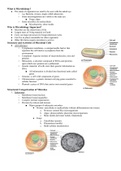
, 2. Prokaryotes
○ No membrane bound nucleus or
organelles
○ Generally smaller
○ Simple internal structure
○ Divide by binary fission
○ Most are unicellular
■ Major groups of prokaryotic
microbes
● Bacteria (eubacteria)
a. Genetically diverse
b. Extremely diverse metabolic styles
c. Includes both pathogens and non-pathogens
● Archaes (archaebacteria)
a. Genetically and biochemically distinct from bacteria
b. Also have diverse metabolism
c. Never pathogenic
d. Most famous for living in extreme environments
3. Viruses
○ Acellular infectious particles
○ Extremely small
○ Obligate intracellular parasites
○ Lack independent metabolism
■ No ribosomes
■ No ribosomal RNA
■ Cannot be classified with other microbes
Evolution and Diversity of Microbial Cells
● First anaerobic life appeared between 3.8-3.9 billion years ago
● Photosynthetic bacteria oxygenated the Earth about 2 billion years ago
○ Allowed the evolution of modern eukaryotic microorganisms
● First plants and animals appeared about 0.5 billion years ago
Classifying Organisms Based on Evolutionary Relationships
→ Comparing small subunit (SSU) rRNA genes
● Prokaryotes - 70S ribosomes - 16S SSU rRNA
● Eukaryotes - 80S ribosomes - 18S SSU rRNA
→ rRNA genes change slowly over time so is a better indicator of evolutionary relationships
→ Sequencing rRNA genes
1. DNA is collected from a pure culture
2. The SSU rRNA gene is amplified using the polymerase chain reaction (PCR)
○ A technique used to synthesize many identical copies of a short sequence of DNA
3. The gene is sequenced
4. Sequence is aligned with sequences from other organisms
○ Number of differences is used to calculate evolutionary distance
Molecular Phylogeny and the Tree of Life
● Phylogenetic tree based on 16S or 18S ribosomal DNA sequence
● All organisms can be grouped into 3 distinct domains of life
a. Bacteria
b. Archaea
c. Eukarya
The Species Concept in Microbiology
● The species is the fundamental unit of biological diversity.
● Phylogenetic species concept:
○ A group of strains that share certain diagnostic traits, are genetically cohesive and have a unique recent
common ancestor
● In theory, species of Bacteria and Archaea should have
, ○ Most but not all characteristics in common
○ Greater than 97% sequence similarity in the 16S rRNA gene
○ High degree of genome similarity
■ DNA-DNA hybridization
Classification and Nomenclature
→ Domain; Phylum; Class; Order; Family; Genus; Species
1. Names are latinized
2. Italicized or underlined
3. Genus capitalized, epithet is not
4. Genus name may be abbreviated the second time it’s
used
The Discovery of Microorganism
1. Robert Hooke (1635-1703)
○ The first to describe microbes
■ Used a compound microscope that had a magnification up to 30x
■ Used it to observe
● Cells in cork
● Bread mold filaments- 1st microbe
● Beginning of cell theory - all living things are composed of cells
2. Antoni van Leeuwenhoek (1632-1723)
○ Built microscopes that magnified specimen by 50-300x
○ Observed single celled microorganisms - called them “animalcules”
○ First discovery of bacteria
3. Louis Pasteur (1822-1895)
○ Studied wine and beer production
○ Yeasts convert sugar to alcohol in the absence of oxygen
■ Fermentation
○ Bacteria can sour wine by converting alcohols to acid
○ Developed a method of gentle heating to kill unwanted bacteria
■ Pasteurization
○ Prepared meatinusion inside a long swan-necked flasks
○ Boiled the infusion to sterilize it
○ As long as the flask remains upright, dust and microbes cannot enter, and the infusion remains sterile
■ Led to the development of methods for controlling the growth of microorganisms (aseptic
technique)
○ Realized that solid media provided a simple way to obtain pure cultures
○ Broth medium solidified with agar
■ Polysaccharide derived from marine algae
■ Melts at -97 degrees Celsius and solidifies at 43 degrees Celsius
■ Cannot be degrade by most microorganisms
■ Typical Petri plate = nutrient broth medium + 1.5% agar
4. Robert Koch (1843-1910)
○ Studied anthrax - responsible for epidemics in livestock
● The study of organisms too small to be seen with the naked eye
○ e.g. Bacteria, viruses, single celled eukaryotes
○ Some microorganisms are visible to the nake eye
■ Fungi, algae
○ Some microbes are multicellular
■ Myxobacteria, slime molds
Why is Microbiology Important?
● Microbes are the oldest form of life
● Largest mass of living material on Earth
● Carry out major processes for biogeochemical cycles
● Can live in places unsuitable for other organisms
● Other life forms require microbes to survive
Structure and Activities of Microbial Cells
● All Cells have
○ Cytoplasmic membrane- a semipermeable barrier that
separates the cell interior (cytoplasm) from the
environment
○ Cytoplasm- Aqueous mixture of macromolecules, ions and
proteins
○ Ribosomes- a structure composed of RNAs and proteins
upon which new proteins are synthesized
○ Genetic material- all cells store their genetic information as
DNA
■ All information is divided into functional units called
genes
○ Genome- a cell’s full component of genes
○ Chromosomes- a genetic element carrying genes essential to
cellular function
○ Plasmid- a piece of DNA that carries non-essential genes
Structural Categorization of Microbes
1. Eukaryotes
○ Membrane bound nucleus
○ Membrane bound organelles
○ Complex internal organization
○ Division by mitosis and meiosis
■ Major groups of eukaryotic microbes
● Protists- unicellular or multicellular without differentiation into tissues
a. Protozoa- animal-like microorganisms
b. Algae- photosynthetic plant-like microorganisms
c. Slime molds and water molds- filamentous
● Fungi
a. Unicellular (yeasts)
b. Filamentous (molds)
c. Multi-cellular (mushrooms)
, 2. Prokaryotes
○ No membrane bound nucleus or
organelles
○ Generally smaller
○ Simple internal structure
○ Divide by binary fission
○ Most are unicellular
■ Major groups of prokaryotic
microbes
● Bacteria (eubacteria)
a. Genetically diverse
b. Extremely diverse metabolic styles
c. Includes both pathogens and non-pathogens
● Archaes (archaebacteria)
a. Genetically and biochemically distinct from bacteria
b. Also have diverse metabolism
c. Never pathogenic
d. Most famous for living in extreme environments
3. Viruses
○ Acellular infectious particles
○ Extremely small
○ Obligate intracellular parasites
○ Lack independent metabolism
■ No ribosomes
■ No ribosomal RNA
■ Cannot be classified with other microbes
Evolution and Diversity of Microbial Cells
● First anaerobic life appeared between 3.8-3.9 billion years ago
● Photosynthetic bacteria oxygenated the Earth about 2 billion years ago
○ Allowed the evolution of modern eukaryotic microorganisms
● First plants and animals appeared about 0.5 billion years ago
Classifying Organisms Based on Evolutionary Relationships
→ Comparing small subunit (SSU) rRNA genes
● Prokaryotes - 70S ribosomes - 16S SSU rRNA
● Eukaryotes - 80S ribosomes - 18S SSU rRNA
→ rRNA genes change slowly over time so is a better indicator of evolutionary relationships
→ Sequencing rRNA genes
1. DNA is collected from a pure culture
2. The SSU rRNA gene is amplified using the polymerase chain reaction (PCR)
○ A technique used to synthesize many identical copies of a short sequence of DNA
3. The gene is sequenced
4. Sequence is aligned with sequences from other organisms
○ Number of differences is used to calculate evolutionary distance
Molecular Phylogeny and the Tree of Life
● Phylogenetic tree based on 16S or 18S ribosomal DNA sequence
● All organisms can be grouped into 3 distinct domains of life
a. Bacteria
b. Archaea
c. Eukarya
The Species Concept in Microbiology
● The species is the fundamental unit of biological diversity.
● Phylogenetic species concept:
○ A group of strains that share certain diagnostic traits, are genetically cohesive and have a unique recent
common ancestor
● In theory, species of Bacteria and Archaea should have
, ○ Most but not all characteristics in common
○ Greater than 97% sequence similarity in the 16S rRNA gene
○ High degree of genome similarity
■ DNA-DNA hybridization
Classification and Nomenclature
→ Domain; Phylum; Class; Order; Family; Genus; Species
1. Names are latinized
2. Italicized or underlined
3. Genus capitalized, epithet is not
4. Genus name may be abbreviated the second time it’s
used
The Discovery of Microorganism
1. Robert Hooke (1635-1703)
○ The first to describe microbes
■ Used a compound microscope that had a magnification up to 30x
■ Used it to observe
● Cells in cork
● Bread mold filaments- 1st microbe
● Beginning of cell theory - all living things are composed of cells
2. Antoni van Leeuwenhoek (1632-1723)
○ Built microscopes that magnified specimen by 50-300x
○ Observed single celled microorganisms - called them “animalcules”
○ First discovery of bacteria
3. Louis Pasteur (1822-1895)
○ Studied wine and beer production
○ Yeasts convert sugar to alcohol in the absence of oxygen
■ Fermentation
○ Bacteria can sour wine by converting alcohols to acid
○ Developed a method of gentle heating to kill unwanted bacteria
■ Pasteurization
○ Prepared meatinusion inside a long swan-necked flasks
○ Boiled the infusion to sterilize it
○ As long as the flask remains upright, dust and microbes cannot enter, and the infusion remains sterile
■ Led to the development of methods for controlling the growth of microorganisms (aseptic
technique)
○ Realized that solid media provided a simple way to obtain pure cultures
○ Broth medium solidified with agar
■ Polysaccharide derived from marine algae
■ Melts at -97 degrees Celsius and solidifies at 43 degrees Celsius
■ Cannot be degrade by most microorganisms
■ Typical Petri plate = nutrient broth medium + 1.5% agar
4. Robert Koch (1843-1910)
○ Studied anthrax - responsible for epidemics in livestock


