Chapter 2
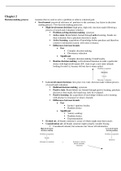
Decision-making process Assumes that we seek to solve a problem or achieve a desired goal.
▪ Involvement: perceived relevance of purchase to the customer, key factor in decision-
making process. Two decision-making processes:
▪ High-involvement decisions (high price, high risk): decision made following a
process of search and evaluation (criteria).
▪ Problem-solving decision making: synonym.
▪ Active state: Brand beliefs formed through active learning, brands are
then evaluated, then a purchase decision is made.
▪ Active learning: acquisition of knowledge before purchase and therefore
extensive information search, with some resistance.
▪ Differences between brands:
• Few
▪ Complex decision-making;
▪ Dissonance reduction
• Significant:
▪ Complex decision-making / brand loyalty
▪ Routine decision making: well-informed intention to make a particular
choice with high-involvement (EX: want to get a new mini (already
looking for mini’s), because old one has to many miles)
Problem recognition
↓
Intention
↓
Choice
↓
Outcome / evaluation
▪ Low-involvement decisions (low price, low risk): decision made without process
of search and evaluation.
▪ Habitual decision making: synonym.
▪ Passive state: Brand beliefs are formed through passive learning, purchase
decision is then made, the brand may (not) be evaluated.
▪ Passive learning: the acquisition of knowledge without active learning
with absence to resistance to what is learned.
▪ Differences between brands:
• Few
▪ Inertia / spurious loyalty;
▪ Random choice
• Significant:
▪ Variety-seeking;
▪ Random choice;
▪ Experimentation
▪ Evoked set: all brands someone is aware of which might meet their needs;
▪ Consideration set: all brands someone might actually consider buying.
▪ Considered rational, but someone can’t know all information.
High-involvement Low-involvement
decision- making decision-making
↓
Problem recognition Problem recognition
↓ |
Search ↓
↓ Intention
Alternative evaluation ← Evaluative criteria-
beliefs, attitudes,
intentions
, ↓ ↓
Choice Choice
↓ ↓
▪ Outcomes of choice Outcomes of choice
▪ Alternative involvement types, because different people will exhibit varying involvement
levels with regard to the same product because of differences in personality, previous
experience, relevance, their situation, socio-economic and demographic factors:
1. Product involvement: perceived personal relevance of the product based on
needs, values or interest.
2. Message-response involvement: reflects consumer’s interest in marketing
communications.
3. Enduring involvement: the pre-existing relationship between an individual and
the object of concern.
4. Ego involvement: when consumers perceive products / brands as relevant to their
personal interests.
▪ Involvement is a relationship between company and consumer
▪ Some consumers may be more involved with low-involvement product field
▪ Situational involvement: personal factors and long-term interest in a product may
affect the level of involvement, but may also change depending upon the purchase
situation
▪ High involvement through:
1. Link the brand to hedonic needs
2. Use distinctive / novel ways of communicating the product
3. Use celebrities (that create impact).
4. Tell a story
▪ Especially effective when there is a longer time period to present a narrative.
5. Build a relationship by investing in a particular communications message (thus
investing in customer relationship)
6. Get the consumer to participate
▪ Brands are more successful when they get active involvement from consumers.
▪ Gamification: increases attention and builds involvement through
personalized experiences when the consumer doesn’t expect it.
Decision making process (but decisions can influenced by others):
1. Problem recognition: realization (triggered by internal factors (hunger etc.) and/or
external factors (birthday upcoming etc.)) that a problem needs to be solved through
purchase, because we (un)consciously notice there is a difference between the actual and
ideal state.
• Problem recognition:
1. Need recognition:
(actual / ideal state) ↔ (actual state)
• Consumer can easily bring itself back to a actual state that is the ideal state
• Simple information search in next phase, maybe ongoing search (previous
experience , EX: subway is nice), which occurs next to other information
searches.
2. Opportunity recognition:
(ideal state) ↔ (actual state)
1. Consumer has larger distance between it’s actual state and desired state
2. More extensive information search in next phase.
2. Information search: the process by which we, not only functional but also for fun
(browsing), identify appropriate (internal / external) information to help aid our choice in a
decision-making situation.
• Information need classes:
Decision-making process Assumes that we seek to solve a problem or achieve a desired goal.
▪ Involvement: perceived relevance of purchase to the customer, key factor in decision-
making process. Two decision-making processes:
▪ High-involvement decisions (high price, high risk): decision made following a
process of search and evaluation (criteria).
▪ Problem-solving decision making: synonym.
▪ Active state: Brand beliefs formed through active learning, brands are
then evaluated, then a purchase decision is made.
▪ Active learning: acquisition of knowledge before purchase and therefore
extensive information search, with some resistance.
▪ Differences between brands:
• Few
▪ Complex decision-making;
▪ Dissonance reduction
• Significant:
▪ Complex decision-making / brand loyalty
▪ Routine decision making: well-informed intention to make a particular
choice with high-involvement (EX: want to get a new mini (already
looking for mini’s), because old one has to many miles)
Problem recognition
↓
Intention
↓
Choice
↓
Outcome / evaluation
▪ Low-involvement decisions (low price, low risk): decision made without process
of search and evaluation.
▪ Habitual decision making: synonym.
▪ Passive state: Brand beliefs are formed through passive learning, purchase
decision is then made, the brand may (not) be evaluated.
▪ Passive learning: the acquisition of knowledge without active learning
with absence to resistance to what is learned.
▪ Differences between brands:
• Few
▪ Inertia / spurious loyalty;
▪ Random choice
• Significant:
▪ Variety-seeking;
▪ Random choice;
▪ Experimentation
▪ Evoked set: all brands someone is aware of which might meet their needs;
▪ Consideration set: all brands someone might actually consider buying.
▪ Considered rational, but someone can’t know all information.
High-involvement Low-involvement
decision- making decision-making
↓
Problem recognition Problem recognition
↓ |
Search ↓
↓ Intention
Alternative evaluation ← Evaluative criteria-
beliefs, attitudes,
intentions
, ↓ ↓
Choice Choice
↓ ↓
▪ Outcomes of choice Outcomes of choice
▪ Alternative involvement types, because different people will exhibit varying involvement
levels with regard to the same product because of differences in personality, previous
experience, relevance, their situation, socio-economic and demographic factors:
1. Product involvement: perceived personal relevance of the product based on
needs, values or interest.
2. Message-response involvement: reflects consumer’s interest in marketing
communications.
3. Enduring involvement: the pre-existing relationship between an individual and
the object of concern.
4. Ego involvement: when consumers perceive products / brands as relevant to their
personal interests.
▪ Involvement is a relationship between company and consumer
▪ Some consumers may be more involved with low-involvement product field
▪ Situational involvement: personal factors and long-term interest in a product may
affect the level of involvement, but may also change depending upon the purchase
situation
▪ High involvement through:
1. Link the brand to hedonic needs
2. Use distinctive / novel ways of communicating the product
3. Use celebrities (that create impact).
4. Tell a story
▪ Especially effective when there is a longer time period to present a narrative.
5. Build a relationship by investing in a particular communications message (thus
investing in customer relationship)
6. Get the consumer to participate
▪ Brands are more successful when they get active involvement from consumers.
▪ Gamification: increases attention and builds involvement through
personalized experiences when the consumer doesn’t expect it.
Decision making process (but decisions can influenced by others):
1. Problem recognition: realization (triggered by internal factors (hunger etc.) and/or
external factors (birthday upcoming etc.)) that a problem needs to be solved through
purchase, because we (un)consciously notice there is a difference between the actual and
ideal state.
• Problem recognition:
1. Need recognition:
(actual / ideal state) ↔ (actual state)
• Consumer can easily bring itself back to a actual state that is the ideal state
• Simple information search in next phase, maybe ongoing search (previous
experience , EX: subway is nice), which occurs next to other information
searches.
2. Opportunity recognition:
(ideal state) ↔ (actual state)
1. Consumer has larger distance between it’s actual state and desired state
2. More extensive information search in next phase.
2. Information search: the process by which we, not only functional but also for fun
(browsing), identify appropriate (internal / external) information to help aid our choice in a
decision-making situation.
• Information need classes: