Cognitive Key Question – “HOW CAN PSYCHOLOGY
HELP TREAT PEOPLE SUFFERING FROM DEMENTIA?”
AO1 Content on dementia:
• Dementia- a general term for the impaired ability to remember, think or make
decisions in the everyday life.
• It is caused by damage to or loss of nerve cells and their connections in the brain.
• Alzheimer’s disease is the most common type of dementia and is more common in
women than men.
• Alzheimer’s Society indicates that there are about 900,000 people in the UK suffering
from dementia.
• The cost of dementia in the UK is currently £26 billion.
• There are dementia hubs where people can be referred to, if dementia is suspected.
How does Alzheimer’s progress?
• First the hippocampus and its connected structures are damaged, making it harder
for new memories to be formed.
• Someone in the earliest stages of dementia will still have an intact cortex so may be
able to remember past memories better than recent ones.
• The amygdala (regulates emotions) will be affected later, so a sufferer may respond
with an emotion aspect rather than factual content.
• The cortex overall becomes thinner (past memories are lost) and the brain gradually
shrinks.
• Damage to the left hemisphere is linked to problems with semantic memory.
• Damage to the visual system in the temporal lobe makes recognising faces and
object harder.
• Damage to the right parietal lobe means a person may have problems with judging
distances.
• Damage spreads to the frontal lobes, meaning that the sufferer can struggle with
decision making.
• Many abilities are retained such as learned skills (dancing or playing an instrument)
as these memories are stored deep within the brain.
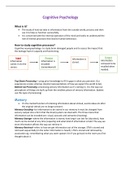
How do memory models help us understand dementia?
Multi-store Memory Model
o If the STM is affected then someone with dementia got told new information, but this
wasn’t encoded/stored and thus cannot be recalled. A way to help would be to ask
very specific questions to cue memories.
o Using pictures and colours can help in encoding memories and retrieving them . For
example they might respond better to a photo of a family member than their name.
writing things down for people with dementia can replace their impaired STM, such as
labelling keys and door or placing notes as reminders.
HELP TREAT PEOPLE SUFFERING FROM DEMENTIA?”
AO1 Content on dementia:
• Dementia- a general term for the impaired ability to remember, think or make
decisions in the everyday life.
• It is caused by damage to or loss of nerve cells and their connections in the brain.
• Alzheimer’s disease is the most common type of dementia and is more common in
women than men.
• Alzheimer’s Society indicates that there are about 900,000 people in the UK suffering
from dementia.
• The cost of dementia in the UK is currently £26 billion.
• There are dementia hubs where people can be referred to, if dementia is suspected.
How does Alzheimer’s progress?
• First the hippocampus and its connected structures are damaged, making it harder
for new memories to be formed.
• Someone in the earliest stages of dementia will still have an intact cortex so may be
able to remember past memories better than recent ones.
• The amygdala (regulates emotions) will be affected later, so a sufferer may respond
with an emotion aspect rather than factual content.
• The cortex overall becomes thinner (past memories are lost) and the brain gradually
shrinks.
• Damage to the left hemisphere is linked to problems with semantic memory.
• Damage to the visual system in the temporal lobe makes recognising faces and
object harder.
• Damage to the right parietal lobe means a person may have problems with judging
distances.
• Damage spreads to the frontal lobes, meaning that the sufferer can struggle with
decision making.
• Many abilities are retained such as learned skills (dancing or playing an instrument)
as these memories are stored deep within the brain.
How do memory models help us understand dementia?
Multi-store Memory Model
o If the STM is affected then someone with dementia got told new information, but this
wasn’t encoded/stored and thus cannot be recalled. A way to help would be to ask
very specific questions to cue memories.
o Using pictures and colours can help in encoding memories and retrieving them . For
example they might respond better to a photo of a family member than their name.
writing things down for people with dementia can replace their impaired STM, such as
labelling keys and door or placing notes as reminders.