Micro – organisms
Different types of Micro – organisms:
• Virus.
• Bacteria.
• Fungi.
• Protists.
What are micro – organisms?
➢ Organism which are too small to be seen What are they measured in?
with the human eye. - Micrometers {Чм}
➢ They are not all pathogenic. - Nanometers {nm}
➢ Some are harmful
➢ Some are used in industry.
Viruses:
- Not cells
- Non living
- Ubiquitous but inactive outside host cell.
- Use host cell to replicate.
- Pathogenic in plants and animals.
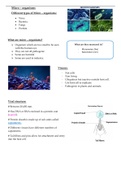
Viral structure:
# Between 20-450 mm.
# Has DNA or RNA enclosed in a protein coat
Capsid head DNA or RNA
{capsid}.
# Protein sheath is made up of sub-units called
capsomeres. Protein sheath Capsomeres
# Different viruses have different numbers of
capsomeres.
# Tail fibres and pins allow for attachment and entry
into the host cell.
Tail fibres
, Characteristics of viruses:
- They are ultramicroscopic.
- They are able to pass through ultra-filters other organisms
cannot.
- Active only within cell.
- Can only replicate within the host cell. {genetic parasites}
- Passes either DNE or RNA.
Two types of viral replication:
1. Lysogenic cycle
2. Lytic cycle {host cell dies}
Steps in viral replication:
1. Adsorption.
2. Penetration.
3. Replication.
4. Assembly.
5. Maturation.
6. Lysis.
Name and explain Viral replication steps:
1. Adsorption: Viruses attaches to wall of host cell.
2. Penetration: penetrates cell wall by means of its tail fibres and injects viral-
DNA into host cell.
3. Replication: Viral DNA replicates using host cell.
4. Assembly: Viral components begin to assemble.
5. Maturation: Viral components are assembled & viruses are fully developed.
6. Lysis: The numerous viruses are expelled from the host cell which is
destroyed.
Lysis: means to
“breakdown”
Different types of Micro – organisms:
• Virus.
• Bacteria.
• Fungi.
• Protists.
What are micro – organisms?
➢ Organism which are too small to be seen What are they measured in?
with the human eye. - Micrometers {Чм}
➢ They are not all pathogenic. - Nanometers {nm}
➢ Some are harmful
➢ Some are used in industry.
Viruses:
- Not cells
- Non living
- Ubiquitous but inactive outside host cell.
- Use host cell to replicate.
- Pathogenic in plants and animals.
Viral structure:
# Between 20-450 mm.
# Has DNA or RNA enclosed in a protein coat
Capsid head DNA or RNA
{capsid}.
# Protein sheath is made up of sub-units called
capsomeres. Protein sheath Capsomeres
# Different viruses have different numbers of
capsomeres.
# Tail fibres and pins allow for attachment and entry
into the host cell.
Tail fibres
, Characteristics of viruses:
- They are ultramicroscopic.
- They are able to pass through ultra-filters other organisms
cannot.
- Active only within cell.
- Can only replicate within the host cell. {genetic parasites}
- Passes either DNE or RNA.
Two types of viral replication:
1. Lysogenic cycle
2. Lytic cycle {host cell dies}
Steps in viral replication:
1. Adsorption.
2. Penetration.
3. Replication.
4. Assembly.
5. Maturation.
6. Lysis.
Name and explain Viral replication steps:
1. Adsorption: Viruses attaches to wall of host cell.
2. Penetration: penetrates cell wall by means of its tail fibres and injects viral-
DNA into host cell.
3. Replication: Viral DNA replicates using host cell.
4. Assembly: Viral components begin to assemble.
5. Maturation: Viral components are assembled & viruses are fully developed.
6. Lysis: The numerous viruses are expelled from the host cell which is
destroyed.
Lysis: means to
“breakdown”