Protista
- Are unicellular eukaryotes with no specialized structures.
- Usually, aquatic.
- Reproduce asexually and sexually.
- Mobile due to flagella; Cilla; pseudopodia.
- Autographic or heterotrophic.
- Animal like protist known as amoeba.
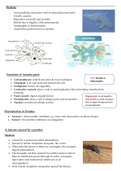
Functions of Amoeba parts-
*NB* Amoeba is
➢ Cell membrane: controls the entry & exit of substance.
heterotrophic.
➢ Ectoplasm: is in a gel state and protects the cell.
➢ Endoplasm: houses all organelles.
➢ Contractive vacuole: plays a role in osmoregulation, thus preventing Amoeba from
bursting.
➢ Food vacuole: digests engulfed food. Phagocytosis: A cell engulfs a
➢ Pseudopodia: plays a role in phagocytosis and locomotion. solid particle as food amoeba is
➢ Nucleus: controls all cellular activity. able to ingest foreign particles
via pseudopodia.
Reproduction in Protista:
• Asexual > unfavourable conditions e.g., heat, cold, desiccation via binary fission.
• Sexual > Favourable conditions via conjugation.
A disease caused by a protist-
Malaria:
➢ Caused by a protozoan called plasmodium.
➢ Spread by female Anopheles mosquito, the vector.
➢ When infected person is bitten by a mosquito, the mosquito
ingests plasmodium.
➢ The mosquito can then spread it to another person when it
bites an uninfected person through its saliva. {mosquito
inject saliva into human host which acts as an
anticoagulant.}
➢ Only female Anopheles mosquitoes spread the disease.
- Are unicellular eukaryotes with no specialized structures.
- Usually, aquatic.
- Reproduce asexually and sexually.
- Mobile due to flagella; Cilla; pseudopodia.
- Autographic or heterotrophic.
- Animal like protist known as amoeba.
Functions of Amoeba parts-
*NB* Amoeba is
➢ Cell membrane: controls the entry & exit of substance.
heterotrophic.
➢ Ectoplasm: is in a gel state and protects the cell.
➢ Endoplasm: houses all organelles.
➢ Contractive vacuole: plays a role in osmoregulation, thus preventing Amoeba from
bursting.
➢ Food vacuole: digests engulfed food. Phagocytosis: A cell engulfs a
➢ Pseudopodia: plays a role in phagocytosis and locomotion. solid particle as food amoeba is
➢ Nucleus: controls all cellular activity. able to ingest foreign particles
via pseudopodia.
Reproduction in Protista:
• Asexual > unfavourable conditions e.g., heat, cold, desiccation via binary fission.
• Sexual > Favourable conditions via conjugation.
A disease caused by a protist-
Malaria:
➢ Caused by a protozoan called plasmodium.
➢ Spread by female Anopheles mosquito, the vector.
➢ When infected person is bitten by a mosquito, the mosquito
ingests plasmodium.
➢ The mosquito can then spread it to another person when it
bites an uninfected person through its saliva. {mosquito
inject saliva into human host which acts as an
anticoagulant.}
➢ Only female Anopheles mosquitoes spread the disease.