PVL3701 EXAM PACK 2024
PVL3701 - Law Of Property PVL3701 EXAM PACK 2024 MCQ 1. Indicate the correct option. Which one of the following things can be regarded as a res nullius? (1) a domesticated tiger living in his owner‟s house (2) an impala roaming in the bushes (3) a Persian cat lying on the neighbor‟s patio (4) a springbok kept on a private game farm for hunting purposes ANSWER: Option 2 is correct. A res nullius is a thing which does not belong to anyone. All creatures that are wild by nature either in their natural state or when they have reverted to their former wild state are regarded as res nullius. Wild animals that have been tamed (option 1), domestic animals (option 3) or wild animals regulated by the Game Theft Act 105 of 1991 (option 4), are not res nullius. An impala roaming in the bushes is wild by nature and regarded as a res nullius. See Study Guide pg 92 2. Indicate the correct option. The following is an example of constructive delivery where a transferee is placed in position to exercises physical control over a thing: (1) delivery with the short hand (2) symbolic delivery (3) attornment (4) cession of ownership ANSWER: Option 2 is correct. Constructive delivery is when there is no physical or actual handing over of the thing. The transferee is either placed in a position to excercise physical control, already in physical control or someone else exercises physical control on his/her behalf. Examples of a transferee placed in a position to excercise physical control over the thing are symbolic delivery, delivery with the long hand (traditio longa manu) and bills of lading. See Study Guide pg 132-134 3. Indicate the correct option. The aim of the actio negatoria is: (1) to determine the rights and duties of contesting parties. (2) to claim the stolen thing or its highest value since the theft. (3) to claim the market value of the thing that was destroyed or alienated with mala fide intention. (4) to protect ownership where a servitude holder exceeds the limits of her servitude. ANSWER: Option 4 is correct. The actio negatoria is a property law remedy. It is a real action aimed at protection of ownership in circumstances where third persons seek to exercise rights of a servitude holder which they do not have or where servitude holders exceed the limits of their servitude. The Downloaded by Ipeleng Selepe () lOMoARcPSD| WE PROVIDE SOLUTIONS TO ALL UNISA QUALIFICATIONS owner can institute this action against the violator and have to prove that he/she is the owner and that there is a physical infringement of his/her entitlements of ownership. See Study Guide pg 163 and 169 4. Indicate the correct option. X and Y are co-owners of a farm. They built a road on the farm, which they use to transport lime to the market. Without X's knowledge and approval Y gives permission to a neighbour, Z, to use the road so that he can transport his lime to the market. X is unhappy about the heavy traffic on the road and asks Y to revoke her permission to Z. X also asks Z to discontinue his activities. Neither Y nor Z takes any notice of X. Which remedy does X have against Y? (1) X can claim damages from Y. (2) X can institute the condictio furtiva against Y. (3) X can approach the court for a declaratory order. (4) X can institute the rei vindicatio against Y. Answer: option 1 5. Indicate the correct option. S, X and Y‟ son, leases a portion of their farm. When his father's farm implements are stolen, he gives some of his (rented) equipment to his father, X, to use. Father and son have an argument. In his anger X destroys his son's rented equipment. Which remedy is available to S? (1) spoliation remedy (2) condicio furtiva (3) enrichment action (4) possessory action ANSWER: Option 4 is correct. S is in control of the rented equipment. When a person who is in control of a thing, loses control of the thing, he/she can restore his/her control with the spoliation remedy. In this example the equipment is destroyed and S will not be able to claim restoration of his control with the spoliation remedy. S will however be able to claim damages resulting from the loss of control from X with the possessory action. S can therefore claim the value of the equipment from X, who has a weaker right to control it than what S has. See Study Guide pg 212-213 6. Indicate the incorrect option. A land servitude must comply with the following requirements before it will be recognised as a limited real right to the land of another: (1) The servitude must have a degree of permanency. (2) The servitude must enhance the use and benefit of the dominant tenement. (3) The servitude must impose a duty on the owner of the servient tenement to perform a positive act. (4) The tenements must be situated, in relation to each other, in such a way that the effective exercise of the servitude to the benefit of the dominant tenement is possible. ANSWER: Option 3 is incorrect. The maxim servitus in faciendo consistere non potest applies to all servitutes. According to this maxim a servitude (personal or land) cannot impose a duty on the owner of the lOMoARcPSD| WE PROVIDE SOLUTIONS TO ALL UNISA QUALIFICATIONS Tutorials, Assignment Packs, Revisions, Exam Packs servient tenement to perform a positive act. Land servitutes must have a degree of permanency (perpetua causa) and enhance the use and benefit of the dominant tenement (utilitas). Furthermore the tenements must be situated, in relation to each other, in such a way that the effective exercise of the servitude to the benefit of the dominant tenement is possible (proximity). See Study Guide pg 237-238 7. Indicate the correct option. X lends R5 000 to Y and X secures payment of the loan by registering a notarial bond over Y‟s car. Y owes Z R8 000 as a result of a collision that occurred between Y and Z. Y becomes insolvent before repaying X and before paying Z. In this scenario, who has a preferent claim against Y‟s insolvent estate? (1) X, because he has a limited real right over Y‟s car. (2) X, because the smaller amount must be paid first. (3) Z, because he has a personal right against Y‟s insolvent estate. (4) Z, because the larger amount must be paid first. ANSWER: Option 1 is correct. X has a notarial bond over Y‟s car. A notarial bond is a form of a conventional or express mortgage. The notarial bond in this case is a special notarial bond as it is registered over a specified movable thing. In terms of section 1 of the Security by Means of Movable Property Act 57 of 1993 the specified movable thing under a special notarial bond are deemed to have been pledged and delivered. The Act creates a fictitious (non-possessory) pledge. The Act therefore creates a real security right in the form of a pledge and X (the notarial bond holder) is consequently a secured creditor. Z only has a personal right (creditor„s right) against Y‟s insolvent estate. He is an unsecured creditor. Therefore X‟s secured claim (real security right) will enjoy preference over Y‟s unsecured claim. See Study Guide pg 269-272 8. Indicate the correct option. In Mapenduka v Ashington 1919 AD 33 the court held that: (1) the clause in the pledge agreement stipulating that the pledgee may keep the calve of the cow as interest on the amount owing by the pledgor is invalid. (2) the clause in the pledge agreement stipulating that the pledgee may sell the 6 oxen, 1 cow and 1 horse (the pledged animals) without a court order is invalid. (3) the clause in the pledge agreement stipulating that the pledgee may keep the 6 oxen, 1 cow and 1 horse if the pledgor fails to pay his debt is invalid. (4) the clause in the pledge agreement stipulating that the pledgor may not pay his debt is invalid. ANSWER: Option 3 is correct. The parties in Mapenduka v Ashington (1919 AD 33) agreed in writing that the pledgee may keep the 6 oxen, 1 cow and 1 horse (the pledged animals) if the pledgor fails to pay his debt. The court held that this clause was invalid. See Study Guide pg 264 -265 and Mapenduka v Ashington 1919 AD 33 lOMoARcPSD| WE PROVIDE SOLUTIONS TO ALL UNISA QUALIFICATIONS Tutorials, Assignment Packs, Revisions, Exam Packs Cell: / Fax: Email: GOD BLESS US 9. Indicate the incorrect option. A mortgage is terminated: (1) by destruction of the mortgaged thing. (2) by extinction of the principal debt. (3) by the death of the mortgagor or mortgagee. (4) when a mortgagee becomes owner of the mortgaged thing. ANSWER: Option 3 is incorrect. The death of the mortgagor or mortgagee does not terminate a mortgage. In the case of the death of the mortgagor the mortgagee will have a claim against the mortgagor‟s deceased estate. In the case of the death of the mortgagee his/her deceased estate will have a claim against the mortgagor. In both instances the principal debt needs to be paid in order for the mortgage to be terminated. See Study Guide pg 278 10. Indicate the incorrect option. In First National Bank of SA Ltd t/a Wesbank v Commissioner, South African Revenue Service: First National Bank of SA Ltd t/a Wesbank v Minister of Finance (2002 (4) SA 768 (CC)) the court held: (1) that the purpose of section 25 had to be seen both as protecting existing property rights as well as serving the public interest, mainly in the sphere of land reform. (2) that section 25 embodied the positive protection of property and expressly guaranteed the right to acquire, hold and dispose of property. (3) with reference to Van der Walt, that the meaning of section 25 should be determined in each specific case. (4) that FNB was entitled to the property rights under section 25 of the 1996 Constitution. ANSWER: Option 2 is incorrect. In par 48 of this decision the court states that section 25 embodies a negative protection of property. Section 25 does not guarantee the right to acquire, hold or dispose of property. See Study Guide pg 315-317 and First National Bank of SA Ltd t/a Wesbank v Commissioner, South African Revenue Service: First National Bank of SA Ltd t/a Wesbank v Minister of Finance 2002 (4) SA 768 (CC) par 48 QUESTION 11 Which one of the following things is a composite thing? (1) a dog (2) a motor (3) a glass (4) a brick ANSWER: (2) COMMENTS: (1) A dog is a singular thing. (2) A motor is a composite thing and is made up of constituent parts which lost their individuality. (3) A glass is a singular thing. (4) A brick is a singular thing. (Study Guide page 36) Downloaded by Ipeleng Selepe () lOMoARcPSD| WE PROVIDE SOLUTIONS TO ALL UNISA QUALIFICATIONS Tutorials, Assignment Packs, Revisions, Exam Packs QUESTION 12 Which option is not a feature or characteristic of real rights? (1) The rule prior in tempore potior in iure applies to real rights. (2) Real rights grant preference in the case of insolvency. (3) Real rights are unenforceable against bona fide third parties. (4) The object of a real right is a thing. ANSWER: (3) COMMENTS: (1) In the case of insolvency the maxim first in time stronger in law (prior in tempore potior in iure) will apply in the case of two or more competing real rights. (2) In the case of insolvency a real right enjoys preference over other rights. Real rights are absolute in principle and the real right holder can enforce his/her right against bona fide third parties. (4) The object of a real right is a corporeal thing (leaving aside the exception of a pledge of claims). (Study Guide pages 44-45) QUESTION 13 Which option does not reflect a recognised subdivision of neighbour law? (1) lateral support (2) planting of trees (3) interference with the natural flow of water (4) nuisance ANSWER: (2) COMMENTS: The recognised subdivisions of neighbour law are: nuisance; lateral and surface support; encroachments; surface water; party walls and fences and elimination of danger. (1) Lateral support is a recognised subdivision of neighbour law. (2) Planting of trees is not a recognised subdivision of neighbour law, it is a subdivision of encroachments. (3) Interference with the natural flow of water is a recognised subdivision of neighbour law. (4) Nuisance is a recognised subdivision of neighbour law. (Study Guide pages 57-59) QUESTION 14 Which option is the odd one out? (1) a carp swimming around in the Roodeplaat dam (2) a kudu grazing on Q and R‟s game farm which is fenced by means of a 3-metre high game proof fence and with the mark QR on them (3) a wounded impala which has been shot on X‟s unfenced farm and which is being pursued by hunter Z (4) a Congolese wood parrot which lived for two years in an open cage in the lounge of Z‟s Waterkloof home, but flew away and now lives in the trees at Magnolia Dell ANSWER: (2) COMMENTS: lOMoARcPSD| WE PROVIDE SOLUTIONS TO ALL UNISA QUALIFICATIONS Tutorials, Assignment Packs, Revisions, Exam Packs (1) A carp swimming around in the Roodeplaat dam is a thing that is susceptible to ownership, but that belongs to no-one at this particular stage and can therefore be categorized as a res nullius. (2) A kudu grazing on Q and R‟s game farm which is fenced by means of a 3-metre high game proof fence and with the mark QR on him belongs to Q and R and forms part of Q and R‟s estate and can therefore be classified as a res alicuius. (3) A wounded impala which has been shot on X‟s unfenced farm and which is being pursued by hunter Z is a res nullius. If Z catches it he can obtain ownership through appropriation if all the requirements are met. (4) A Congolese wood parrot which lived for two years in an open cage in the lounge of Z‟s Waterkloof home, but flew away and now lives in the trees at Magnolia Dell reverted to his former wild state, after having been controlled by a person, and is regarded as a res nullius. (Study Guide pages 36 and 70) QUESTION 15 Indicate when natural interruption of prescription will occur: (1) when a person is absent from the country because of war (2) when a fiduciarius has alienated fideicommissary goods without the power to alienate it (3) when summons, claiming ownership of the thing, is served (4) when the acquirer lost possession of the thing, by relinquishing it voluntarily or when the thing was forcibly taken from him/her. ANSWER: No correct answer. Please note that all students will get a mark for this question irrespective of their answer. COMMENTS: (1) Prescription will be suspended when a person is absent from the country because of war. (2) Prescription will be suspended when a fiduciarius has alienated fideicommissary goods without the power to alienate it. (3) Prescription will not be interrupted when summons, claiming ownership of the thing, is served. Interruption only occurs if the person who claims ownership succeeds in carrying his/her claim to the final judgment. (4) Prescription will not be interrupted when the acquirer lost possession of the thing, by relinquishing it voluntarily or when the thing was forcibly taken from him/her. Prescription can only be interrupted through voluntary loss of possession. (Study Guide pages 85-86) QUESTION 16 Which option is not a requirement or characteristic of treasure trove as an original mode of acquisition of ownership? (1) The treasure must be a valuable movable or immovable thing. (2) The finder must exercise some kind of physical control over the treasure. (3) The original owner of the treasure cannot be found. (4) A valuable thing lying openly on the ground can never qualify as a treasure for purposes of treasure trove. ANSWER: (1) COMMENTS: (1) The treasure must be a valuable movable thing. The treasure cannot be an immovable lOMoARcPSD| WE PROVIDE SOLUTIONS TO ALL UNISA QUALIFICATIONS Tutorials, Assignment Packs, Revisions, Exam Packs thing. (2) The finder must exercise some kind of physical control over the treasure. (3) The original owner of the treasure cannot be found. (4) A valuable thing lying openly on the ground can never qualify as a treasure for purposes of treasure trove. QUESTION 17 Indicate the false option in respect of the requirements for attornment: (1) A tripartite agreement must exist between all three parties concerned. (2) The third party (holder) must be in control of the thing when the tripartite agreement is concluded. (3) The third party (holder) can consent in advance to a future transfer of ownership. (4) In Caledon en SWD Eksekuteurskamer Bpk v Wentzel (1972 1 SA 270 (A)) the court held that all the requirements for attornment were complied with. ANSWER: Both 3 and 4 are incorrect. Please note that all students will get a mark for this question irrespective of their answer. COMMENTS: (1) One of the requirements for attornment to take place is that there must be a tripartite agreement between the transferor, the transferee and the third party holder in terms of which the holder will continue to hold for the transferee and no longer for the transferor. (2) Another requirement for attornment to take place is that the third party (holder) should exercise physical control at the moment of transfer from the transferor to the transferee. (3) In Caledon en SWD Eksekuteurskamer Bpk v Wentzel (1972 1 SA 270 (A)) the court held that the third party (holder) can consent in advance to a future transfer of ownership. In this case a new form of delivery was recognized. (4) In Caledon en SWD Eksekuteurskamer Bpk v Wentzel (1972 1 SA 270 (A)) a new form of delivery was acknowledged. (Study Guide pages 107-108) QUESTION 18 Give an example of delivery with the long hand: (1) A flock of sheep pointed out in the presence of the transferee. (2) The delivery of the keys to a motor. (3) X bought a watch from a jeweller and leaves it with the jeweller for cleaning. (4) X hires a motor from Y and then purchases it from Y. ANSWER: (1) QUESTION 19 Which option is the odd one out? (1) In order to succeed with the Aquilian action a causal connection between the patrimonial loss and the conduct of the defendant a just balance between the public interest and the interests of those affected has to be proved. (2) The Aquilian action can be instituted against anyone who causes damage due to an intentional or negligent act. (3) Damages can be claimed with the Aquilian action. (4) The Aquilian action is available to the owner of the damaged thing only. lOMoARcPSD| WE PROVIDE SOLUTIONS TO ALL UNISA QUALIFICATIONS Tutorials, Assignment Packs, Revisions, Exam Packs ANSWER: Both 2 and 4 are incorrect. Please note that all students will get a mark for this question irrespective of their answer. COMMENTS: (1) In order to succeed with the Aquilian action a causal connection between the patrimonial loss and the conduct of the defendant has to be proved. (2) The Aquilian action can be instituted against anyone who causes damage due to an unlawful intentional or negligent act, thus culpability of the defendant. (3) Damages can be claimed with the Aquilian action. (4) The Aquilian action is available to anyone who has a proprietal right or interest in the damaged thing, thus not only owners. (Study Guide page 124) QUESTION 20 A purchaser who is not the owner of a thing, but who has the intention of an owner on the incorrect assumption that he/she is the owner is a: (1) bona fide possessor (2) mala fide unlawful holder (3) mala fide possessor (4) bona fide unlafwul holder ANSWER: (1) QUESTION 21 Which one of the following things is a composite thing? (1) a dog (2) a motor (3) a glass (4) a brick ANSWER: (2) COMMENTS: (1) A dog is a singular thing. (2) A motor is a composite thing and is made up of constituent parts which lost their individuality. (3) A glass is a singular thing. (4) A brick is a singular thing. (Study Guide page 36) QUESTION 22 Which option is not a feature or characteristic of real rights? (1) The rule prior in tempore potior in iure applies to real rights. (2) Real rights grant preference in the case of insolvency. (3) Real rights are unenforceable against bona fide third parties. (4) The object of a real right is a thing. ANSWER: (3) lOMoARcPSD| WE PROVIDE SOLUTIONS TO ALL UNISA QUALIFICATIONS Tutorials, Assignment Packs, Revisions, Exam Packs Cell: / Fax: Email: GOD BLESS US QUESTION 23 Which option does not reflect a recognised subdivision of neighbour law? (1) lateral support (2) planting of trees (3) interference with the natural flow of water (4) nuisance ANSWER: (2) The recognised subdivisions of neighbour law are: nuisance; lateral and surface support; encroachments; surface water; party walls and fences and elimination of danger. (1) Lateral support is a recognised subdivision of neighbour law. (2) Planting of trees is not a recognised subdivision of neighbour law, it is a subdivision of encroachments. (3) Interference with the natural flow of water is a recognised subdivision of neighbour law. (4) Nuisance is a recognised subdivision of neighbour law. (Study Guide pages 57-59) QUESTION 24 Which option is the odd one out? (1) a carp swimming around in the Roodeplaat dam (2) a kudu grazing on Q and R‟s game farm which is fenced by means of a 3-metre high game proof fence and with the mark QR on them (3) a wounded impala which has been shot on X‟s unfenced farm and which is being pursued by hunter Z (4) a Congolese wood parrot which lived for two years in an open cage in the lounge of Z‟s Waterkloof home, but flew away and now lives in the trees at Magnolia Dell ANSWER: (2) COMMENTS: (1) A carp swimming around in the Roodeplaat dam is a thing that is susceptible to ownership, but that belongs to no-one at this particular stage and can therefore be categorized as a res nullius. (2) A kudu grazing on Q and R‟s game farm which is fenced by means of a 3-metre high game proof fence and with the mark QR on him belongs to Q and R and forms part of Q and R‟s estate and can therefore be classified as a res alicuius. (3) A wounded impala which has been shot on X‟s unfenced farm and which is being pursued by hunter Z is a res nullius. If Z catches it he can obtain ownership through appropriation if all the requirements are met. (4) A Congolese wood parrot which lived for two years in an open cage in the lounge of Z‟s Waterkloof home, but flew away and now lives in the trees at Magnolia Dell reverted to his former wild state, after having been controlled by a person, and is regarded as a res nullius. (Study Guide pages 36 and 70) QUESTION 25 Indicate when natural interruption of prescription will occur: (1) when a person is absent from the country because of war (2) when a fiduciarius has alienated fideicommissary goods without the power to alienate it (3) when summons, claiming ownership of the thing, is served (4) when the acquirer lost possession of the thing, by relinquishing it voluntarily or when Downloaded by Ipeleng Selepe () lOMoARcPSD| WE PROVIDE SOLUTIONS TO ALL UNISA QUALIFICATIONS Tutorials, Assignment Packs, Revisions, Exam Packs Cell: / Fax: Email: GOD BLESS US the thing was forcibly taken from him/her. ANSWER: No correct answer. Please note that all students will get a mark for this question irrespective of their answer. COMMENTS: (1) Prescription will be suspended when a person is absent from the country because of war. (2) Prescription will be suspended when a fiduciarius has alienated fideicommissary goods without the power to alienate it. (3) Prescription will not be interrupted when summons, claiming ownership of the thing, is served. Interruption only occurs if the person who claims ownership succeeds in carrying his/her claim to the final judgment. (4) Prescription will not be interrupted when the acquirer lost possession of the thing, by relinquishing it voluntarily or when the thing was forcibly taken from him/her. Prescription can only be interrupted through voluntary loss of possession. (Study Guide pages 85-86) QUESTION 26 Which option is not a requirement or characteristic of treasure trove as an original mode of acquisition of ownership? (1) The treasure must be a valuable movable or immovable thing. (2) The finder must exercise some kind of physical control over the treasure. (3) The original owner of the treasure cannot be found. (4) A valuable thing lying openly on the ground can never qualify as a treasure for purposes of treasure trove. ANSWER: (1) COMMENTS: (1) The treasure must be a valuable movable thing. The treasure cannot be an immovable thing. (2) The finder must exercise some kind of physical control over the treasure. (3) The original owner of the treasure cannot be found. (4) A valuable thing lying openly on the ground can never qualify as a treasure for purposes of treasure trove. (Study Guide page 81) QUESTION 27 Indicate the false option in respect of the requirements for attornment: (1) A tripartite agreement must exist between all three parties concerned. (2) The third party (holder) must be in control of the thing when the tripartite agreement is concluded. (3) The third party (holder) can consent in advance to a future transfer of ownership. (4) In Caledon en SWD Eksekuteurskamer Bpk v Wentzel (1972 1 SA 270 (A)) the court held that all the requirements for attornment were complied with. ANSWER: Both 3 and 4 are incorrect. Please note that all students will get a mark for this question irrespective of their answer. COMMENTS: (1) One of the requirements for attornment to take place is that there must be a tripartite Downloaded by Ipeleng Selepe () lOMoARcPSD| WE PROVIDE SOLUTIONS TO ALL UNISA QUALIFICATIONS Tutorials, Assignment Packs, Revisions, Exam Packs Cell: / Fax: Email: GOD BLESS US agreement between the transferor, the transferee and the third party holder in terms of which the holder will continue to hold for the transferee and no longer for the transferor. (2) Another requirement for attornment to take place is that the third party (holder) should exercise physical control at the moment of transfer from the transferor to the transferee. (3) In Caledon en SWD Eksekuteurskamer Bpk v Wentzel (1972 1 SA 270 (A)) the court held that the third party (holder) can consent in advance to a future transfer of ownership. In this case a new form of delivery was recognized. (4) In Caledon en SWD Eksekuteurskamer Bpk v Wentzel (1972 1 SA 270 (A)) a new form of delivery was acknowledged. (Study Guide pages 107-108) QUESTION 28 Give an example of delivery with the long hand: (1) A flock of sheep pointed out in the presence of the transferee. (2) The delivery of the keys to a motor. (3) X bought a watch from a jeweller and leaves it with the jeweller for cleaning. (4) X hires a motor from Y and then purchases it from Y. ANSWER: (1) COMMENTS: (1) A flock of sheep pointed out in the presence of the transferee is an example of delivery with the long hand (traditio longa manu). (2) The delivery of the keys to a motor is an example of symbolic delivery. (3) An example of constitutum possessorium would be when X buys a watch from a jeweller and leaves it with the jeweller for cleaning. (4) An example of delivery with the short hand (traditio brevi manu) would be when X hires a motor from Y and then purchases it from Y. (Study Guide pages 105-106) QUESTION 29 Which option is the odd one out? (1) In order to succeed with the Aquilian action a causal connection between the patrimonial loss and the conduct of the defendant a just balance between the public interest and the interests of those affected has to be proved. (2) The Aquilian action can be instituted against anyone who causes damage due to an intentional or negligent act. (3) Damages can be claimed with the Aquilian action. (4) The Aquilian action is available to the owner of the damaged thing only. ANSWER: Both 2 and 4 are incorrect. Please note that all students will get a mark for this question irrespective of their answer. COMMENTS: (1) In order to succeed with the Aquilian action a causal connection between the patrimonial loss and the conduct of the defendant has to be proved. (2) The Aquilian action can be instituted against anyone who causes damage due to an unlawful intentional or negligent act, thus culpability of the defendant. (3) Damages can be claimed with the Aquilian action. (4) The Aquilian action is available to anyone who has a proprietal right or interest in the Downloaded by Ipeleng Selepe () lOMoARcPSD| WE PROVIDE SOLUTIONS TO ALL UNISA QUALIFICATIONS Tutorials, Assignment Packs, Revisions, Exam Packs Cell: / Fax: Email: GOD BLESS US damaged thing, thus not only owners. (Study Guide page 124) QUESTION 30 A purchaser who is not the owner of a thing, but who has the intention of an owner on the incorrect assumption that he/she is the owner is a: (1) bona fide possessor (2) mala fide unlawful holder (3) mala fide possessor (4) bona fide unlafwul holder ANSWER: (1) COMMENTS: (1) A person who is not the owner of a thing because he/she does not comply with the requirements for vesting of ownership, but who has the intention of an owner on the incorrect assumption that he/she is the owner is a bona fide possessor. (2) A person who knows that he/she does not have the owner‟s consent for controlling the thing, but still exercises physical control over it for the sake of the benefit he/she can derive from it is a mala fide unlawful holder. (3) A person who is aware of the fact that he/she is not legally recognised as the owner of a thing since he/she does not conform to the requirements of ownership, but whom nevertheless has the intention of an owner is mala fide possessor. (4) A person who physically controls the thing unlawfully, but he/she is unaware of the fact, since he/she is under the incorrect impression that he/she has the necessary permission or legal ground to control it is a bona fide unlawful holder (Study Guide pages 144-145) 31. Indicate the correct option. Which one of the following things can be regarded as a res nullius? (1) a domesticated tiger living in his owner‟s house (2) an impala roaming in the bushes (3) a Persian cat lying on the neighbor‟s patio (4) a springbok kept on a private game farm for hunting purposes ANSWER: Option 2 is correct. A res nullius is a thing which does not belong to anyone. All creatures that are wild by nature either in their natural state or when they have reverted to their former wild state are regarded as res nullius. Wild animals that have been tamed (option 1), domestic animals (option 3) or wild animals regulated by the Game Theft Act 105 of 1991 (option 4), are not res nullius. An impala roaming in the bushes is wild by nature and regarded as a res nullius. See Study Guide pg 92 32. Indicate the correct option. The following is an example of constructive delivery where a transferee is placed in a position to exercises physical control over a thing: (1) delivery with the short hand (2) symbolic delivery (3) attornment Downloaded by Ipeleng Selepe () lOMoARcPSD| WE PROVIDE SOLUTIONS TO ALL UNISA QUALIFICATIONS Tutorials, Assignment Packs, Revisions, Exam Packs Cell: / Fax: Email: GOD BLESS US (4) cession of ownership ANSWER: Option 2 is correct. Constructive delivery is when there is no physical or actual handing over of the thing. The transferee is either placed in a position to excercise physical control, already in physical control or someone else exercises physical control on his/her behalf. Examples of a transferee placed in a position to excercise physical control over the thing are symbolic delivery, delivery with the long hand (traditio longa manu) and bills of lading. See Study Guide pg 132-134 33. Indicate the correct option. The aim of the actio negatoria is: (1) to determine the rights and duties of contesting parties. (2) to claim the stolen thing or its highest value since the theft. (3) to claim the market value of the thing that was destroyed or alienated with mala fide intention. (4) to protect ownership where a servitude holder exceeds the limits of her servitude. ANSWER: Option 4 is correct. The actio negatoria is a property law remedy. It is a real action aimed at protection of ownership in circumstances where third persons seek to exercise rights of a servitude holder which they do not have or where servitude holders exceed the limits of their servitude. The owner can institute this action against the violator and have to prove that he/she is the owner and that there is a physical infringement of his/her entitlements of ownership. See Study Guide pg 163 and 169 34. Indicate the correct option. X and Y are co-owners of a farm. They built a road on the farm, which they use to transport lime to the market. Without X's knowledge and approval Y gives permission to a neighbour, Z, to use the road so that he can transport his lime to the market. X is unhappy about the heavy traffic on the road and asks Y to revoke her permission to Z. X also asks Z to discontinue his activities. Neither Y nor Z takes any notice of X. Which remedy does X have against Y? (1) X can claim damages from Y. (2) X can institute the condictio furtiva against Y. (3) X can approach the court for a declaratory order. (4) X can institute the rei vindicatio against Y. ANSWER: Option 1 is correct. When a co-owner uses the thing unreasonably by using it for a purpose for which it was not intended or to an extent which is not in accordance with his/her share, the other co-owner can claim damages from him/her. In this example Y used the road over the farm unreasonably by giving Z permission to use the road against X‟s wishes. X will have to proof the following to succeed with a delictual claim for damages (actio legis Aquiliae): unlawful conduct by Y; culpability (intent / negligence) on Y‟s part; he (X) has a proprietary right / interest in the thing; he (X) has suffered patrimonial loss and that there is a causal connection between his patrimonial loss and Y‟s conduct. Downloaded by Ipeleng Selepe () lOMoARcPSD| WE PROVIDE SOLUTIONS TO ALL UNISA QUALIFICATIONS Tutorials, Assignment Packs, Revisions, Exam Packs Cell: / Fax: Email: GOD BLESS US 35. Indicate the correct option. S, X and Y‟ son, leases a portion of their farm. When his father's farm implements are stolen, he gives some of his (rented) equipment to his father, X, to use. Father and son have an argument. In his anger X destroys his son's rented equipment. Which remedy is available to S? (1) spoliation remedy (2) condicio furtiva (3) enrichment action (4) possessory action ANSWER: Option 4 is correct. S is in control of the rented equipment. When a person who is in control of a thing, loses control of the thing, he/she can restore his/her control with the spoliation remedy. In this example the equipment is destroyed and S will not be able to claim restoration of his control with the spoliation remedy. S will however be able to claim damages resulting from the loss of control from X with the possessory action. S can therefore claim the value of the equipment from X, who has a weaker right to control it than what S has. See Study Guide pg 212-213 36. Indicate the incorrect option. A land servitude must comply with the following requirements before it will be recognised as a limited real right to the land of another: (1) The servitude must have a degree of permanency. (2) The servitude must enhance the use and benefit of the dominant tenement. (3) The servitude must impose a duty on the owner of the servient tenement to perform a positive act. (4) The tenements must be situated, in relation to each other, in such a way that the effective exercise of the servitude to the benefit of the dominant tenement is possible. ANSWER: Option 3 is incorrect. The maxim servitus in faciendo consistere non potest applies to all servitutes. According to this maxim a servitude (personal or land) cannot impose a duty on the owner of the servient tenement to perform a positive act. Land servitutes must have a degree of permanency (perpetua causa) and enhance the use and benefit of the dominant tenement (utilitas). Furthermore the tenements must be situated, in relation to each other, in such a way that the effective exercise of the servitude to the benefit of the dominant tenement is possible (proximity). 37. Indicate the correct option. X lends R5 000 to Y and X secures payment of the loan by registering a notarial bond over Y‟s car. Y owes Z R8 000 as a result of a collision that occurred between Y and Z. Y becomes insolvent before repaying X and before paying Z. In this scenario, who has a preferent claim against Y‟s insolvent estate? (1) X, because he has a limited real right over Y‟s car. (2) X, because the smaller amount must be paid first. (3) Z, because he has a personal right against Y‟s insolvent estate. (4) Z, because the larger amount must be paid first. ANSWER: Downloaded by Ipeleng Selepe () lOMoARcPSD| WE PROVIDE SOLUTIONS TO ALL UNISA QUALIFICATIONS Tutorials, Assignment Packs, Revisions, Exam Packs Cell: / Fax: Email: GOD BLESS US Option 1 is correct. X has a notarial bond over Y‟s car. A notarial bond is a form of a conventional or express mortgage. The notarial bond in this case is a special notarial bond as it is registered over a specified movable thing. In terms of section 1 of the Security by Means of Movable Property Act 57 of 1993 the specified movable thing under a special notarial bond are deemed to have been pledged and delivered. The Act creates a fictitious (non-possessory) pledge. The Act therefore creates a real security right in the form of a pledge and X (the notarial bond holder) is consequently a secured creditor. Z only has a personal right (creditor„s right) against Y‟s insolvent estate. He is an unsecured creditor. Therefore X‟s secured claim (real security right) will enjoy preference over Y‟s unsecured claim. 38. Indicate the correct option. In Mapenduka v Ashington 1919 AD 33 the court held that: (1) the clause in the pledge agreement stipulating that the pledgee may keep the calve of the cow as interest on the amount owing by the pledgor is invalid. (2) the clause in the pledge agreement stipulating that the pledgee may sell the 6 oxen, 1 cow and 1 horse (the pledged animals) without a court order is invalid. (3) the clause in the pledge agreement stipulating that the pledgee may keep the 6 oxen, 1 cow and 1 horse if the pledgor fails to pay his debt is invalid. (4) the clause in the pledge agreement stipulating that the pledgor may not pay his debt is invalid. ANSWER: Option 3 is correct. The parties in Mapenduka v Ashington (1919 AD 33) agreed in writing that the pledgee may keep the 6 oxen, 1 cow and 1 horse (the pledged animals) if the pledgor fails to pay his debt. The court held that this clause was invalid. See Study Guide pg 264 -265 and Mapenduka v Ashington 1919 AD 33 39. Indicate the incorrect option. A mortgage is terminated: (1) by destruction of the mortgaged thing. (2) by extinction of the principal debt. (3) by the death of the mortgagor or mortgagee. (4) when a mortgagee becomes owner of the mortgaged thing. ANSWER: Option 3 is incorrect. The death of the mortgagor or mortgagee does not terminate a mortgage. In the case of the death of the mortgagor the mortgagee will have a claim against the mortgagor‟s deceased estate. In the case of the death of the mortgagee his/her deceased estate will have a claim against the mortgagor. In both instances the principal debt needs to be paid in order for the mortgage to be terminated. See Study Guide pg 278 40. Indicate the incorrect option. In First National Bank of SA Ltd t/a Wesbank v Commissioner, South African Revenue Service: First National Bank of SA Ltd t/a Wesbank v Minister of Finance (2002 (4) SA 768 (CC)) the court held: (1) that the purpose of section 25 had to be seen both as protecting existing property rights as well as serving the public interest, mainly in the sphere of land reform. Downloaded by Ipeleng Selepe () lOMoARcPSD| WE PROVIDE SOLUTIONS TO ALL UNISA QUALIFICATIONS Tutorials, Assignment Packs, Revisions, Exam Packs Cell: / Fax: Email: GOD BLESS US (2) that section 25 embodied the positive protection of property and expressly guaranteed the right to acquire, hold and dispose of property. (3) with reference to Van der Walt, that the meaning of section 25 should be determined in each specific case. (4) that FNB was entitled to the property rights under section 25 of the 1996 Constitution. ANSWER: Option 2 is incorrect. In par 48 of this decision the court states that section 25 embodies a negative protection of property. Section 25 does not guarantee the right to acquire, hold or dispose of property. See Study Guide pg 315-317 and First National Bank of SA Ltd t/a Wesbank v Commissioner, South African Revenue Service: First National Bank of SA Ltd t/a Wesbank v Minister of Finance 2002 (4) SA 768 (CC) par 4 QUESTION 41 Indicate the correct option In Ex Parte Geldenhuys (1926 OPD 155) the court formulated a test to determine the distinction between (1) ownership and personal rights (2) personal rights and real rights (3) real rights and limited real rights (4) personal servitudes and personal rights QUESTION 42 Indicate the correct option In Papalardo v Hau (2010 (2) SA 451 (SCA)) the court held that the owner of the (1) lower erf must allow all water flowing from the higher erf on to his erf (2) lower erf must divert the water from the higher erf to the street (3) lower erf must allow the natural flow of water from the higher erf on to his erf (4) higher erf has an ex lege servitude over the lower erf in terms of which the owner of the lower erf must allow all water to flow on to his/her erf QUESTION 43 Indicate the incorrect option In MacDonald Ltd v Radin & The Potchefstroom Dames & Industries Co, Ltd (1915 AD 454) it was decided with reference to the different criteria which are relevant when a court has to determine whether a movable became permanently attached to land that (1) the intention of the owner of the movable thing that is attached to the land is an important consideration, (2) if substantial injury will be caused to either the land or the attached thing if the attached thing were to be removed no uncertainty would exist as to the question whether it was the intention that permanent annexation should take place, (3) the consideration of intention was even more important than the consideration of the nature of the movable thing and the degree and manner of its annexation, or (4) the consideration of the intention with which the movable thing was attached to land was irrelevant in English law Downloaded by Ipeleng Selepe () lOMoARcPSD| WE PROVIDE SOLUTIONS TO ALL UNISA QUALIFICATIONS Tutorials, Assignment Packs, Revisions, Exam Packs Cell: / Fax: Email: GOD BLESS US QUESTION 44 Which one of the following statements based on the decision of Vasco Dry Cleaners v Twycross (1979 (1) SA 603 (A)) is incorrect? (1) In the case of constitutum possessonum a transferor retains physical control of the thing to be transferred (2) Constitutum possessonum does constitute delivery for purposes of creating a valid pledge (3) Constitutum possessonum creates the possibility of fraud (4) The real object underlying the transaction between Air Capricorn and Twycross was not a sale agreement but a pledge agreement QUESTION 45 In which court decision was the law relating to attornment altered and a method of transfer analogous to attornment recognised? (1) Regal v African Superslate (1963 (1) SA 102 (A)) (2) Air-Kel (Edms) Bpk h/a Merkel Motors v Bodenstein (1980 (3) SA 917 (A)) (3) Konstanz Properties (Pty) Ltd v Wm Spilhaus en Kie (Wp) Bpk (1996 (3) SA 273 (A)) (4) Caledon en Surd-Westelike Distrikte Eksekuteurskamer Bpk v Wentzel (1972 (1) SA 270 (A)) QUESTION 46 Indicate the correct option In Telkom Ltd v Xsinet (Pty) Ltd (2003 (5) SA 309 (SCA)) (1) The appeal against the decision of the court a quo was dismissed with costs (2) It was held that there existed no authority regarding the quasi-possession of incorporeals such as servitudes (3) Jones AJA stated that the court a quo correctly held that the use of the bandwidth and the telephone services constituted an incident of Xsinet's possession of its premises (4) Xsinet applied for a spoliation order because it regarded the disconnection of the telephone services as an unlawful deprivation of its use and possession of the systems QUESTION 47 Indicate the correct option Who of the following persons is a lawful holder? (1) an owner who controls his thing (2) a controller who bona tide bought the thing from a person who was not the owner of the thing (3) a pledgee (4) a lessee who refuses to vacate the leased premises after the lease has expired, because he bona fide (but incorrectly) believes that the lease period was extended „ Downloaded by Ipeleng Selepe () lOMoARcPSD| WE PROVIDE SOLUTIONS TO ALL UNISA QUALIFICATIONS Tutorials, Assignment Packs, Revisions, Exam Packs Cell: / Fax: Email: GOD BLESS US QUESTION 48 Which one of the following statements regarding co-ownership is incorrect'? (1) The who commune dividundo can only be instituted for division of the thing held in co-ownership Damages for the unreasonable use of the thing held in co- ownership must be claimed by way of the echo leg's Aquiliae (2) A husband and wife, married in community of property, who own a farm together, are bound co-owners (3) A co-owner can claim damages from another co-owner if the latter uses the thing unreasonably in relation to his/her share (4) In Pretonus v Nefdt and Glas (1908 TS 854) it was held that a co-owner can use an interdict to prohibit another co-owner from making unreasonable use of the property (2) QUESTION 49 Which one of the following is not a factor in considering the amount of compensation for expropriation in terms of section 25(3) of the 1996 Constitution? (1) a just balance between the public interest and the interests of those affected (2) present use of the property (3) aim of the expropriation (4) market value of the property (2) QUESTION 50 A 'section' in terms of the Sectional Titles Act 95 of 1996 can be described as. (1) The object of the sectional title ownership (real right) (2) A defined part of a building such as a flat, a garage, an office or shop in a building or office block (3) The land and all permanent structures on the land that do not form part of a section (4) A unit which consists of a section together with an undivided share in the common property 51. Indicate the correct option. Where owners encroach on their neighbour's land, the rules regarding encroachments come into operation. This is an example of: (1) A limitation on the real right (ownership) of an owner imposed by the rights of other legal subjects. (2) A limitation on the personal right of a legal subject imposed by the real right (ownership) of an owner. (3) A limitation on the real right (ownership) of an owner imposed by the law. (4) A limitation on the personal right of a legal subject imposed by the law
Connected book
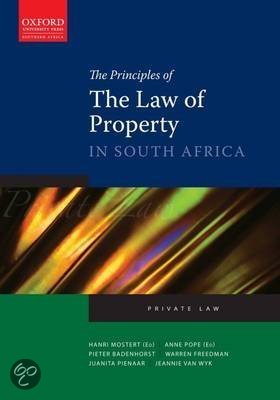
- januari 2010
- 9780195984040
- Unknown
Written for
- Institution
- University of South Africa (Unisa)
- Module
- Law Of Property (PVL3701)
Document information
- Uploaded on
- February 9, 2023
- Number of pages
- 72
- Written in
- 2022/2023
- Type
- Exam (elaborations)
- Contains
- Questions & answers
Subjects
-
pvl3701
-
law of property
-
2023
-
pvl3701 law of property
-
pvl3701 exam pack 2023
-
pvl3701 exam pack 2023
-
exam pack
-
pvl3701 exam pack 2023
-
3701 exam pack 2023
-
exam pack 2023


Also available in package deal