Atomic structure!
!
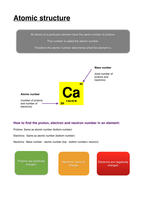
All atoms of a particular element have the same number of protons.!
!
This number is called the atomic number.!
!
Therefore the atomic number determines what the element is.
!
!
!
!
! Mass number!
!
! (total number of
!
! protons and
! neutrons)
!
!
!
Atomic number!
! !
!
(number of protons !
and number of !
electrons) !
!
!
!
!
How to find the proton, electron and neutron number in an element:!
!
Protons: Same as atomic number (bottom number)!
!
Electrons: Same as atomic number (bottom number)!
!
Neutrons: Mass number - atomic number (top - bottom number= neutron)!
!
!
!
!
!
!
Protons are positively
! Neutrons have no Electrons are negatively
charged.
! charge. charged.
!
!
!
!
!
,Atoms!
!
In an atom, a proton and a neutron are about 1800 times the
mass than an electron.!
!
Most of an atom is an empty space. !
!
This is because the electrons orbit a large distance away from the nucleus.!
!
!
Particle Mass Charge Where it is found
Proton 1 +1 In the nucleus
Electron 1/1836 -1 Orbiting the nucleus
Neutron 1 0 In the nucleus
!
!
!
!
!
!
!
!
!
!
, Energy levels of electron shells!
!
Electrons are arranged into shells around the nucleus. Each shell is at a particular
energy level.!
!
The 1st shell can hold 2 electrons!
The 2nd shell can hold 8 electrons!
The 3rd shell can hold 8 electrons!
The 4th shell can hold 2 electrons!
!
!
Examples of electron shell arrangements:!
!
!
!
!
!
!
!
!
!
!
!
!
!
!
!
!
!
!
Li= 2,1 ! ! ! ! Na= 2, 8, 1! ! ! ! !
!
!
!
Isotopes!
!
All atoms of a particular element have the same number of protons. E.g) if an atom has 6 protons,
then it must be carbon.!
!
Isotopes of the same element have a different number of neutrons. This means they also have a
different mass number.!
!
Basic definition: Isotopes are the same element, but different ‘versions’. They
have different mass and atomic numbers because the neutron number changed.
Carbon with a mass of: 12 and an atomic number of: 6 is normal.!
An isotope of carbon would have a mass of: 13 and an atomic number of: 6. This
is because the proton number hasn’t changed, but there has been a neutron
added.
!
All atoms of a particular element have the same number of protons.!
!
This number is called the atomic number.!
!
Therefore the atomic number determines what the element is.
!
!
!
!
! Mass number!
!
! (total number of
!
! protons and
! neutrons)
!
!
!
Atomic number!
! !
!
(number of protons !
and number of !
electrons) !
!
!
!
!
How to find the proton, electron and neutron number in an element:!
!
Protons: Same as atomic number (bottom number)!
!
Electrons: Same as atomic number (bottom number)!
!
Neutrons: Mass number - atomic number (top - bottom number= neutron)!
!
!
!
!
!
!
Protons are positively
! Neutrons have no Electrons are negatively
charged.
! charge. charged.
!
!
!
!
!
,Atoms!
!
In an atom, a proton and a neutron are about 1800 times the
mass than an electron.!
!
Most of an atom is an empty space. !
!
This is because the electrons orbit a large distance away from the nucleus.!
!
!
Particle Mass Charge Where it is found
Proton 1 +1 In the nucleus
Electron 1/1836 -1 Orbiting the nucleus
Neutron 1 0 In the nucleus
!
!
!
!
!
!
!
!
!
!
, Energy levels of electron shells!
!
Electrons are arranged into shells around the nucleus. Each shell is at a particular
energy level.!
!
The 1st shell can hold 2 electrons!
The 2nd shell can hold 8 electrons!
The 3rd shell can hold 8 electrons!
The 4th shell can hold 2 electrons!
!
!
Examples of electron shell arrangements:!
!
!
!
!
!
!
!
!
!
!
!
!
!
!
!
!
!
!
Li= 2,1 ! ! ! ! Na= 2, 8, 1! ! ! ! !
!
!
!
Isotopes!
!
All atoms of a particular element have the same number of protons. E.g) if an atom has 6 protons,
then it must be carbon.!
!
Isotopes of the same element have a different number of neutrons. This means they also have a
different mass number.!
!
Basic definition: Isotopes are the same element, but different ‘versions’. They
have different mass and atomic numbers because the neutron number changed.
Carbon with a mass of: 12 and an atomic number of: 6 is normal.!
An isotope of carbon would have a mass of: 13 and an atomic number of: 6. This
is because the proton number hasn’t changed, but there has been a neutron
added.