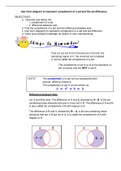
Use Venn diagram to represent complement of a set and the set difference.
OBJECTIVES:
a. Describe and define the:
i. complement of a set.
ii. difference between sets
b. Find the complement of a set and the difference between sets.
c. Use Venn diagrams to represent complement of a set and set difference.
d. Value accumulated knowledge as means of new understanding.
If we cut out set A from the picture on the left, the
remaining region is U, the universal set is labeled
𝐴′ and is called the complement of a set.
The complement of set A is all of the elements (in
the universe) that are NOT in set A.
NOTE*: The complement of a set can be represented with
several differing notations.
The complement of set A can be written as
𝑨′ or 𝑨c or Ā or Ã
Difference between Sets
Let A and B be sets. The difference of A and B, denoted by A - B, is the set
containing those elements that are in A but not in B. The difference of A and B
is also called the complement of B with respect to A.
The difference of B and A, denoted by B – A, is the set containing those
elements that are in B but not in A. It is called the complement of A with
respect to B.
, Example:
If A = { 1, 2, 3} and B ={ 3, 4, 5},
Then
A - B = { 1, 2 }
B – A = {4 , 5}
A–A={}
B–B={}
1. Let U (the universal set) = {1, 2, 3, 4, 5, 6, 7, 8, 9, 10} (a subset of a positive
integers)
A = {2, 4 ,6, 8}
B = {1, 2, 3, 4, 5}
Find the following:
1 (𝐴 ∪ 𝐵 ) ′
2. (𝐴 ∩ 𝐵)′
3. 𝐴′
4. 𝐵′
2: Given set A = {b, d, e, g, a, f, c}
set B = { k, h, u, a, f, c}
Draw Venn diagram and find:
1. A – B
2. B – A
Let U = {1, 2, 3, 4, 5, 6, 7, 8, 9, 10}
A = {1, 2, 4, 6, 8, 10}
B = {1, 3, 5, 7, 8, 9}
Find:
(a) A'
(b) B'
(c) A' ∪ B'
(d) A' ∩ B'
(e) (A ∪ B)'
Also show (A ∪ B)' = A' ∩ B'.
OBJECTIVES:
a. Describe and define the:
i. complement of a set.
ii. difference between sets
b. Find the complement of a set and the difference between sets.
c. Use Venn diagrams to represent complement of a set and set difference.
d. Value accumulated knowledge as means of new understanding.
If we cut out set A from the picture on the left, the
remaining region is U, the universal set is labeled
𝐴′ and is called the complement of a set.
The complement of set A is all of the elements (in
the universe) that are NOT in set A.
NOTE*: The complement of a set can be represented with
several differing notations.
The complement of set A can be written as
𝑨′ or 𝑨c or Ā or Ã
Difference between Sets
Let A and B be sets. The difference of A and B, denoted by A - B, is the set
containing those elements that are in A but not in B. The difference of A and B
is also called the complement of B with respect to A.
The difference of B and A, denoted by B – A, is the set containing those
elements that are in B but not in A. It is called the complement of A with
respect to B.
, Example:
If A = { 1, 2, 3} and B ={ 3, 4, 5},
Then
A - B = { 1, 2 }
B – A = {4 , 5}
A–A={}
B–B={}
1. Let U (the universal set) = {1, 2, 3, 4, 5, 6, 7, 8, 9, 10} (a subset of a positive
integers)
A = {2, 4 ,6, 8}
B = {1, 2, 3, 4, 5}
Find the following:
1 (𝐴 ∪ 𝐵 ) ′
2. (𝐴 ∩ 𝐵)′
3. 𝐴′
4. 𝐵′
2: Given set A = {b, d, e, g, a, f, c}
set B = { k, h, u, a, f, c}
Draw Venn diagram and find:
1. A – B
2. B – A
Let U = {1, 2, 3, 4, 5, 6, 7, 8, 9, 10}
A = {1, 2, 4, 6, 8, 10}
B = {1, 3, 5, 7, 8, 9}
Find:
(a) A'
(b) B'
(c) A' ∪ B'
(d) A' ∩ B'
(e) (A ∪ B)'
Also show (A ∪ B)' = A' ∩ B'.