LEHNINGER PRINCIPLES OF BIOCHEMISTRY: CHAPTER 6 KEY TERMS QUESTIONS WITH CORRECT ANSWERS
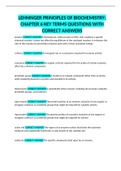
enzyme CORRECT ANSWER A biomolecule, either protein or RNA, that catalyzes a specific chemical reaction. It does not affect the equilibrium of the catalyzed reaction; it enhances the rate of the reaction by providing a reaction path with a lower activation energy. cofactor CORRECT ANSWER An inorganic ion or a coenzyme required for enzyme activity. coenzyme CORRECT ANSWER An organic cofactor required for the action of certain enzymes; often has a vitamin component. prosthetic group CORRECT ANSWER A metal ion or organic compound (other than an amino acid) covalently bound to a protein and essential in its activity. holoenzyme CORRECT ANSWER A catalytically active enzyme, including all necessary subunits, prosthetic groups, and cofactors. Apo enzyme CORRECT ANSWER The protein portion of an enzyme, exclusive of any organic or inorganic cofactors or prosthetic groups that might be required for catalytic activity. Apo protein CORRECT ANSWER The protein portion of a protein, exclusive of any organic or inorganic cofactors or prosthetic groups that might be required for activity. active site CORRECT ANSWER The region of an enzyme surface that binds the substrate molecule and catalytically transforms it; also known as the catalytic site. substrate CORRECT ANSWER The specific compound acted upon by an enzyme.
Written for
- Institution
- LEHNINGER PRINCIPLES OF BIOCHEMISTRY
- Course
- LEHNINGER PRINCIPLES OF BIOCHEMISTRY
Document information
- Uploaded on
- February 7, 2023
- Number of pages
- 7
- Written in
- 2022/2023
- Type
- Exam (elaborations)
- Contains
- Questions & answers
Subjects
- either protein or rna
-
enzyme correct answer a biomolecule
-
that catalyzes a specific chemical reaction it does not affect the equilibrium of the catalyzed reaction it enhances the rate of the react

Document also available in package deal