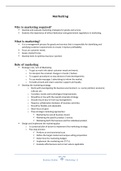
Marketing
Why is marketing required?
▪ Develop and evaluate marketing strategies for goods and service.
▪ Examine the importance of ethical behaviour and government regulations in marketing.
What is marketing?
▪ It is a management process for goods and services that is responsible for identifying and
satisfying customer requirements to create / improve profitability.
▪ Focus on customer needs.
▪ Assess market forces.
▪ Develop tools to optimise business’ position.
Role of marketing
▪ Strategic role / aim of Marketing
o To get as much info about customer needs and wants.
o To interpret the constant changes in trends / fashion.
o To support procedures to stay abreast of new developments.
o To use media messages / advertising to inform the market.
o To build a brand and retain customer support and loyalty.
▪ Develop the marketing strategy
o Starts with investigating the business environment, i.e. social, political, economic,
cultural, etc.
o Considers trends and technological improvements.
o Should be in line with the overall corporate strategy.
o Should ensure buy-in from top management.
o Requires collaboration between all business activities.
o Should be flexible and adjustable.
o Must focus on goal.
o Thee strategic marketing approaches:
✓ Marketing he overall business brand.
✓ Marketing the specific product / service.
✓ Marketing both the business and the individual product.
▪ Design and implement the marketing plan
o Is a practical plan of action to implement the marketing strategy.
o Five-step process:
✓ Perform an environmental scan.
✓ Define the target market and unique selling proposition.
✓ Determine the marketing budget.
✓ Implement the marketing mix (7 P’s).
✓ Evaluate effectiveness and correct where applicable.
Business Studies Marketing | 1
, Step 1: Perform an environmental scan
▪ Scan internal and external environment
▪ Internal includes a SWOT analysis, RBA and VCA
Step 2: Define the target market and Unique selling proposition
▪ Identify WHO will buy the business’ products (target market).
▪ Unique selling preposition (USP), focuses on costs, brand identity, incorporation and
utilisation of technology and Quality.
Step 3: Determine the marketing budget
▪ Marketing is an investment.
▪ Influenced by method and extensiveness.
Step 4: Implement the marketing mix (7 P’s)
Product Price
✓ Customer must want / need it ✓ Customer must be willing to pay.
✓ Must add value to customer ✓ Must create competitive advantage to the business.
✓ Can be tangible / intangible ✓ Must generate income and provide a profit the
✓ Packaging must be desirable and practical business.
✓ Types of products: ✓ Must help business to improve its market share /
❖ Convenience goods: Buy at any place. position
❖ Select goods: Buy at some stores: ✓ Different pricing strategies:
❖ Speciality goods: Not of the shelf. You have to ❖ Market penetration pricing
order the product. - Low price to attract new customers
❖ Services ❖ Leader pricing
✓ Life-cycle of product - Reduce the price of certain items
❖ Promotion pricing
- Discounts offered for a special event
❖ Bulk discount pricing
- Offered for large quantities
❖ Prestige pricing
- When customers expect to pay more
Promotion
Place ✓ Attract attention of customers.
✓ Distribution must be effective, i.e. large enough, ✓ Message must be consistent and appealing.
practical ✓ Reach largest possible target market.
✓ Distribution must be convenient, i.e. accessible ✓ Cost-effective
✓ Availability must be kept in mind, i.e quantity, quality ✓ Principles to keep in mind:
✓ Cost-effective transport, storage ❖ Only quality products
✓ Distribution options: ❖ Have an in-depth knowledge of products
❖ Intensive distribution: Many selling points ❖ Have a unique and memorable design
❖ Selective distribution: Specific retailers ❖ Don’t criticise competitors – illegal
❖ Exclusive distribution: Specialised sales outlets ❖ Stick to the marketing budget
✓ Distribute through franchising. ❖ Use medium that suits the target market
Business Studies Marketing | 2
Why is marketing required?
▪ Develop and evaluate marketing strategies for goods and service.
▪ Examine the importance of ethical behaviour and government regulations in marketing.
What is marketing?
▪ It is a management process for goods and services that is responsible for identifying and
satisfying customer requirements to create / improve profitability.
▪ Focus on customer needs.
▪ Assess market forces.
▪ Develop tools to optimise business’ position.
Role of marketing
▪ Strategic role / aim of Marketing
o To get as much info about customer needs and wants.
o To interpret the constant changes in trends / fashion.
o To support procedures to stay abreast of new developments.
o To use media messages / advertising to inform the market.
o To build a brand and retain customer support and loyalty.
▪ Develop the marketing strategy
o Starts with investigating the business environment, i.e. social, political, economic,
cultural, etc.
o Considers trends and technological improvements.
o Should be in line with the overall corporate strategy.
o Should ensure buy-in from top management.
o Requires collaboration between all business activities.
o Should be flexible and adjustable.
o Must focus on goal.
o Thee strategic marketing approaches:
✓ Marketing he overall business brand.
✓ Marketing the specific product / service.
✓ Marketing both the business and the individual product.
▪ Design and implement the marketing plan
o Is a practical plan of action to implement the marketing strategy.
o Five-step process:
✓ Perform an environmental scan.
✓ Define the target market and unique selling proposition.
✓ Determine the marketing budget.
✓ Implement the marketing mix (7 P’s).
✓ Evaluate effectiveness and correct where applicable.
Business Studies Marketing | 1
, Step 1: Perform an environmental scan
▪ Scan internal and external environment
▪ Internal includes a SWOT analysis, RBA and VCA
Step 2: Define the target market and Unique selling proposition
▪ Identify WHO will buy the business’ products (target market).
▪ Unique selling preposition (USP), focuses on costs, brand identity, incorporation and
utilisation of technology and Quality.
Step 3: Determine the marketing budget
▪ Marketing is an investment.
▪ Influenced by method and extensiveness.
Step 4: Implement the marketing mix (7 P’s)
Product Price
✓ Customer must want / need it ✓ Customer must be willing to pay.
✓ Must add value to customer ✓ Must create competitive advantage to the business.
✓ Can be tangible / intangible ✓ Must generate income and provide a profit the
✓ Packaging must be desirable and practical business.
✓ Types of products: ✓ Must help business to improve its market share /
❖ Convenience goods: Buy at any place. position
❖ Select goods: Buy at some stores: ✓ Different pricing strategies:
❖ Speciality goods: Not of the shelf. You have to ❖ Market penetration pricing
order the product. - Low price to attract new customers
❖ Services ❖ Leader pricing
✓ Life-cycle of product - Reduce the price of certain items
❖ Promotion pricing
- Discounts offered for a special event
❖ Bulk discount pricing
- Offered for large quantities
❖ Prestige pricing
- When customers expect to pay more
Promotion
Place ✓ Attract attention of customers.
✓ Distribution must be effective, i.e. large enough, ✓ Message must be consistent and appealing.
practical ✓ Reach largest possible target market.
✓ Distribution must be convenient, i.e. accessible ✓ Cost-effective
✓ Availability must be kept in mind, i.e quantity, quality ✓ Principles to keep in mind:
✓ Cost-effective transport, storage ❖ Only quality products
✓ Distribution options: ❖ Have an in-depth knowledge of products
❖ Intensive distribution: Many selling points ❖ Have a unique and memorable design
❖ Selective distribution: Specific retailers ❖ Don’t criticise competitors – illegal
❖ Exclusive distribution: Specialised sales outlets ❖ Stick to the marketing budget
✓ Distribute through franchising. ❖ Use medium that suits the target market
Business Studies Marketing | 2