SILVERTHORN
CHAPTER 20 – FLUID AND ELECTROLYTE BALANCE
FLUID AND ELECTROLYE HOMEOSTASIS
The body’s task is to maintain mass balance: what comes in must be excreted if the body does
not need it. The kidneys are the primary route for water loss and removal of many ions. Water and
Na+ are associated with ECF volume and osmolarity. Disturbances in K + balance can cause serious
problems with cardiac and muscle function by disrupting the membrane potential of excitable cells.
Ca2+ is involved in exocytosis, muscle contraction, bone formation and blood clotting. H+ and HCO3-
determine body pH.
ECF OSMOLARITY AFFECTS CELL VOLUME
If ECF osmolarity decreases as a result of excess water intake, water moves into the cell and
they swell. If ECF osmolarity increases, water moves out of the cells and they shrink. Many
cells have independent mechanisms for maintaining cell volume. Renal tubule cells are
constantly exposed to high ECF osmolarity, yet they remain normal cell volume. They
synthesize organic solutes as needed to make their intracellular osmolarity match that of the
medullary interstitial fluid. Other cells regulate by changing their ionic composition.
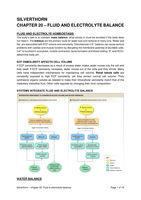
SYSTEMS INTEGRATE FLUID AND ELECTROLYTE BALANCE
WATER BALANCE
Silverthorn – chapter 20: Fluid & electrolyte balance Page 1 of 18
CHAPTER 20 – FLUID AND ELECTROLYTE BALANCE
FLUID AND ELECTROLYE HOMEOSTASIS
The body’s task is to maintain mass balance: what comes in must be excreted if the body does
not need it. The kidneys are the primary route for water loss and removal of many ions. Water and
Na+ are associated with ECF volume and osmolarity. Disturbances in K + balance can cause serious
problems with cardiac and muscle function by disrupting the membrane potential of excitable cells.
Ca2+ is involved in exocytosis, muscle contraction, bone formation and blood clotting. H+ and HCO3-
determine body pH.
ECF OSMOLARITY AFFECTS CELL VOLUME
If ECF osmolarity decreases as a result of excess water intake, water moves into the cell and
they swell. If ECF osmolarity increases, water moves out of the cells and they shrink. Many
cells have independent mechanisms for maintaining cell volume. Renal tubule cells are
constantly exposed to high ECF osmolarity, yet they remain normal cell volume. They
synthesize organic solutes as needed to make their intracellular osmolarity match that of the
medullary interstitial fluid. Other cells regulate by changing their ionic composition.
SYSTEMS INTEGRATE FLUID AND ELECTROLYTE BALANCE
WATER BALANCE
Silverthorn – chapter 20: Fluid & electrolyte balance Page 1 of 18