CARDIO
Symptoms of Heart Disease
NB: Severe heart disease can be asymptomatic
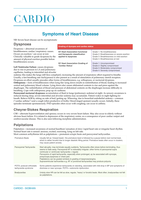
Dyspnoea Grading of dysnpea and cardiac status
Dyspnoea = abnormal awareness of
breathlessness; cardiac/respiratory causes. NY Heart Association functional Grade 1: No breathlessness
Occurs on exertion/ can occur at rest. and therapeutic classification Grade 2: Breathlessness on severe exertion
Clinically valuable to grade dyspnoea by the applied to dyspnoea Grade 3: Breathlessness on mild exertion
amount of physical exertion possible before Grade 4: Breathlessness at rest
breathlessness occurs.
NY Heart Association Grading of Grade 1: Uncompromised
‘Cardiac Status’ Grade 2: Slightly compromised
Left Ventricular Failure: causes dyspnoea Grade 3: Moderately compromised
due to rise in pressure in LA and pulmonary Grade 4: Severely compromised.
capillaries, leading to interstitial and alveolar
oedema: this makes the lungs stiff (less compliant), increasing the amount of respiratory effort required to breathe.
Usually, a fast breathing rate (tachypnoea) is also present as a result of stimulation of pulmonary stretch receptors.
Dyspnoea on effort usually precedes other forms of breathlessness, e.g. orthopnoea, or nocturnal dyspnoea.
Orthopnoea = form of breathlessness when lying flat: lying down results in redistribution of blood, leading to increased
central and pulmonary blood volume. Lying down also causes abdominal contents to rise and press against the
diaphragm. The redistribution of blood and pressure of abdominal contents on the diaphragm increase difficulty in
breathing. Cope with orthopnoea; prop up on cushions.
Paroxysmal nocturnal dyspnoea: accumulation of fluid in lungs (pulmonary oedema) at night. As sensory awareness is
reduced during sleep, severe interstitial and alveolar oedema may accumulate. Patient wakes in night fighting for
breath. Relieve SOB by sitting on side of bed/getting up. Wheezing, due to bronchial endothelial oedema = common
(“cardiac asthma”) and a cough (often productive of frothy/blood-tinged sputum) usually occurs. Initially, these
episodes terminate spontaneously. PND episodes often occur with coughing; can occur in asthma.
Cheyne-Stokes Respiration
CSR = alternate hyperventilation and apnoea; occurs in very severe heart failure. May also occur in elderly without
obvious heart failure. It is related to depression of the respiratory centre, as a consequence of poor cardiac output and
cerebrovascular disease. This is also seen following morphine administration.
Palpitations
Palpitation = increased awareness of normal heartbeat/sensation of slow/rapid heart rate or irregular heart rhythm.
Normal heart rate is sensed: anxious, excited, exercising, lying on left side.
Most common arrhythmias felt as palpitations = premature ectopic beats and paroxysmal tachycardias.
Premature Beats Usually felt as ‘missed beats’; the premature beat is followed by a pause before next normal beat,
which is rather forceful due to longer diastolic filling period. Premature beats often occur in clusters;
may cause patient anxiety
Paroxysmal Tachycardia Start abruptly; may terminate equally suddenly. Tachycardia often slows before terminating, thus
seems to fade away. Paroxysmal AF is noticeably irregular; other forms of paroxysmal supra
ventricular or ventricular tachycardia = regular.
Paroxysms of rapid tachycardia, especially when prolonged, ay be associated with syncope,
presyncope,dyspnoea or chest pain.
Palpitations can be graded similarly to grading of dyspnoea/angina.
Supraventricular tachcardias e.g. AF or junctional tachycardias may produce polyuria
POTS: postural orthostatic Some patients experience tachycardia on standing, associated with mild drop in BP and symptoms of
tachycardia syndrome dizziness or near syncope. POTS = autonomic dysfunction.
Bradycardias Unduly slow HR can be felt as slow, regular, ‘heavy’ or forceful beats. Most often, bradycardias not felt
as palpitations.
CARDIO - SIOBHAN 1
Symptoms of Heart Disease
NB: Severe heart disease can be asymptomatic
Dyspnoea Grading of dysnpea and cardiac status
Dyspnoea = abnormal awareness of
breathlessness; cardiac/respiratory causes. NY Heart Association functional Grade 1: No breathlessness
Occurs on exertion/ can occur at rest. and therapeutic classification Grade 2: Breathlessness on severe exertion
Clinically valuable to grade dyspnoea by the applied to dyspnoea Grade 3: Breathlessness on mild exertion
amount of physical exertion possible before Grade 4: Breathlessness at rest
breathlessness occurs.
NY Heart Association Grading of Grade 1: Uncompromised
‘Cardiac Status’ Grade 2: Slightly compromised
Left Ventricular Failure: causes dyspnoea Grade 3: Moderately compromised
due to rise in pressure in LA and pulmonary Grade 4: Severely compromised.
capillaries, leading to interstitial and alveolar
oedema: this makes the lungs stiff (less compliant), increasing the amount of respiratory effort required to breathe.
Usually, a fast breathing rate (tachypnoea) is also present as a result of stimulation of pulmonary stretch receptors.
Dyspnoea on effort usually precedes other forms of breathlessness, e.g. orthopnoea, or nocturnal dyspnoea.
Orthopnoea = form of breathlessness when lying flat: lying down results in redistribution of blood, leading to increased
central and pulmonary blood volume. Lying down also causes abdominal contents to rise and press against the
diaphragm. The redistribution of blood and pressure of abdominal contents on the diaphragm increase difficulty in
breathing. Cope with orthopnoea; prop up on cushions.
Paroxysmal nocturnal dyspnoea: accumulation of fluid in lungs (pulmonary oedema) at night. As sensory awareness is
reduced during sleep, severe interstitial and alveolar oedema may accumulate. Patient wakes in night fighting for
breath. Relieve SOB by sitting on side of bed/getting up. Wheezing, due to bronchial endothelial oedema = common
(“cardiac asthma”) and a cough (often productive of frothy/blood-tinged sputum) usually occurs. Initially, these
episodes terminate spontaneously. PND episodes often occur with coughing; can occur in asthma.
Cheyne-Stokes Respiration
CSR = alternate hyperventilation and apnoea; occurs in very severe heart failure. May also occur in elderly without
obvious heart failure. It is related to depression of the respiratory centre, as a consequence of poor cardiac output and
cerebrovascular disease. This is also seen following morphine administration.
Palpitations
Palpitation = increased awareness of normal heartbeat/sensation of slow/rapid heart rate or irregular heart rhythm.
Normal heart rate is sensed: anxious, excited, exercising, lying on left side.
Most common arrhythmias felt as palpitations = premature ectopic beats and paroxysmal tachycardias.
Premature Beats Usually felt as ‘missed beats’; the premature beat is followed by a pause before next normal beat,
which is rather forceful due to longer diastolic filling period. Premature beats often occur in clusters;
may cause patient anxiety
Paroxysmal Tachycardia Start abruptly; may terminate equally suddenly. Tachycardia often slows before terminating, thus
seems to fade away. Paroxysmal AF is noticeably irregular; other forms of paroxysmal supra
ventricular or ventricular tachycardia = regular.
Paroxysms of rapid tachycardia, especially when prolonged, ay be associated with syncope,
presyncope,dyspnoea or chest pain.
Palpitations can be graded similarly to grading of dyspnoea/angina.
Supraventricular tachcardias e.g. AF or junctional tachycardias may produce polyuria
POTS: postural orthostatic Some patients experience tachycardia on standing, associated with mild drop in BP and symptoms of
tachycardia syndrome dizziness or near syncope. POTS = autonomic dysfunction.
Bradycardias Unduly slow HR can be felt as slow, regular, ‘heavy’ or forceful beats. Most often, bradycardias not felt
as palpitations.
CARDIO - SIOBHAN 1