Unit 8: Space Physics
Our Solar System
The universe is composed of billions of galaxies
Each galaxy contains hundreds of millions of stars
Our solar system is a tiny part of the Milky Way Galaxy made up of many objects:
- The Sun (one star)
- Planets and dwarf planets that orbit the Sun
- Asteroids and comets that orbit the Sun
- Natural satellites e.g. moons orbiting planets
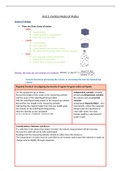
ROCKY PLANETS GAS GIANTS
The Formation of Our Solar System
1) The Sun was formed from a planetary nebula pulled together by gravitational attraction.
2) As the dust and gas drew together they collided increasing temperature and creating a
protostar.
3) As more and more material was drawn together by gravity these collisions increased until
the temperature and pressure was high enough for hydrogen nuclei to fuse together
forming helium and a main sequence star.
4) The energy released from nuclear fusion keeps the core of the Sun hot.
5) Material not drawn into the Sun remained in orbit around the new star and formed the
planets and other objects in our solar system.
Close to the centre of the star all gas was used in its formation leaving only bits of rock to
make the rocky planets.
Further out leftover gas joined to make gas giants.
6) The Sun remains in the main sequence period of its lifecycle and is stable as a result of the
balance between:
- Fusion energy trying to expand the Sun
- Gravity acting inwards trying to collapse the Sun
Our Solar System
The universe is composed of billions of galaxies
Each galaxy contains hundreds of millions of stars
Our solar system is a tiny part of the Milky Way Galaxy made up of many objects:
- The Sun (one star)
- Planets and dwarf planets that orbit the Sun
- Asteroids and comets that orbit the Sun
- Natural satellites e.g. moons orbiting planets
ROCKY PLANETS GAS GIANTS
The Formation of Our Solar System
1) The Sun was formed from a planetary nebula pulled together by gravitational attraction.
2) As the dust and gas drew together they collided increasing temperature and creating a
protostar.
3) As more and more material was drawn together by gravity these collisions increased until
the temperature and pressure was high enough for hydrogen nuclei to fuse together
forming helium and a main sequence star.
4) The energy released from nuclear fusion keeps the core of the Sun hot.
5) Material not drawn into the Sun remained in orbit around the new star and formed the
planets and other objects in our solar system.
Close to the centre of the star all gas was used in its formation leaving only bits of rock to
make the rocky planets.
Further out leftover gas joined to make gas giants.
6) The Sun remains in the main sequence period of its lifecycle and is stable as a result of the
balance between:
- Fusion energy trying to expand the Sun
- Gravity acting inwards trying to collapse the Sun