Unit 7: Magnetism and Electromagnetism
Magnetic Poles and Fields
Poles = the places where the magnetic forces Magnetic field = the region around a magnet
are strongest on a magnet. There are two: where a force acts on another magnet or
north (seeking) pole and south (seeking) pole magnetic material.
Unlike poles attract Magnetic field strength depends on the distance
Like poles repel from magnet, strongest at poles.
Magnet = any object or material that produces a magnetic field.
Magnetic material = any object that can be influenced by a magnetic field and has the
potential to become a magnet:
- Fe
- Co
- Ni
- Steel
There are two types of magnets and the force between them is always one of attraction:
- Permanent magnets: produce their own magnetic field.
- Induced magnets: become a magnet when placed in a magnetic field, when removed they
lost their magnetism quickly.
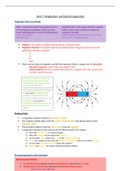
The arrows on field lines always run
from north to south and show the
direction of the force that would act
on a north pole that point.
The density of the field lines is called
the flux density and indicates the
strength of the field at that point.
The higher the flux density the
stronger the field and the greater the
force that would be felt by another
magnet.
Plotting Fields
A magnetic compass contains a small bar magnet
The compass needle aligns with the Earth’s magnetic field and always points to the
magnetic north
This provides evidence that the Earth’s core must be magnetic
A magnetic compass can be used to plot the field around a bar magnet:
1) Place the bar magnet on a piece of paper.
2) Place the compass at one end of the magnet.
3) On the paper, mark where the point of the compass needle is.
4) Move the compass so the tail of the needle is at the point that has just been marked.
5) On the paper, mark a new point where the needle is.
6) Repeat and connect the marks until the full field is plotted.
Electromagnetism and Solenoids
Right Hand Grip Method
A magnetic field is produced around a conducting wire when there is a current.
The direction of the field lines depends on the direction of the current:
- Grip the wire in your right hand
, Solenoids
Formed when a wire is looped into a cylindrical coil
Shaping a wire into a solenoid increases the magnetic field strength
- it concentrates a longer piece of wire into a smaller area
- the looped shape means magnetic field lines around the wire are in the same direction
Inside there is a strong, uniform field
Has similarly-shaped magnetic field to a bar magnet
The north pole can be found with the right hand grip:
- Hold the solenoid with right hand
- Fingers following the direction current flows
- Thumb is pointing to the north pole
To increase the field strength further:
1. Increase the current that flows through the solenoid
2. Increase the number of coils and maintaining the length
3. Decrease the length and maintaining the number of coils
4. Add an iron core
Electromagnets
An electromagnet is created when an iron core (soft magnetic material) is added to a
solenoid – induced magnet
Their magnetism is lost when there is no current
Electromagnetism is when electric currents produce their own magnetic field
Many devices use electromagnets, e.g.: Electric Bell:
When the switch is pushed, the electromagnet
is magnetised
The electromagnet attracts the armature
The striker strikes the gong and breaks the
circuit
The armature springs back, completing the
circuit again and remagnetising the
electromagnet
The cycle repeats for as long as the switch
remains on
Fleming’s Left Hand Rule
Magnetic Poles and Fields
Poles = the places where the magnetic forces Magnetic field = the region around a magnet
are strongest on a magnet. There are two: where a force acts on another magnet or
north (seeking) pole and south (seeking) pole magnetic material.
Unlike poles attract Magnetic field strength depends on the distance
Like poles repel from magnet, strongest at poles.
Magnet = any object or material that produces a magnetic field.
Magnetic material = any object that can be influenced by a magnetic field and has the
potential to become a magnet:
- Fe
- Co
- Ni
- Steel
There are two types of magnets and the force between them is always one of attraction:
- Permanent magnets: produce their own magnetic field.
- Induced magnets: become a magnet when placed in a magnetic field, when removed they
lost their magnetism quickly.
The arrows on field lines always run
from north to south and show the
direction of the force that would act
on a north pole that point.
The density of the field lines is called
the flux density and indicates the
strength of the field at that point.
The higher the flux density the
stronger the field and the greater the
force that would be felt by another
magnet.
Plotting Fields
A magnetic compass contains a small bar magnet
The compass needle aligns with the Earth’s magnetic field and always points to the
magnetic north
This provides evidence that the Earth’s core must be magnetic
A magnetic compass can be used to plot the field around a bar magnet:
1) Place the bar magnet on a piece of paper.
2) Place the compass at one end of the magnet.
3) On the paper, mark where the point of the compass needle is.
4) Move the compass so the tail of the needle is at the point that has just been marked.
5) On the paper, mark a new point where the needle is.
6) Repeat and connect the marks until the full field is plotted.
Electromagnetism and Solenoids
Right Hand Grip Method
A magnetic field is produced around a conducting wire when there is a current.
The direction of the field lines depends on the direction of the current:
- Grip the wire in your right hand
, Solenoids
Formed when a wire is looped into a cylindrical coil
Shaping a wire into a solenoid increases the magnetic field strength
- it concentrates a longer piece of wire into a smaller area
- the looped shape means magnetic field lines around the wire are in the same direction
Inside there is a strong, uniform field
Has similarly-shaped magnetic field to a bar magnet
The north pole can be found with the right hand grip:
- Hold the solenoid with right hand
- Fingers following the direction current flows
- Thumb is pointing to the north pole
To increase the field strength further:
1. Increase the current that flows through the solenoid
2. Increase the number of coils and maintaining the length
3. Decrease the length and maintaining the number of coils
4. Add an iron core
Electromagnets
An electromagnet is created when an iron core (soft magnetic material) is added to a
solenoid – induced magnet
Their magnetism is lost when there is no current
Electromagnetism is when electric currents produce their own magnetic field
Many devices use electromagnets, e.g.: Electric Bell:
When the switch is pushed, the electromagnet
is magnetised
The electromagnet attracts the armature
The striker strikes the gong and breaks the
circuit
The armature springs back, completing the
circuit again and remagnetising the
electromagnet
The cycle repeats for as long as the switch
remains on
Fleming’s Left Hand Rule