Level 2 Diploma in Care Learner Name:
Unit Title: 201 – Safeguarding and protection in care settings
Assessor
Use Only-
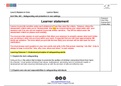
Learner statement Assessment
Criteria Met
Learner to provide narrative under each statement of how they meet the criteria. However, where the
assessment criteria asks you to ‘Demonstrate’ this may be covered during your observation with your
assessor and if so you are not required to provide written narrative. This will be stated under the
assessment criteria so please read carefully.
You must provide answers to each question that allow your assessor to properly assess what work duties
you are doing or what role you have within your work. It expected that you will need approximately 300
words per question. The more detail you provide the less likely your account will be sent back for more
clarification.
You must answer each question in your own words and write in the first person meaning “I do this”. A tip is
always to keep in mind the “who, why, how, where and when” in each answer.
Learning Outcome 1: Understand principles of safeguarding adults
1.1 Explain the term safeguarding
Safeguarding is the action that is taken to promote the welfare of children and protect them from harm.
As a learner, I must protect individual from abuse, maltreatment. preventing harm to individual's health or
development and also ensuring individuals grow up with the provision of safe and effective care.
1.2 Explain own role and responsibilities in safeguarding individuals
www.vocationaltraining.org.uk
C680 L2 LS 201 Issue 2 August 2019 KR
,As a Carer I need to know my role act responsibly when it comes to safeguarding such as:
1. To be aware of the signs of abuse or neglect.
2. Recognise the signs of abuse and neglect.
3. Record and report any concerns or incidents.
4. Report immediate risks to the police by calling 999 if you suspect an immediate risk or crime has taken place.
1.3 Define the following terms: -
1.3 a Physical abuse
Physical abuse is when someone hurts or harms a child or young person on purpose.
It includes hitting with hands or objects, slapping and punching.
1.3 b Domestic abuse
I can define domestic abuse as an incident or pattern of incidents of controlling, coercive, threatening, degrading
and violent behaviour, including sexual violence.
I have seen in the majority of cases it is caused by a partner or ex-partner, but also by a family member or carer. It is
very common and this needs to be addressed.
1.3 c Sexual abuse
Sexual abuse, sex abuse or molestation, is abusive sexual behaviour by one person upon another. It is usually done by using
force or by taking advantage of another.
1.3 d Emotional/ psychological abuse
Emotional abuse is any type of abuse that involves the continual emotional mistreatment of an individual.
www.vocationaltraining.org.uk
C680 L2 LS 201 Issue 2 August 2019 KR
, It's sometimes called psychological abuse.
1.3 e Financial/ material abuse
Financial or material abuse is about fraudulent and improper use of, funds, property or any resources of the
individual at risk.
1.3 f Modern slavery
I can define modern slavery as the illegal exploitation of people for personal or commercial gain.
1.3 g Discriminatory abuse
It is the type of abuse that causes discrimination and can be defined as:
‘’Unequal treatment of an individual based on age, disability, gender and gender reassignment, marriage and civil
partnership, pregnancy and maternity, race, religion and belief, sex or sexual orientation’’.
1.3 h Institutional/ organisational abuse
Organisational or institutional abuse is the mistreatment of people typically in their workplace brought about by
poor or inadequate care or support, or systematic poor practice that affects the whole care setting.
1.3 i Self‐neglect
Self-neglect is used to describe a vulnerable individual living in a way that puts his or her health, safety, or well-
being at risk.
According to me it is a serious problem and it can be difficult to know when or if you should get involved.
1.3 j Neglect by others
www.vocationaltraining.org.uk
C680 L2 LS 201 Issue 2 August 2019 KR
Unit Title: 201 – Safeguarding and protection in care settings
Assessor
Use Only-
Learner statement Assessment
Criteria Met
Learner to provide narrative under each statement of how they meet the criteria. However, where the
assessment criteria asks you to ‘Demonstrate’ this may be covered during your observation with your
assessor and if so you are not required to provide written narrative. This will be stated under the
assessment criteria so please read carefully.
You must provide answers to each question that allow your assessor to properly assess what work duties
you are doing or what role you have within your work. It expected that you will need approximately 300
words per question. The more detail you provide the less likely your account will be sent back for more
clarification.
You must answer each question in your own words and write in the first person meaning “I do this”. A tip is
always to keep in mind the “who, why, how, where and when” in each answer.
Learning Outcome 1: Understand principles of safeguarding adults
1.1 Explain the term safeguarding
Safeguarding is the action that is taken to promote the welfare of children and protect them from harm.
As a learner, I must protect individual from abuse, maltreatment. preventing harm to individual's health or
development and also ensuring individuals grow up with the provision of safe and effective care.
1.2 Explain own role and responsibilities in safeguarding individuals
www.vocationaltraining.org.uk
C680 L2 LS 201 Issue 2 August 2019 KR
,As a Carer I need to know my role act responsibly when it comes to safeguarding such as:
1. To be aware of the signs of abuse or neglect.
2. Recognise the signs of abuse and neglect.
3. Record and report any concerns or incidents.
4. Report immediate risks to the police by calling 999 if you suspect an immediate risk or crime has taken place.
1.3 Define the following terms: -
1.3 a Physical abuse
Physical abuse is when someone hurts or harms a child or young person on purpose.
It includes hitting with hands or objects, slapping and punching.
1.3 b Domestic abuse
I can define domestic abuse as an incident or pattern of incidents of controlling, coercive, threatening, degrading
and violent behaviour, including sexual violence.
I have seen in the majority of cases it is caused by a partner or ex-partner, but also by a family member or carer. It is
very common and this needs to be addressed.
1.3 c Sexual abuse
Sexual abuse, sex abuse or molestation, is abusive sexual behaviour by one person upon another. It is usually done by using
force or by taking advantage of another.
1.3 d Emotional/ psychological abuse
Emotional abuse is any type of abuse that involves the continual emotional mistreatment of an individual.
www.vocationaltraining.org.uk
C680 L2 LS 201 Issue 2 August 2019 KR
, It's sometimes called psychological abuse.
1.3 e Financial/ material abuse
Financial or material abuse is about fraudulent and improper use of, funds, property or any resources of the
individual at risk.
1.3 f Modern slavery
I can define modern slavery as the illegal exploitation of people for personal or commercial gain.
1.3 g Discriminatory abuse
It is the type of abuse that causes discrimination and can be defined as:
‘’Unequal treatment of an individual based on age, disability, gender and gender reassignment, marriage and civil
partnership, pregnancy and maternity, race, religion and belief, sex or sexual orientation’’.
1.3 h Institutional/ organisational abuse
Organisational or institutional abuse is the mistreatment of people typically in their workplace brought about by
poor or inadequate care or support, or systematic poor practice that affects the whole care setting.
1.3 i Self‐neglect
Self-neglect is used to describe a vulnerable individual living in a way that puts his or her health, safety, or well-
being at risk.
According to me it is a serious problem and it can be difficult to know when or if you should get involved.
1.3 j Neglect by others
www.vocationaltraining.org.uk
C680 L2 LS 201 Issue 2 August 2019 KR