

energy transfers involving energy stores: conservation of energy
● energy stores: chemical, kinetic, gravitational, elastic, thermal,
magnetic, electrostatic, nuclear Energy cannot be created or destroyed, it can only be transferred
● energy transfers: mechanically, electrically, by heating, by radiation from one form into another.
(light and sound)
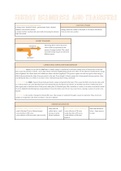
SANKEY DIAGRAMS
The energy flow is shown by arrows
whose width is proportional to the
amount of energy involved. The wasted
and useful energy outputs are shown by
different arrows.
CONDUCTION, CONVECTION AND RADIATION
CONDUCTION happens as one end of a solid object is heated, energy is transferred to the kinetic energy stores of the particles in that end.
This causes the particles to vibrate , and so they vibrate with their neighbouring particles more often. As the collisions transfer kinetic energy,
their neighbours also vibrate faster and collide more often with their neighbours. This process repeats over and over again so that energy is
effectively passed along the object from one particle to the next. Even though it's kinetic energy that's being passed between particles, when
considering the object as a whole we say that it's heat / thermal energy that's being transferred.
CONVECTION As a fluid is heated, the particles gain kinetic energy and spread further apart. This causes the fluid to become less dense and
so it will rise above any cooler fluid that hasn't been heated (because that fluid is more dense). As the fluid cools down it will become more
dense again, and so sink back down. If this process takes place in a limited space, like a container or a room, it can create a convection current.
(It can be helpful by distributing heat energy (radiator) to heat the whole room. Hot air rises away from it, creating a current of cool air to be
heated).
RADIATION is the transfer of energy by infrared (IR) waves. Heat energy is transferred through a vacuum (no particles). These travel very
quickly in straight lines. The hotter an object is, the more radiation.
EMISSION & RADIATION
POLISHED / SHINY / LIGHT SURFACES shiny reflect & MATT / DARK / BLACK SURFACES dark emmit & absorb
- good reflecting IR waves (thermal energy) radiate better = small - poor reflectors of IR waves better = large increase
- poor absorbers of IR waves increase in temp - good absorbers of IR waves in temp
- poor radiators of IR waves (don’t emit it easily) (better insulators) - good radiators of IR waves
(emitors)
● energy stores: chemical, kinetic, gravitational, elastic, thermal,
magnetic, electrostatic, nuclear Energy cannot be created or destroyed, it can only be transferred
● energy transfers: mechanically, electrically, by heating, by radiation from one form into another.
(light and sound)
SANKEY DIAGRAMS
The energy flow is shown by arrows
whose width is proportional to the
amount of energy involved. The wasted
and useful energy outputs are shown by
different arrows.
CONDUCTION, CONVECTION AND RADIATION
CONDUCTION happens as one end of a solid object is heated, energy is transferred to the kinetic energy stores of the particles in that end.
This causes the particles to vibrate , and so they vibrate with their neighbouring particles more often. As the collisions transfer kinetic energy,
their neighbours also vibrate faster and collide more often with their neighbours. This process repeats over and over again so that energy is
effectively passed along the object from one particle to the next. Even though it's kinetic energy that's being passed between particles, when
considering the object as a whole we say that it's heat / thermal energy that's being transferred.
CONVECTION As a fluid is heated, the particles gain kinetic energy and spread further apart. This causes the fluid to become less dense and
so it will rise above any cooler fluid that hasn't been heated (because that fluid is more dense). As the fluid cools down it will become more
dense again, and so sink back down. If this process takes place in a limited space, like a container or a room, it can create a convection current.
(It can be helpful by distributing heat energy (radiator) to heat the whole room. Hot air rises away from it, creating a current of cool air to be
heated).
RADIATION is the transfer of energy by infrared (IR) waves. Heat energy is transferred through a vacuum (no particles). These travel very
quickly in straight lines. The hotter an object is, the more radiation.
EMISSION & RADIATION
POLISHED / SHINY / LIGHT SURFACES shiny reflect & MATT / DARK / BLACK SURFACES dark emmit & absorb
- good reflecting IR waves (thermal energy) radiate better = small - poor reflectors of IR waves better = large increase
- poor absorbers of IR waves increase in temp - good absorbers of IR waves in temp
- poor radiators of IR waves (don’t emit it easily) (better insulators) - good radiators of IR waves
(emitors)


