Energy Change & Rates of Reactions:
Enthalpy: (H) Measure of the internal energy (Ep) of reactants or products
Heat of reaction: Net change of chemical potential energy of the system ¢H
Temperature: Average kinetic energy of composing particles
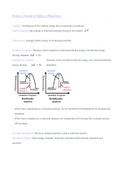
Exothermic reaction: Reaction which transforms chemical potential energy into thermal energy
(Energy released: ¢H < 0 )
Endothermic reaction: Reaction which transforms thermal energy into chemical potential
energy (Energy ¢H > 0 ) absorbed:
• When heat is absorbed by a chemical reaction, Ep will increase and temperature will decrease (Ek
decrease)
• When heat is released by a chemical reaction, the temperature will increase (Ek increase) and Ep
will decrease
Activation energy (Ea): Minimum energy required to start a chemical reaction
Activated complex: High energy, unstable, temporary transition state between reactants and
products
, Collision theory:
In order for reaction to take place, colliding molecules must have:
• Correct orientation
• Kinetic energy equal to or bigger than the activation energy of reaction
• If Ek1 + Ek2 ¸ Ea then a successful collision occurs
• If Ek1 + Ek2 < Ea then no reaction is possible
Catalyst: Substance that increases the rate of reaction but remains unchanged at the end of the
reaction
(Catalyst works by providing an alternate path between reactants and products. This path has a
lower activation energy)
Rate of reaction: Change in concentration per unit time of either a reactant or product
¢c
• Rate =
¢t
• Factors that a ect rate:
- Nature of reacting substances (can't change)
- Temperature
- Catalyst
- Pressure (gas)
- Concentration (liquid)
Enthalpy: (H) Measure of the internal energy (Ep) of reactants or products
Heat of reaction: Net change of chemical potential energy of the system ¢H
Temperature: Average kinetic energy of composing particles
Exothermic reaction: Reaction which transforms chemical potential energy into thermal energy
(Energy released: ¢H < 0 )
Endothermic reaction: Reaction which transforms thermal energy into chemical potential
energy (Energy ¢H > 0 ) absorbed:
• When heat is absorbed by a chemical reaction, Ep will increase and temperature will decrease (Ek
decrease)
• When heat is released by a chemical reaction, the temperature will increase (Ek increase) and Ep
will decrease
Activation energy (Ea): Minimum energy required to start a chemical reaction
Activated complex: High energy, unstable, temporary transition state between reactants and
products
, Collision theory:
In order for reaction to take place, colliding molecules must have:
• Correct orientation
• Kinetic energy equal to or bigger than the activation energy of reaction
• If Ek1 + Ek2 ¸ Ea then a successful collision occurs
• If Ek1 + Ek2 < Ea then no reaction is possible
Catalyst: Substance that increases the rate of reaction but remains unchanged at the end of the
reaction
(Catalyst works by providing an alternate path between reactants and products. This path has a
lower activation energy)
Rate of reaction: Change in concentration per unit time of either a reactant or product
¢c
• Rate =
¢t
• Factors that a ect rate:
- Nature of reacting substances (can't change)
- Temperature
- Catalyst
- Pressure (gas)
- Concentration (liquid)