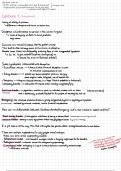
Chapter 7: Investment Decision Rules
- The NPV investment rule is the decision rule that managers should use to maximize firm
value
7.1 NPV and Stand-Alone Project
- NPV Investment Rule: When making an investment decision, take the alternative with the
highest NPV. Choosing this alternative is equivalent to receiving its NPV in cash today.
● Applying the NPV Rule
NPV = initial investment + Year 1 cash / r
- It explains how much a project will increase the value of the firm in the present value.
● The NPV Profile and IRR
○ An NPV profile is a graph of the project’s NPV over a range of discount rates.
○ The internal rate of return (IRR) of an investment is the discount rate that sets the
NPV of the project’s cash flows equal to zero.
● Alternative Rules Versus the NPV Rule
○ Other rules exist besides the NPV rule for making investment decisions, and these
may sometimes contradict.
7.2 The Internal Rate of Return Rule
- The internal rate of return (IRR) investment rule says to take any investment opportunity
where the IRR exceeds the opportunity cost of capital. Turn down any opportunity whose
IRR is less than the opportunity cost of capital.
1
, ● Applying the IRR Rule
○ Applied to single, stand-alone projects within the firm
○ Might give the same answer as the NPV
○ The IRR rule is only guaranteed to work for a stand-alone project if all of the
project’s negative cash flow proceeds its positive cash flows.
● Pitfall #1: Delayed Investments
○ The IRR is found by setting the NPV equal to zero and solving for r.
○ Accept the project if the IRR is greater than the opportunity cost.
○ IRR indicates how sensitive the investment decision is to uncertainty in the cost of
capital estimate
● Pitfall #2: Multiple IRRS
○ When there is more than one IRR you can’t apply the rule
■ However, they are useful bound on the cost of capital
● Pitfall #3: Nonexistent IRR
○ The IRR can only be used if all of the negative cash flows of the project proceed
the positive cash flows.
7.3 The Payback Rule
- The payback rule is used as an alternative decision rule for a single, stand-alone project
within the firm.
- The payback investment rule states that you should only accept a project if its cash flows
pay back its initial investment within a prespecified period.
- The payback period is the amount of time it takes to pay back the initial investment.
● Applying the Payback Rule
2
- The NPV investment rule is the decision rule that managers should use to maximize firm
value
7.1 NPV and Stand-Alone Project
- NPV Investment Rule: When making an investment decision, take the alternative with the
highest NPV. Choosing this alternative is equivalent to receiving its NPV in cash today.
● Applying the NPV Rule
NPV = initial investment + Year 1 cash / r
- It explains how much a project will increase the value of the firm in the present value.
● The NPV Profile and IRR
○ An NPV profile is a graph of the project’s NPV over a range of discount rates.
○ The internal rate of return (IRR) of an investment is the discount rate that sets the
NPV of the project’s cash flows equal to zero.
● Alternative Rules Versus the NPV Rule
○ Other rules exist besides the NPV rule for making investment decisions, and these
may sometimes contradict.
7.2 The Internal Rate of Return Rule
- The internal rate of return (IRR) investment rule says to take any investment opportunity
where the IRR exceeds the opportunity cost of capital. Turn down any opportunity whose
IRR is less than the opportunity cost of capital.
1
, ● Applying the IRR Rule
○ Applied to single, stand-alone projects within the firm
○ Might give the same answer as the NPV
○ The IRR rule is only guaranteed to work for a stand-alone project if all of the
project’s negative cash flow proceeds its positive cash flows.
● Pitfall #1: Delayed Investments
○ The IRR is found by setting the NPV equal to zero and solving for r.
○ Accept the project if the IRR is greater than the opportunity cost.
○ IRR indicates how sensitive the investment decision is to uncertainty in the cost of
capital estimate
● Pitfall #2: Multiple IRRS
○ When there is more than one IRR you can’t apply the rule
■ However, they are useful bound on the cost of capital
● Pitfall #3: Nonexistent IRR
○ The IRR can only be used if all of the negative cash flows of the project proceed
the positive cash flows.
7.3 The Payback Rule
- The payback rule is used as an alternative decision rule for a single, stand-alone project
within the firm.
- The payback investment rule states that you should only accept a project if its cash flows
pay back its initial investment within a prespecified period.
- The payback period is the amount of time it takes to pay back the initial investment.
● Applying the Payback Rule
2