

Lecture 1: Introduction to river systems
Also look more upslope at alpine hillslope biogeomorphology and coastal biogeomorphology.
System = a set of objects together with relationships between the objects and their attributes.
Objects include river processes, materials and landforms. All of these objects have own attributes.
Geomorphological systems
1. Morphological system (simplest system type). Set of interrelated forms, static e.g. bar,
channel pattern and bedforms. It only considers forms, which are not changing.
2. Process or cascading systems (system type with flow). Forms are connected by pathways of
energy/matter transport, e.g. input and output of sediments. For example in a bar gravel in
and out put. The forms will change in this system.
3. Process-response system (system type with feedbacks). Form changes by energy or sediment
transport that affects other forms and flows, with feedbacks. For example bar and meander
bend.
4. Control system (system type with human impact). Form change or feedbacks inhibited. We
might not want a meander to move, so we make a gravel bed that makes it put in place.
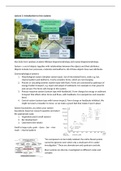
System boundaries, you select your system
boundaries based on research question and select
the appropriate scale.
1. Vegetation patch (small system)
2. Bar development
3. Catchment (the whole)
Small to large scale: grain – dune – bar – river
reach – channel pattern
“No component can be totally isolated, the entire fluvial system
cannot be ignored, even when only a small part of it is under
investigation.” There are downstream and upstream controls.
River systems are diverse, investigated on different scales and
complex
,Lecture 2: River processes and materials: Flow
Channel geometry.
- Width (W) in m
- Depth (h) in m
- Channel slope (S) in m/m
- Mean flow velocity (u) in m/s
Based on these variables, we can characterize a water flow. If the discharge
(how much water passes through a river) is steady in time, it is a steady
flow. When the discharge changes over time it is an unsteady flow. This is a
question of scale.
If all particles in the water move in the same direction along a parallel
streamline, there is a uniform flow. This is possible in the slope and cross
section are constant and there is no change in depth or velocity along reach
parallel streamline. If the streamlines are no longer parallel due to
bends, obstacles etc, it is a non-uniform flow.
Gravity acts against the forces within the water, like:
- intermolecular forces: bonding between particles or
molecules that determine the velocity of water (v in m 2/s)
- friction between layers of movement
- friction of the surface which leads to flow resistance
- inertial forces: depends on the mass of water
- Fluid density ( ρ =1000 kg/m3).
We characterize the flow of water depending on relationship between inertial (flow velocity/depth)
u
and gravitational forces (g). This is calculated in the Froude number: Fr= . If this number is
√ gh
below 1, it is a subcritical flow which is a slow flow and occurs in most natural channels. If it is above
1 it is a supercritical flow, which is a rapid flow which causes less turbulent mixing, so there is less
deviation from downstream direction of flow, so the flow is more efficiently. If it is precisely 1, it is a
critical flow. When there is a hydraulic drop, there is an increase in slope, which reduces the depth
and it goes from subcritical to supercritical flow. When there is a hydraulic jump, there is a decrease
in slope, which increases the depth, and then it goes back to subcritical, while there is still inertia of
fast flow and this continues along river bed before pulled up. E.g. river surf.
How water flows also depends on a relationship between inertial (flow velocity/depth) and viscous
uh
forces. This can be calculated by the Reynolds number : ℜ= . If this number is below 500 it is a
v
laminar flow in which the viscous forces are high and the flow moves as a series of layers on top of
each other. If the number is above 2000 it is a turbulent flow in which the inertial forces are high and
there is horizontal and vertical swirling motions where water is flowing in all directions.
There are different layers within the water column. In the top there is a
free stream layer where there is a constant maximum flow velocity (no
friction). The other part is the boundary layer (have friction) with a
outer layer with high velocity, logarithmic layer (velocity increases
logarithmically), a buffer layer and at the bed there is viscous sublayer.
If the particles are smaller than the viscous sublayer, there is a
, hydraulically smooth surface and if they stick out there is a hydraulically rough surface. This viscous
sublayer decreases with increases velocity.
How quick water flows depends on the channel geometry, gravity and forces in the water.
The flow velocity depends on the channel cross
section and the friction at the river bed boundary.
The flow velocity is decreasing with increasing water
depth, so we look at mean flow velocity. This is very
difficult and unsolved, so semi-empirical approaches
are used. For this several new factors are needed
- Hydraulic radius (R) = Wh/(W+2h) = h for
wide river.
- Rougness/friction factors: C, n and f
Different approaches
R2 ∕ 3 S 1 ∕ 2
1. Manning equation: u= with n = manning roughness coefficient look up table
n
12 R
2. Chezy equation: u=C √ RS with C=18 log . Ks is the nikuradse roughness length,
ks
which is dependent on the grain size.
3. Darcy-Weisbach equation: u=
√ 8 gRS
f √8
with =5.74 log 12.2
dimensional so you can also use it on mars.
f
R
(
ks )
. This one is non-
With the mean flow velocity and cross sectional area, the discharge can be calculated: Q = uhW in
m3/s. h and Q are typically measured at gauging stations, which can be used to calculate the flow
velocity.
The strength of flowing water is dependent on the flow bed shear stress, which depends on fluid
density, gravity, water depth and the channel slope: τ =ρgh sin [ S ] ∈N /m2. For a small channel slope
gradient it is approximately τ =ρghS . If we know how strong this is, we know how much sediment
will be transported.
Stream power is how well flowing water can erode. Specific stream power depends on flow velocity
and flow bed shear stress: ω=uτ ∈W /m . You can compare strengths of rivers for erosion.
When water flows across an obstacle (e.g. dams,
bridges, vegetation, large bedforms), there is a
slowing of water. This is called the backwater effect,
which depends on water depth and bed slope
h
gradient: λ= .
3S
Also look more upslope at alpine hillslope biogeomorphology and coastal biogeomorphology.
System = a set of objects together with relationships between the objects and their attributes.
Objects include river processes, materials and landforms. All of these objects have own attributes.
Geomorphological systems
1. Morphological system (simplest system type). Set of interrelated forms, static e.g. bar,
channel pattern and bedforms. It only considers forms, which are not changing.
2. Process or cascading systems (system type with flow). Forms are connected by pathways of
energy/matter transport, e.g. input and output of sediments. For example in a bar gravel in
and out put. The forms will change in this system.
3. Process-response system (system type with feedbacks). Form changes by energy or sediment
transport that affects other forms and flows, with feedbacks. For example bar and meander
bend.
4. Control system (system type with human impact). Form change or feedbacks inhibited. We
might not want a meander to move, so we make a gravel bed that makes it put in place.
System boundaries, you select your system
boundaries based on research question and select
the appropriate scale.
1. Vegetation patch (small system)
2. Bar development
3. Catchment (the whole)
Small to large scale: grain – dune – bar – river
reach – channel pattern
“No component can be totally isolated, the entire fluvial system
cannot be ignored, even when only a small part of it is under
investigation.” There are downstream and upstream controls.
River systems are diverse, investigated on different scales and
complex
,Lecture 2: River processes and materials: Flow
Channel geometry.
- Width (W) in m
- Depth (h) in m
- Channel slope (S) in m/m
- Mean flow velocity (u) in m/s
Based on these variables, we can characterize a water flow. If the discharge
(how much water passes through a river) is steady in time, it is a steady
flow. When the discharge changes over time it is an unsteady flow. This is a
question of scale.
If all particles in the water move in the same direction along a parallel
streamline, there is a uniform flow. This is possible in the slope and cross
section are constant and there is no change in depth or velocity along reach
parallel streamline. If the streamlines are no longer parallel due to
bends, obstacles etc, it is a non-uniform flow.
Gravity acts against the forces within the water, like:
- intermolecular forces: bonding between particles or
molecules that determine the velocity of water (v in m 2/s)
- friction between layers of movement
- friction of the surface which leads to flow resistance
- inertial forces: depends on the mass of water
- Fluid density ( ρ =1000 kg/m3).
We characterize the flow of water depending on relationship between inertial (flow velocity/depth)
u
and gravitational forces (g). This is calculated in the Froude number: Fr= . If this number is
√ gh
below 1, it is a subcritical flow which is a slow flow and occurs in most natural channels. If it is above
1 it is a supercritical flow, which is a rapid flow which causes less turbulent mixing, so there is less
deviation from downstream direction of flow, so the flow is more efficiently. If it is precisely 1, it is a
critical flow. When there is a hydraulic drop, there is an increase in slope, which reduces the depth
and it goes from subcritical to supercritical flow. When there is a hydraulic jump, there is a decrease
in slope, which increases the depth, and then it goes back to subcritical, while there is still inertia of
fast flow and this continues along river bed before pulled up. E.g. river surf.
How water flows also depends on a relationship between inertial (flow velocity/depth) and viscous
uh
forces. This can be calculated by the Reynolds number : ℜ= . If this number is below 500 it is a
v
laminar flow in which the viscous forces are high and the flow moves as a series of layers on top of
each other. If the number is above 2000 it is a turbulent flow in which the inertial forces are high and
there is horizontal and vertical swirling motions where water is flowing in all directions.
There are different layers within the water column. In the top there is a
free stream layer where there is a constant maximum flow velocity (no
friction). The other part is the boundary layer (have friction) with a
outer layer with high velocity, logarithmic layer (velocity increases
logarithmically), a buffer layer and at the bed there is viscous sublayer.
If the particles are smaller than the viscous sublayer, there is a
, hydraulically smooth surface and if they stick out there is a hydraulically rough surface. This viscous
sublayer decreases with increases velocity.
How quick water flows depends on the channel geometry, gravity and forces in the water.
The flow velocity depends on the channel cross
section and the friction at the river bed boundary.
The flow velocity is decreasing with increasing water
depth, so we look at mean flow velocity. This is very
difficult and unsolved, so semi-empirical approaches
are used. For this several new factors are needed
- Hydraulic radius (R) = Wh/(W+2h) = h for
wide river.
- Rougness/friction factors: C, n and f
Different approaches
R2 ∕ 3 S 1 ∕ 2
1. Manning equation: u= with n = manning roughness coefficient look up table
n
12 R
2. Chezy equation: u=C √ RS with C=18 log . Ks is the nikuradse roughness length,
ks
which is dependent on the grain size.
3. Darcy-Weisbach equation: u=
√ 8 gRS
f √8
with =5.74 log 12.2
dimensional so you can also use it on mars.
f
R
(
ks )
. This one is non-
With the mean flow velocity and cross sectional area, the discharge can be calculated: Q = uhW in
m3/s. h and Q are typically measured at gauging stations, which can be used to calculate the flow
velocity.
The strength of flowing water is dependent on the flow bed shear stress, which depends on fluid
density, gravity, water depth and the channel slope: τ =ρgh sin [ S ] ∈N /m2. For a small channel slope
gradient it is approximately τ =ρghS . If we know how strong this is, we know how much sediment
will be transported.
Stream power is how well flowing water can erode. Specific stream power depends on flow velocity
and flow bed shear stress: ω=uτ ∈W /m . You can compare strengths of rivers for erosion.
When water flows across an obstacle (e.g. dams,
bridges, vegetation, large bedforms), there is a
slowing of water. This is called the backwater effect,
which depends on water depth and bed slope
h
gradient: λ= .
3S


