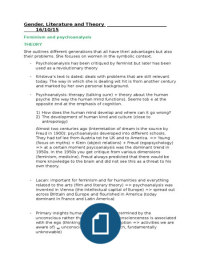
Gender, Literature and Theory
16/10/15
Feminism and psychoanalysis
THEORY
She outlines different generations that all have theri advantages but also
their problems. She focuses on women in the symbolic context.
- Psycholoanalysis has been critiqued by feminist but later has been
used as a revolutionary theory
- Kristeva’s text is dated: deals with problems that are still relevant
today. The way in which she is dealing wit hit is from another century
and marked by her own personal background.
- Psychoanalysis: therapy (talking cure) + theory about the human
psyche (the way the human mind functions). Seems tob e at the
opposite end at the emphasis of cognition.
1) How does the human mind develop and where can it go wrong?
2) The development of human kind and culture (close to
antropology)
Almost two centuries ago (Interretation of dream is the source by
Freud in 1900): psychoanalysis developed into different schools.
They had tof lee from Austria tot he UK and to America. => Young
(focus on myths) + Klein (object relations) + Freud (egopsychology)
=> at a certain moment psycoanalysis was the dominant trend in
1950s. In the 1950s you get critique from various dimensions
(feminism, medicine). Freud always predicted that there would be
more knowledge to the brain and did not see this as a threat to his
own theory.
- Lacan: important for feminism and for humanities and everything
related to the arts (film and literary theory) => psychoanalysis was
invented in Vienna (the intellectual capital of Europe) => spread out
across Brittain and Europe and flourished in America (today
dominant in France and Latin America)
- Primary insights human functioning is determined by the
unconscious rather than the conscious. Conscienceness is associated
with the ego (thinking, memory and perception => activities we are
aware of) unconscious (beyond our reach, fundamentally
unknowable)
, - You approach the unsconscious indirectly (analysis of symptoms,
dreams and parapractice: accidental mistakes (verspreking)) =>
small details are relevant tow hat is going on in the unconscious
- Drives: human version of instincts: determined by biology:
organisms get a kind of energy, called instinct, mechanism for
survival, and we always want to preserve the species (sexuality): in
humans, instincts do always have a psychological component. The
sexual impulse is strong but in a human culture it’s related to
fantasies, rituals, restraints and a whole cultural elaboration =>
drive = border category between body and mind. Two basic drives
are life and death
- Goal of drive: force/power that wants to acheive something. Goal =
satisfaction or lust = abreaction of tension: when the tension is
released you experience a sense of lust (the avoidance of
displeasure)
- Pleasure principle reality principle (everything imposed by
society)
- Importance of infancy: most important face in your life is between 0
and 5: gender distinction is very important in this phase =>
sexuality as one of the most important things driving human beings.
Also related is the idea of castration and Oedipus complex.
- No strict limit between normal and pathology => we are all neurotic
and have characteristics of certain pathologies. In real pathology
they go beyond a certain limit. Neurosis: disturbance of relationship
between subject and object (other people around you or the world).
Neurotics are still able to talk and think so can be cured
psychosis: problem with subject itself and relationship between
language and reality is disturbed. Much more serious pathology and
dangerous fort he self and others. Freud thinks it’s not treatable by
psychoanalysis like neurosis is => Kristeva also makes a clear
distinction between these two. + hysteria: associated with women
and repressive social environment (19th century women staying at
homa, feeling confined and they expressed their pain through the
body. Developed symptoms that had no biological cause and Freud
discovered they were related to psychological problems and
problems in early childhood). Present day hysteria = anorexia or
burn out.
- Important in 20th century: developed a new vocabulary: influential in
the human sciences but literary theory. Power in penetrating the
imagination about the human psyche because it was so closely
16/10/15
Feminism and psychoanalysis
THEORY
She outlines different generations that all have theri advantages but also
their problems. She focuses on women in the symbolic context.
- Psycholoanalysis has been critiqued by feminist but later has been
used as a revolutionary theory
- Kristeva’s text is dated: deals with problems that are still relevant
today. The way in which she is dealing wit hit is from another century
and marked by her own personal background.
- Psychoanalysis: therapy (talking cure) + theory about the human
psyche (the way the human mind functions). Seems tob e at the
opposite end at the emphasis of cognition.
1) How does the human mind develop and where can it go wrong?
2) The development of human kind and culture (close to
antropology)
Almost two centuries ago (Interretation of dream is the source by
Freud in 1900): psychoanalysis developed into different schools.
They had tof lee from Austria tot he UK and to America. => Young
(focus on myths) + Klein (object relations) + Freud (egopsychology)
=> at a certain moment psycoanalysis was the dominant trend in
1950s. In the 1950s you get critique from various dimensions
(feminism, medicine). Freud always predicted that there would be
more knowledge to the brain and did not see this as a threat to his
own theory.
- Lacan: important for feminism and for humanities and everything
related to the arts (film and literary theory) => psychoanalysis was
invented in Vienna (the intellectual capital of Europe) => spread out
across Brittain and Europe and flourished in America (today
dominant in France and Latin America)
- Primary insights human functioning is determined by the
unconscious rather than the conscious. Conscienceness is associated
with the ego (thinking, memory and perception => activities we are
aware of) unconscious (beyond our reach, fundamentally
unknowable)
, - You approach the unsconscious indirectly (analysis of symptoms,
dreams and parapractice: accidental mistakes (verspreking)) =>
small details are relevant tow hat is going on in the unconscious
- Drives: human version of instincts: determined by biology:
organisms get a kind of energy, called instinct, mechanism for
survival, and we always want to preserve the species (sexuality): in
humans, instincts do always have a psychological component. The
sexual impulse is strong but in a human culture it’s related to
fantasies, rituals, restraints and a whole cultural elaboration =>
drive = border category between body and mind. Two basic drives
are life and death
- Goal of drive: force/power that wants to acheive something. Goal =
satisfaction or lust = abreaction of tension: when the tension is
released you experience a sense of lust (the avoidance of
displeasure)
- Pleasure principle reality principle (everything imposed by
society)
- Importance of infancy: most important face in your life is between 0
and 5: gender distinction is very important in this phase =>
sexuality as one of the most important things driving human beings.
Also related is the idea of castration and Oedipus complex.
- No strict limit between normal and pathology => we are all neurotic
and have characteristics of certain pathologies. In real pathology
they go beyond a certain limit. Neurosis: disturbance of relationship
between subject and object (other people around you or the world).
Neurotics are still able to talk and think so can be cured
psychosis: problem with subject itself and relationship between
language and reality is disturbed. Much more serious pathology and
dangerous fort he self and others. Freud thinks it’s not treatable by
psychoanalysis like neurosis is => Kristeva also makes a clear
distinction between these two. + hysteria: associated with women
and repressive social environment (19th century women staying at
homa, feeling confined and they expressed their pain through the
body. Developed symptoms that had no biological cause and Freud
discovered they were related to psychological problems and
problems in early childhood). Present day hysteria = anorexia or
burn out.
- Important in 20th century: developed a new vocabulary: influential in
the human sciences but literary theory. Power in penetrating the
imagination about the human psyche because it was so closely