COMPLIANCE AND PULMONARY CIRCULATION
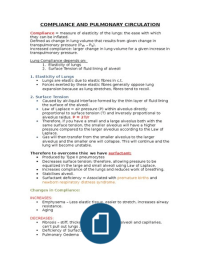
Compliance = measure of elasticity of the lungs: the ease with which
they can be inflated.
Defined as change in lung volume that results from given change in
transpulmonary pressure (Palv – Pip).
Increased compliance: larger change in lung volume for a given increase in
transpulmonary pressure.
Lung Compliance depends on:
1. Elasticity of lungs
2. Surface Tension of fluid lining of alveoli
1. Elasticity of Lungs
Lungs are elastic due to elastic fibres in c.t.
Forces exerted by these elastic fibres generally oppose lung
expansion because as lung stretches, fibres tend to recoil.
2. Surface Tension
Caused by air-liquid interface formed by the thin layer of fluid lining
the surface of the alveoli.
Law of Laplace = air pressure (P) within alveolus directly
proportional to surface tension (T) and inversely proportional to
alveolus raidus. P = 2T/r
Therefore, if you have a small and a large alveolus both with the
same surface tension, the smaller alveolus will have a higher
pressure compared to the larger alveolus according to the Law of
Laplace.
Gas will then transfer from the smaller alveolus to the larger
alveolus and the smaller one will collapse. This will continue and the
lung will become unstable.
Therefore to overcome this: we have surfactant:
Produced by Type II pneumocytes
Decreases surface tension; therefore, allowing pressure to be
equalized in the large and small alveoli using Law of Laplace.
Increases compliance of the lungs and reduces work of breathing.
Stabilises alveoli.
Surfactant deficiency = Associated with premature births and
newborn respiratory distress syndrome.
Changes in Compliance:
INCREASES:
Emphysema – Less elastic tissue, easier to stretch, increases airway
resistance.
Aging
DECREASES:
Fibrosis – stiff, thickening of wall between alveoli and capillaries,
can’t pull out lungs , decreased FVC.
Deficiency of Surfactant
Pulmonary Oedema
Compliance = measure of elasticity of the lungs: the ease with which
they can be inflated.
Defined as change in lung volume that results from given change in
transpulmonary pressure (Palv – Pip).
Increased compliance: larger change in lung volume for a given increase in
transpulmonary pressure.
Lung Compliance depends on:
1. Elasticity of lungs
2. Surface Tension of fluid lining of alveoli
1. Elasticity of Lungs
Lungs are elastic due to elastic fibres in c.t.
Forces exerted by these elastic fibres generally oppose lung
expansion because as lung stretches, fibres tend to recoil.
2. Surface Tension
Caused by air-liquid interface formed by the thin layer of fluid lining
the surface of the alveoli.
Law of Laplace = air pressure (P) within alveolus directly
proportional to surface tension (T) and inversely proportional to
alveolus raidus. P = 2T/r
Therefore, if you have a small and a large alveolus both with the
same surface tension, the smaller alveolus will have a higher
pressure compared to the larger alveolus according to the Law of
Laplace.
Gas will then transfer from the smaller alveolus to the larger
alveolus and the smaller one will collapse. This will continue and the
lung will become unstable.
Therefore to overcome this: we have surfactant:
Produced by Type II pneumocytes
Decreases surface tension; therefore, allowing pressure to be
equalized in the large and small alveoli using Law of Laplace.
Increases compliance of the lungs and reduces work of breathing.
Stabilises alveoli.
Surfactant deficiency = Associated with premature births and
newborn respiratory distress syndrome.
Changes in Compliance:
INCREASES:
Emphysema – Less elastic tissue, easier to stretch, increases airway
resistance.
Aging
DECREASES:
Fibrosis – stiff, thickening of wall between alveoli and capillaries,
can’t pull out lungs , decreased FVC.
Deficiency of Surfactant
Pulmonary Oedema