Revolution No Revolution
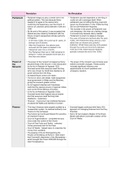
Parliament • Parliament began to play a central role in the • Parliament was still dependent on the King. It
political system. This was because Henry could not call or prorogue itself. When
needed it to agree to the various Acts parliament was not sitting the King could still
con rming his Supremacy over the Church. It govern by Proclamation. In the 1540s the King
met for an unbroken period between 1529 and did not call Parliament frequently
1536. • The increase in the power of Parliament was
• By the end of this period, it was accepted that only temporary: this was not a lasting change.
statute law (law made by Parliament with the It occurred only because Henry needed
King’s consent) represented ultimate authority Parliament to enact his religious changes.
in England. • The uses of Parliament declined after the early
• In the early 1530s, the Lords had 51 peers, 21 1530s, with Parliament being used as a tool
bishops and 29 abbots rather than an inherent and powerful
• After the Dissolution, the abbots were institution. Whilst there were key Acts passed
removed and the peers increased to 55. through the Lords and Commons between
Clergymen were now a minority 1532 and 1540, these became relatively
• The Parliament that met in 1529 remained in sporadic towards the end of the 1530s
being for 7 years and passed more laws at a
time than ever before
Power of • The power of the monarch increased as Henry • The power of the monarch was immense even
the became Head of the Church: in the introduction before Cromwell’s changes. These powers
Monarch to the Act in Restraint of Appeals 1533, included signi cant in uence over
Cromwell wrote that everyone owed the King appointments to church positions and
(who was chosen by God) total obedience; all emergency taxation.
power derived from the King.
• Increased Royal control over realm;
• The Act of Union with Wales 1536 reorganised
local government in Wales and the Marches,
giving the monarch greater control.
• An Act against Liberties and Franchises
restricted the special powers of regional nobles,
such as the Prince Bishop of Durham.
• In the Act of Restraint of Appeals (1533),
Cromwell wrote that England was an empire
and that everyone owed the King total
obedience - supremacy
• However - royal power was scattered because
of places like Wales and liberties in Durham
Finance • The king's nances were properly audited by a • Cromwell largely continued with Henry VII’s
bureaucratic system. he restored authority over approach of managing nances from the Privy
nance to the exchequer. Chamber.
• The Tudors had continued Edward IV's practice • Henry VII had created a Master of the King’s
of Chamber Finance Wards well before Cromwell’s creation of the
• Court of Augmentations - controlled the land Court of Wards.
once under the control of the Church
• Court of First Fruits and Tenths - collected
money previously sent to the Pope
• Court of Wards - helped Henry to maximise his
money from wardship
• The passing of the Act Extinguishing the
Powers of the Bishop of Rome in 1536 meant
that Cromwell’s dissolution of the Monasteries –
which brought the Crown £320,000 through the
Valor Ecclesiasticus.
fi fi
fi fi fl fi
Parliament • Parliament began to play a central role in the • Parliament was still dependent on the King. It
political system. This was because Henry could not call or prorogue itself. When
needed it to agree to the various Acts parliament was not sitting the King could still
con rming his Supremacy over the Church. It govern by Proclamation. In the 1540s the King
met for an unbroken period between 1529 and did not call Parliament frequently
1536. • The increase in the power of Parliament was
• By the end of this period, it was accepted that only temporary: this was not a lasting change.
statute law (law made by Parliament with the It occurred only because Henry needed
King’s consent) represented ultimate authority Parliament to enact his religious changes.
in England. • The uses of Parliament declined after the early
• In the early 1530s, the Lords had 51 peers, 21 1530s, with Parliament being used as a tool
bishops and 29 abbots rather than an inherent and powerful
• After the Dissolution, the abbots were institution. Whilst there were key Acts passed
removed and the peers increased to 55. through the Lords and Commons between
Clergymen were now a minority 1532 and 1540, these became relatively
• The Parliament that met in 1529 remained in sporadic towards the end of the 1530s
being for 7 years and passed more laws at a
time than ever before
Power of • The power of the monarch increased as Henry • The power of the monarch was immense even
the became Head of the Church: in the introduction before Cromwell’s changes. These powers
Monarch to the Act in Restraint of Appeals 1533, included signi cant in uence over
Cromwell wrote that everyone owed the King appointments to church positions and
(who was chosen by God) total obedience; all emergency taxation.
power derived from the King.
• Increased Royal control over realm;
• The Act of Union with Wales 1536 reorganised
local government in Wales and the Marches,
giving the monarch greater control.
• An Act against Liberties and Franchises
restricted the special powers of regional nobles,
such as the Prince Bishop of Durham.
• In the Act of Restraint of Appeals (1533),
Cromwell wrote that England was an empire
and that everyone owed the King total
obedience - supremacy
• However - royal power was scattered because
of places like Wales and liberties in Durham
Finance • The king's nances were properly audited by a • Cromwell largely continued with Henry VII’s
bureaucratic system. he restored authority over approach of managing nances from the Privy
nance to the exchequer. Chamber.
• The Tudors had continued Edward IV's practice • Henry VII had created a Master of the King’s
of Chamber Finance Wards well before Cromwell’s creation of the
• Court of Augmentations - controlled the land Court of Wards.
once under the control of the Church
• Court of First Fruits and Tenths - collected
money previously sent to the Pope
• Court of Wards - helped Henry to maximise his
money from wardship
• The passing of the Act Extinguishing the
Powers of the Bishop of Rome in 1536 meant
that Cromwell’s dissolution of the Monasteries –
which brought the Crown £320,000 through the
Valor Ecclesiasticus.
fi fi
fi fi fl fi