

Medical Surgical Nursing Notes
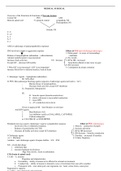
MEDICAL SURGICAL Overview of the Structures & Functions of Nervous System Central NS PNS ANS Brain & spinal cord 31 spinal & cranial sympathetic NS Parasypathatic NS Somatic NS C- 8 T- 12 L- 5 S- 5 C- 1 ANS (or adrenergic of parasympatholitic response) SNS involved in fight or aggression response Effects of SNS (anti-cholinergic/adrenergic) 1. Dilate pupil – to aware of surroundings Release of norepinephrine (adrenaline – cathecolamine) - medriasis Adrenal medulla (potent vasoconstrictor) 2. Dry mouth Increases body activities VS = Increase 3. BP & HR= increased Except GIT – decrease GITmotility bronchioles dilated to take more oxygen 4. RR increased * Why GIT is not increased = GIT is not important! 5. Constipation & urinary retention Increase blood flow to skeletal muscles, brain & heart. I. Adrenergic Agents – Epinephrine (adrenaline) SE: SNS effect II. PNS: Beta adrenergic blocking agents (opposite of adrenergic agents) (all end in –‘lol’) - Blocks release of norepinephrine. - Decrease body activities except GIT (diarrhea) Ex. Propanolol, Metopanolol SE: B – broncho spasm (bronchoconstriction) E – elicits a decrease in myocardial contraction T – treats HPN A – AV conduction slows down Given to angina & MI – beta-blockers to rest heart Anti HPN agents: 1. Beta blockers (-lol) 2. Ace inhibitors (-pril) ex ENALAPRIL, CAPTOPRIL 3. Calcium antagonist ex CALCIBLOC or NEFEDIPINE Peripheral nervous system: cholinergic/ vagal or sympatholitic response Effect of PNS: (cholinergic) - Involved in fly or withdrawal response 1. Meiosis – contraction of pupils - Release of acetylcholine (ACTH) 2. Increase salivation - Decrease all bodily activities except GIT (diarrhea) 3. BP & HR decreased 4. RR decrease – broncho constriction I Cholinergic agents 5. Diarrhea – increased GI motility ex 1. Mestinon 6. Urinary frequency Antidote – anti cholinergic agents Atropine Sulfate – S/E – SNS S/E- of anti-hpn drugs: 1. orthostatic hpn 2. transient headache & dizziness. -Mgt. Rise slowly. Assist in ambulation. CNS (brain & spinal cord) I. Cells – A. neurons Properties and characteristics a. Excitability – ability of neuron to be affected in external environment. b. Conductivity – ability of neuron to transmit a wave of excitation from one cell to another c. Permanent cells – once destroyed, cant regenerate (ex. heart, retina, brain, osteocytes) Regenerative capacity A. Labile – once destroyed cant regenerate - Epidermal cells, GIT cells, resp (lung cells). GUT B. Stable – capable of regeneration BUT limited time only ex salivary gland, pancreas cells cell of liver, kidney cells C. Permanent cells – retina, brain, heart, osteocytes can’t regenerate. 1 3.) Neuroglia – attached to neurons. Supports neurons. Where brain tumors are found. Types: 1. Astrocyte 2. Oligodendria Astrocytoma – 90 – 95% brain tumor from astrocyte. Most brain tumors are found at astrocyte. Astrocyte – maintains integrity of blood brain barrier (BBB). BBB – semi permeable / selective -Toxic substance that destroys astrocyte & destroy BBB. Toxins that can pass in BBB: 1. Ammonia-liver cirrhosis. 2. 2. Carbon Monoxide – seizure & parkinsons. 3. 3. Bilirubin- jaundice, hepatitis, kernicterus/hyperbilirubenia. 4. 4. Ketones –DM. OLIGODENDRIA – Produces myelin sheath – wraps around a neuron – acts as insulator facilitates rapid nerve impulse transmission. No myelin sheath – degenerates neurons Damage to myelin sheath – demyellenating disorders DEMYELLENATING DSE 1.)ALZHEIMER’S DISEASE– atrophy of brain tissue due to a deficiency of acetylcholine. S&Sx: A – amnesia – loss of memory A – apraxia – unable to determine function & purpose of object A – agnosia – unable to recognize familiar object A – aphasia – - Expressive – brocca’s aphasia – unable to speak - Receptive – wernickes aphasia – unable to understand spoken words Common to Alzheimer – receptive aphasia Drug of choice – ARICEPT (taken at bedtime) & COGNEX. Mgt: Supportive & palliative. Microglia – stationary cells, engulfs bacteria, engulfs cellular debris. II. Compositions of Cord & Spinal cord 80% - brain mass 10% - CSF 10% - blood MONROE KELLY HYPOTHESIS: The skull is a closed vault. Any increase in one component will increase ICP. Normal ICP: 0-15mmHg Brain mass 1. Cerebrum – largest - Connects R & L cerebral hemisphere - Corpus collusum Rt cerebral hemisphere, Lt cerebral hemisphere Function: 1. Sensory 2. Motor 3. Integrative Lobes 1.) Frontal a. Controls motor activity b. Controls personality development c. Where primitive reflexes are inhibited d. Site of development of sense of umor e. Brocca’s area – speech center Damage - expressive aphasia 2.) Temporal – a. Hearing b. Short term memory c. Wernickes area – gen interpretative or knowing Gnostic area Damage – receptive aphasia 3.) Parietal lobe – appreciation & discrimation of sensory imp - Pain, touch, pressure, heat & cold 4.) Occipital - vision 5.) Insula/island of reil/ Central lobe- controls visceral fx Function: - activities of internal organ
Document information
- Uploaded on
- January 13, 2023
- Number of pages
- 76
- Written in
- 2022/2023
- Type
- Exam (elaborations)
- Contains
- Questions & answers


