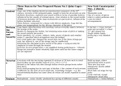
Three Dances for Two Prepared Pianos No.1 (John Cage) - New York Counterpoint
1944 Mov. 2 (Reich)
Context Cage: one of the leading American experimental composers of the 20th 1985
century, inventor of the prepared piano, sought to base his structures on new Minimalist work
rhythmic directions, explored new sound worlds in terms of possible timbres, One of a series of pieces
influenced by the sounds of oriental music, clear relation to the sound worlds where a soloist performs with
of Javanese gamelan (all the main instruments are percussive), influenced by a pre-recorded
Indian rhythmic structure accompaniment
Three Dances: composed for a dance with African emphasis, Cage felt the
piano was inappropriate for the African character of the piece
Perform Cage began experimenting with inserting various everyday objects between 8 clarinet + 2 bass clarinet
ing the strings of the notes parts pre-recorded + a final
Results in changing the timbre, but retaining some sense of pitch or making 11th part played live
Forces
the sound entirely percussive Single timbre family –
and Items specified: e.g. screws, rubbers, bolts, pieces of plastic and weather producing a very blended
Sonority strips (+ specified which strings/how near the bridge) sound
Una corda pedal also changed the sound (hits one of the three strings per
note, but without it, one of the strings may be unaffected)
Enhancing the sharp/percussive sound of the piano + using accents for
emphasis of notes through the texture
Each has its own preparation + are amplified during performance – virtuosic
Range not extensive (some relatively high notes used but the lower ranges
are not explored
Structur 8 sections with the last being repeated (9 sections of 30 bars each in total) Build up stage, where
e Each broken up into smaller units of 2-5-2, 2-6-2 + 2-7-2 instruments enter in pairs
Related to the Indian tala idea (though Indian version groups beats rather Then new four note
than bars) semiquaver chords added
Each small grouping has its own type of rhythm + the content of each section underneath
is different (at the start of each small unit, something changes – e.g. the Short fade out stage for top
texture/melody/rhythm) but some ideas do return (all motifs repeated in some parts
way) Lacks contrast, except
semiquaver chord idea
Texture Homophonic – some ‘chords’ produced by a group of different sounds Homophonic + homorhythmic
1944 Mov. 2 (Reich)
Context Cage: one of the leading American experimental composers of the 20th 1985
century, inventor of the prepared piano, sought to base his structures on new Minimalist work
rhythmic directions, explored new sound worlds in terms of possible timbres, One of a series of pieces
influenced by the sounds of oriental music, clear relation to the sound worlds where a soloist performs with
of Javanese gamelan (all the main instruments are percussive), influenced by a pre-recorded
Indian rhythmic structure accompaniment
Three Dances: composed for a dance with African emphasis, Cage felt the
piano was inappropriate for the African character of the piece
Perform Cage began experimenting with inserting various everyday objects between 8 clarinet + 2 bass clarinet
ing the strings of the notes parts pre-recorded + a final
Results in changing the timbre, but retaining some sense of pitch or making 11th part played live
Forces
the sound entirely percussive Single timbre family –
and Items specified: e.g. screws, rubbers, bolts, pieces of plastic and weather producing a very blended
Sonority strips (+ specified which strings/how near the bridge) sound
Una corda pedal also changed the sound (hits one of the three strings per
note, but without it, one of the strings may be unaffected)
Enhancing the sharp/percussive sound of the piano + using accents for
emphasis of notes through the texture
Each has its own preparation + are amplified during performance – virtuosic
Range not extensive (some relatively high notes used but the lower ranges
are not explored
Structur 8 sections with the last being repeated (9 sections of 30 bars each in total) Build up stage, where
e Each broken up into smaller units of 2-5-2, 2-6-2 + 2-7-2 instruments enter in pairs
Related to the Indian tala idea (though Indian version groups beats rather Then new four note
than bars) semiquaver chords added
Each small grouping has its own type of rhythm + the content of each section underneath
is different (at the start of each small unit, something changes – e.g. the Short fade out stage for top
texture/melody/rhythm) but some ideas do return (all motifs repeated in some parts
way) Lacks contrast, except
semiquaver chord idea
Texture Homophonic – some ‘chords’ produced by a group of different sounds Homophonic + homorhythmic