Student Exploration: Calorimetry Lab possible Questions And Answers 2023
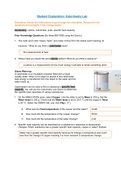
1. The Latin word calor means “heat,” and meter comes from the Greek word meaning “to measure.” What do you think a calorimeter does? the measurement of heat 2. Where have you heard the word calorie before? What do you think a calorie is? a calorie is a measurement of how much energy it will take to break something down Gizmo Warm-up A calorimeter is an insulated container filled with a liquid, usually water. When a hot object is placed in the calorimeter, heat energy is transferred from the object to the water and the water heats up. Calorimeters can be used to find a substance’s specific heat capacity. You will use the Calorimetry Lab Gizmo to determine the specific heat capacities of various substances. 1. On the SIMULATION pane, select Copper. Use the slider to set its Mass to 200 g. Set the Water mass to 200 g. Check that the Water temp is set to 30.0 °C and the copper’s Temp is 90 °C. Select the GRAPH tab, and click Play ( ). A. What was the Final temperature of the copper and the water? 34.96 B. How much did the temperature of the copper change? 55.04 C. How much did the temperature of the water change? 4.04 2. Specific heat capacity can be described as a substance’s resistance to temperature changes. Which substance has a greater specific heat capacity, copper or water? Explain. Water has a greater specific heat capacity because its change in temperature was much less than the change of copper meaning it is more resistant to temperature change. Activity A: Heat transfer Get the Gizmo ready: ● Click Reset ( ). Question: What factors determine how heat energy transfers between objects? 1. Predict: In the Gizmo warm-up, you saw how 200 g of 90 °C copper transfers heat to 200 g of 30.0 °C water. A. How do you think increasing the water’s mass would affect the final temperature? I think an increase in waters mass will lessen the final temperature B. How do you think decreasing the copper’s mass would affect the final temperature? I think that a decrease in coppers mass will lessen the final temperature C. How do you think increasing or decreasing the copper’s initial temperature would affect the final temperature? I do, I think the greater the temperature the greater the change and vise versa 2. Collect data: Use the Gizmo to determine the final temperature for each set-up listed below. Record your results in the tables. In the first table, you experiment with changing the water’s mass. In the second table, you change the copper’s mass. In the third table, you change the initial temperature of the copper. The first row of each table has been completed for you. Copper Water Final Temp. (°C) Initial Temp. (°C) Mass (g) Initial Temp. (°C) Mass (g) 3. 90 °C 200 g 30.0 °C 200 g 34.96 °C 90 °C 200 g 30.0 °C 2,000 g 30.54°C 4. 90 °C 200 g 30.0 °C 200 g 34.96 °C 90 °C 20 g 30.0 °C 200 g 30.54°C 5. 90 °C 200 g 30.0 °C 200 g 34.96 °C 100 °C 200 g 30.0 °C 200 g 35.79 °C 50 °C 200 g 30.0 °C 200 g 31.65 °C 3. Analyze: For each factor listed in the chart below, explain how the final temperature was changed and why you think that change occurred. A. What was the effect of increasing the water’s mass? when the waters mass increased the temperature decreased B. What was the effect of decreasing the copper’s mass? when the mass of copper decreased so did the final temperature C. What was the effect of changing the initial temperature of the copper? as the initial temperature of copper increased so did the final temperature and as it decreased so did the final temperature. 4. Draw conclusions: The amount that the water’s temperature increases depends on the mass of the water and the amount of heat energy in the copper. A. How does changing the initial mass of the copper affect how much heat energy it has? when the initial mass of copper decreases the amount of heat energy used decreases B. How does changing the initial temperature of the copper affect how much heat energy it has? when the initial temperature of the copper increases the amount of heat energy also increases and as it decreases so does the amount of heat energy. 5. Apply: Many gyms and health clubs have steam saunas, which are small steam-filled rooms. Traditionally, steam saunas have a container of heated rocks. A small ladle of water is poured on the rocks in order to make the steam. A. Use what you have learned so far about heat transfer to explain how hot rocks can be used to make steam? I think that rocks have a greater amount of heat energy which results in a transfer of water furthering resulting in a phase change and steam B. Why do you think o
Document information
- Uploaded on
- January 10, 2023
- Number of pages
- 19
- Written in
- 2022/2023
- Type
- Exam (elaborations)
- Contains
- Questions & answers