
Zusammenfassung Physiologie I – Blut
Aufgaben und Zusammensetzung des Blutes
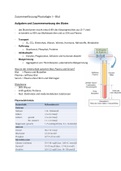
- das Blutvolumen macht etwa 6-8% des Körpergewichtes aus (5-7 Liter)
- es besteht zu 45% aus Blutkörperchen und zu 55% aus Plasma
- Transport
o O2, CO2, Elektrolyte, Wasser, Wärme, Hormone, Nährstoffe, Metabolite
- Pufferung
o Bicarbonat, Phosphat, Proteine
- Infektabwehr
o Enzyme, Phagozytose, Zelluläre und humorale Abwehr
- Blutgerinnung
o Aggregation von Thrombozyten, plasmatische Blutgerinnung
Was ist der Unterschied zwischen Blut, Plasma und Serum?
Blut = Plasma und Blutzellen
Plasma = zellfreies Blut
Serum = Plasma ohne Fibrin und Fibrinogen
Blutplasma
- 90% Wasser
- 6-8% gelöste Proteine
- Rest: Elektrolyte und niedermolekulare Substanzen
Plasmaelektrolyte:
,Proteine des Blutplasmas:
Bei der Bestimmung von Plasma- und Blutvolumen wird zunächst eine Indikatorsubstanz
injiziert. Daraufhin lassen sich die Werte mit folgenden Formeln berechnen:
Berechnung des Plasmavolumens:
!&'()*#+,- ∙ $&'()*#+,-
!!"#$%# =
$&'()*#+,-,!"#$%#
Bestimmung des Blutvolumens:
!!"#$%#
!/"0+ =
1 − 'ä)*+,-./+
, Zelluläre Bestandteile des Blutes
Erythrozyten
- kernlose Zellen, die weder Mitochondrien noch ein ER enthalten
- Energiebedarf muss über anaerobe Glykolyse gedeckt werden
- scheibenförmig: zur Oberflächenvergrößerung + Verformbarkeit für Kapillarsystem
- Erythropoese (Dauer 6-9 Tage):
o werden im Knochenmark aus pluripotenten Stammzellen gebildet (pro Tag etwa
2∙1011 Erythrozyten)
o Stammzelle à Präerythroblast à Erythroblast à Normoblast à Erythrozyt
o Normoblast = letzte kernhaltige Vorstufe, nach Ausstoßen des Kerns verlässt die
reife Zelle das Knochenmark
o findet unter Einfluss des Hormons Erythropoetin (EPO) statt
o EPO ist ein Glykopeptid-Hormon, das in der Nierenrinde gebildet wird
(und z.T. auch in der Leber)
o der Reiz für EPO-Ausschüttung ist O2-Mangel
o frische Erythrozyten, die das Knochenmark gerade erst verlassen haben,
enthalten noch Reste von RNA im Zytoplasma (mikroskopisch sichtbar). Man
nennt sie Retikulozyten. Eine gesteigerte Retikulozyten-Zahl weist auf eine
erhöhte Erythropoese hin!
- überalterte Zellen werden in der Milzpulpa erkannt und aussortiert
o Häm-Ring des Hämoglobins wird zu Bilirubin abgebaut und ausgeschieden
o Eisen aus Hämoglobin wird wiederverwendet


