1
Mathematics – Grade 12 Notes
Sequences
Content:
Sequences:
1.1 Important Definitions and Notes for Sequences
1.2 Types of Sequences
1.3 Arithmetic/Linear Sequences
1.4 Quadratic Sequences
1.5 Geometric Sequences
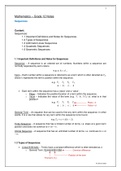
1.1 Important Definitions and Notes for Sequences
Sequence – A sequence is an ordered set of numbers. Numbers within a sequence are
normally separated by semi-colons.
e.g. 𝑎; 𝑏; 𝑐; 𝑑 …
Term – Each number within a sequence is referred to as a term which is often denoted as 𝑇𝑘 ,
where 𝑘 represents the term’s position within the sequence.
e.g.
; ; ;
➢ Each term within the sequence has a ‘place’ and a ‘value’:
o Place – Indicates the position/location of a term within the sequence.
o Value – Indicates the value of the term (e.g. ‘1’, ‘e’, ‘t1’), i.e. what is in that
position?
e.g. Place = 4
; ; ; Value = d
General Term – An equation that can be used to find any term within the sequence. In other
words, it is a rule that allows for any term within the sequence to be found.
e.g. 𝑇𝑘 = 𝑎 + 𝑑(𝑘 − 2)
Finite Sequence – A sequence that has a limited number of terms, i.e. stops at a given term
position and does not continue to ∞ or −∞.
Infinite Sequence – A sequence that has an unlimited number of terms, i.e. continues to ∞ or
−∞.
1.2 Types of Sequences:
➢ Linear/Arithmetic – Terms have a constant difference which is often denoted as 𝑑.
o General Term: 𝑇𝑘 = 𝑎 + (𝑘 − 1)𝑑 Common difference
Position of the term
First term (𝑇1 )
Pia Eklund 2023
, 2
➢ Quadratic – Terms have a constant second difference.
o General Term: 𝑇𝑘 = 𝑎𝑘 2 + 𝑏𝑘 + 𝑐
▪ 2nd difference = 2𝑎 Very important!
▪ 1st term of the 1st difference = 3𝑎 + 𝑏 Use worked example below for
▪ 1st term of the sequence = 𝑎 + 𝑏 + 𝑐 clarification on what these represent
➢ Geometric – Terms have a constant ratio.
o Can also be referred to as an exponential number pattern.
o General Term: 𝑇𝑘 = 𝑎𝑟 𝑘−1
Constant ratio
First term (𝑇1 )
1.3 Arithmetic/Linear Sequences
➢ Arithmetic/Linear Sequence – It is a sequence where the terms have a common
difference between them. In other words, it is a sequence in which each term
(excluding the first term) is formed by adding a constant amount to the previous term.
➢ The constant difference is usually denoted as 𝑑.
o The constant difference is determined by subtracting the term in position 𝑘 from
the term in position 𝑘 + 1:
▪ 𝑑 = 𝑇𝑘+1 − 𝑇𝑘 , so you chose two consecutive terms and minus the term
in the lower position from the term in the higher position (e.g. 𝑑 = 𝑇3 −
𝑇2 )
➢ 𝑇1 = 𝑎, often the first term of a sequence is denoted by the symbol 𝑎.
➢ In general:
o 𝑇𝑛 is used to represent the last term of a finite sequence.
o 𝑇𝑘 is used to represent a term within a sequence.
➢ Recursive formula:
o 𝑇𝑘 = 𝑇𝑘−1 + 𝑑, states that the term 𝑇𝑘 is equal to the previous term (𝑇𝑘−1 ) plus
the common difference (𝑑).
o This formula only works if you know the previous term.
➢ General formula:
o 𝑇𝑘 = 𝑎 + (𝑘 − 1)𝑑
▪ 𝑎 = first term
▪ 𝑑 = constant difference
▪ 𝑘 = position of term
▪ 𝑇𝑘 = value of term in the 𝑘 𝑡ℎ position
Example 1 – Detailed Step by Step
Consider the arithmetic sequence 3; 5; 7; 9…
a) Determine the general formula for the above sequence.
b) Find the value of the 50th term.
Pia Eklund 2023
Mathematics – Grade 12 Notes
Sequences
Content:
Sequences:
1.1 Important Definitions and Notes for Sequences
1.2 Types of Sequences
1.3 Arithmetic/Linear Sequences
1.4 Quadratic Sequences
1.5 Geometric Sequences
1.1 Important Definitions and Notes for Sequences
Sequence – A sequence is an ordered set of numbers. Numbers within a sequence are
normally separated by semi-colons.
e.g. 𝑎; 𝑏; 𝑐; 𝑑 …
Term – Each number within a sequence is referred to as a term which is often denoted as 𝑇𝑘 ,
where 𝑘 represents the term’s position within the sequence.
e.g.
; ; ;
➢ Each term within the sequence has a ‘place’ and a ‘value’:
o Place – Indicates the position/location of a term within the sequence.
o Value – Indicates the value of the term (e.g. ‘1’, ‘e’, ‘t1’), i.e. what is in that
position?
e.g. Place = 4
; ; ; Value = d
General Term – An equation that can be used to find any term within the sequence. In other
words, it is a rule that allows for any term within the sequence to be found.
e.g. 𝑇𝑘 = 𝑎 + 𝑑(𝑘 − 2)
Finite Sequence – A sequence that has a limited number of terms, i.e. stops at a given term
position and does not continue to ∞ or −∞.
Infinite Sequence – A sequence that has an unlimited number of terms, i.e. continues to ∞ or
−∞.
1.2 Types of Sequences:
➢ Linear/Arithmetic – Terms have a constant difference which is often denoted as 𝑑.
o General Term: 𝑇𝑘 = 𝑎 + (𝑘 − 1)𝑑 Common difference
Position of the term
First term (𝑇1 )
Pia Eklund 2023
, 2
➢ Quadratic – Terms have a constant second difference.
o General Term: 𝑇𝑘 = 𝑎𝑘 2 + 𝑏𝑘 + 𝑐
▪ 2nd difference = 2𝑎 Very important!
▪ 1st term of the 1st difference = 3𝑎 + 𝑏 Use worked example below for
▪ 1st term of the sequence = 𝑎 + 𝑏 + 𝑐 clarification on what these represent
➢ Geometric – Terms have a constant ratio.
o Can also be referred to as an exponential number pattern.
o General Term: 𝑇𝑘 = 𝑎𝑟 𝑘−1
Constant ratio
First term (𝑇1 )
1.3 Arithmetic/Linear Sequences
➢ Arithmetic/Linear Sequence – It is a sequence where the terms have a common
difference between them. In other words, it is a sequence in which each term
(excluding the first term) is formed by adding a constant amount to the previous term.
➢ The constant difference is usually denoted as 𝑑.
o The constant difference is determined by subtracting the term in position 𝑘 from
the term in position 𝑘 + 1:
▪ 𝑑 = 𝑇𝑘+1 − 𝑇𝑘 , so you chose two consecutive terms and minus the term
in the lower position from the term in the higher position (e.g. 𝑑 = 𝑇3 −
𝑇2 )
➢ 𝑇1 = 𝑎, often the first term of a sequence is denoted by the symbol 𝑎.
➢ In general:
o 𝑇𝑛 is used to represent the last term of a finite sequence.
o 𝑇𝑘 is used to represent a term within a sequence.
➢ Recursive formula:
o 𝑇𝑘 = 𝑇𝑘−1 + 𝑑, states that the term 𝑇𝑘 is equal to the previous term (𝑇𝑘−1 ) plus
the common difference (𝑑).
o This formula only works if you know the previous term.
➢ General formula:
o 𝑇𝑘 = 𝑎 + (𝑘 − 1)𝑑
▪ 𝑎 = first term
▪ 𝑑 = constant difference
▪ 𝑘 = position of term
▪ 𝑇𝑘 = value of term in the 𝑘 𝑡ℎ position
Example 1 – Detailed Step by Step
Consider the arithmetic sequence 3; 5; 7; 9…
a) Determine the general formula for the above sequence.
b) Find the value of the 50th term.
Pia Eklund 2023