Genome Evolution
Genome content and genome size
- Genome parasites: transposable elements
- Evolution of gene number
Genomic compartments
- Evolution or organellar genomes
- Conflicts of interests between genomic compartments
C-value paradox
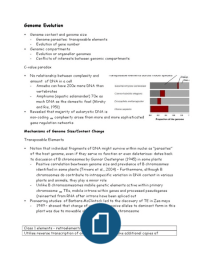
No relationship between complexity and
amount of DNA in a cell
- Amoeba can have 200x more DNA than
vertebrates
- Amphiuma (aquatic salamander) 70x as
much DNA as the domestic fowl (Mirsky
and Ris, 1951)
Revealed that majority of eukaryotic DNA is
non-coding complexity arose from more and more sophisticated
gene regulation networks
Mechanisms of Genome Size/Content Change
Transposable Elements
Notion that individual fragments of DNA might survive within nuclei as “parasites”
of the host genome, even if they serve no function or even deleterious: dates back
to discussion of B chromosomes by Gunnar Oestergren (1945) in some plants
- Positive correlation bewtween genome size and prevalence of B chromosomes
identified in some plants (Trivers et al., 2004) – Furthermore, although B
chromosomes do contribute to intraspecific variation in DNA content in various
plants and animals, they play a minor role
- Unlike B chromosomesomes mobile genetic elements active within primary
chromosome TEs, mobile introns within genes and processed pseudogenes
(reinserted from RNA after introns have been spliced out
Pioneering studies of Barbara McClintock led to the discovery of TE in Zea mays
- 1949 – showed that change of unstable recessive alleles to dominant form in this
plant was due to moveable short segments of a chromosome
Class 1 elements – retroelements
Utilise reverse transcription of an RNA template to make additional copies of
,themselves (retrotransposition)
Original element is maintained in situ,
where it is transcribed
RNA transcript is then reverse
transcribed into DNA then integrates into new location in the genome
No correlation between current position and target position
Long Terminal Repeat (LTR) retrotransposons
Similar in structure and coding capacity to retroviruses
During transposition, dsDNA intermediate is synthesised from RNA template by
mechanism similar to that used by DNA transposons (Craig et al., 2002)
Similar to retroviruses, elements encode open reading frames (ORFs) – gag (group
specific antigen) and pol (polymerase)
Pol ORF divided into different domains: RT, integrase/endonuclease (EN), RNase H
Many species harbour endogenous proviruses in their genomes – proviruses may
represent either recent insertions into genome/ancient molecular fossils
Endogenous retroviruses originate from retroviral infection of germline cells –
after fertilisation involving modified gamete gives rise to progeny different from
parent modified chromosome becomes fixed in the population and permanent
genetic property of population unless changed by mutations
LINEs and SINEs
LINEs: with RTase, no terminal repeats, SINEs: no RTase
Short interspersed nuclear elements (SINEs) are nonautonomous retroposons
exploit enzymatic retrotransposition of LINEs (Kajikawa and Okada, 2002)
SINEs widely dispersed throughout eukaryotic genomes nd can be present in more
than 10s of thousands of copies per genome
Eg. SINE family Alu constitutes more than 10% of human genome
Class II elements – DNA transposons
Transpose by classic cut and paste mode similar to that of Tn10 elements in bacteria
Second group transposes by means of a rolling circle (RC) mechanism
Cut-and-paste mechanism
Element-encoded transposases perform both cleavage and transfer reactions required
to cut transposon at both its terminals and insert into new position in genomes, relies
on DNA repair mechanism, no RNA intermediate stage
Example: P elements in Drosophila, piggyback family in baculoviruses, Mutator
families in maize
Factors controlling the population dynamics of transposable elements
Rate of infection (genomes previously lacking transposable element becomes
infected with it), rate of transposition, mechanism of eliminating elements from
population (or copy number would increase indefinitely)
, For eukaryotic species that reproduce through sexual reproduction – segregation
and recombination imply that in each generation, TEs in the genome become
reasserted in such a way that a copy inserted at any particular genome becomes
nearly independent of copies inserted at other positions, except for those positions
that are genetically tightly linked
- Population dynamics can be encapsulated in the distribution of copy number
among individuals in the population
Rate of insertions and rate of removal, more removals than insertions, TEs will be
eliminated
- Eliminate selection via D. melanogaster mutation-accumulation lines to study
effects in absence of selection more and more TEs accumulated
- But selection against TE insertions negative relationship between fitness and
number of insertions insertions harm the host (Houle and Nuzhdin, 2004)
Deleterious effects of TE insertions
Population studies of the distribution of TEs on chromosomes have strong
suggested that copy number increased, due to transposition is balanced by some
form of natural selection
Negative purifying selection is expected to act against deleterious effects of
insertions, particularly those located in gene coding regions
Selection also expected to act against gross chromosomal rearrangements caused
by ectopic exchange between TE copies (unequal recombination)
- Both mechanisms exist though the relative importance of each is debated
TE are powerful mutagens, changes they produce have broad range of fitness values
at organismal level, with high proportion being lethal, causing sterility etc.
- Expected and observed that TEs are less dense in coding than in non-coding
regions (lower selection pressure)
- Some TEs do survive for variable lengths of time in coding regions, either as
they have neutral impact on host fitness or as they confer some fitness benefit
to the host
- TEs can also insert in or near coding regions that have evolved ways to take
advantage of relatively accessible chromosomal architecture, high concentration
of transcription actors, host enhancer sequences and horizontal transfer to
maximise replication advantage – Mu in maize (target single copy sequences), P
elements in Drosophila (Spradling et al., 1995) – at laest 65% of inerstions are
located near enhancers
Ectopic recombination: non-homologous recombination when homologous regions of
genes misalign and genetic exchange takes place either intra-or interchromosomally
Genome content and genome size
- Genome parasites: transposable elements
- Evolution of gene number
Genomic compartments
- Evolution or organellar genomes
- Conflicts of interests between genomic compartments
C-value paradox
No relationship between complexity and
amount of DNA in a cell
- Amoeba can have 200x more DNA than
vertebrates
- Amphiuma (aquatic salamander) 70x as
much DNA as the domestic fowl (Mirsky
and Ris, 1951)
Revealed that majority of eukaryotic DNA is
non-coding complexity arose from more and more sophisticated
gene regulation networks
Mechanisms of Genome Size/Content Change
Transposable Elements
Notion that individual fragments of DNA might survive within nuclei as “parasites”
of the host genome, even if they serve no function or even deleterious: dates back
to discussion of B chromosomes by Gunnar Oestergren (1945) in some plants
- Positive correlation bewtween genome size and prevalence of B chromosomes
identified in some plants (Trivers et al., 2004) – Furthermore, although B
chromosomes do contribute to intraspecific variation in DNA content in various
plants and animals, they play a minor role
- Unlike B chromosomesomes mobile genetic elements active within primary
chromosome TEs, mobile introns within genes and processed pseudogenes
(reinserted from RNA after introns have been spliced out
Pioneering studies of Barbara McClintock led to the discovery of TE in Zea mays
- 1949 – showed that change of unstable recessive alleles to dominant form in this
plant was due to moveable short segments of a chromosome
Class 1 elements – retroelements
Utilise reverse transcription of an RNA template to make additional copies of
,themselves (retrotransposition)
Original element is maintained in situ,
where it is transcribed
RNA transcript is then reverse
transcribed into DNA then integrates into new location in the genome
No correlation between current position and target position
Long Terminal Repeat (LTR) retrotransposons
Similar in structure and coding capacity to retroviruses
During transposition, dsDNA intermediate is synthesised from RNA template by
mechanism similar to that used by DNA transposons (Craig et al., 2002)
Similar to retroviruses, elements encode open reading frames (ORFs) – gag (group
specific antigen) and pol (polymerase)
Pol ORF divided into different domains: RT, integrase/endonuclease (EN), RNase H
Many species harbour endogenous proviruses in their genomes – proviruses may
represent either recent insertions into genome/ancient molecular fossils
Endogenous retroviruses originate from retroviral infection of germline cells –
after fertilisation involving modified gamete gives rise to progeny different from
parent modified chromosome becomes fixed in the population and permanent
genetic property of population unless changed by mutations
LINEs and SINEs
LINEs: with RTase, no terminal repeats, SINEs: no RTase
Short interspersed nuclear elements (SINEs) are nonautonomous retroposons
exploit enzymatic retrotransposition of LINEs (Kajikawa and Okada, 2002)
SINEs widely dispersed throughout eukaryotic genomes nd can be present in more
than 10s of thousands of copies per genome
Eg. SINE family Alu constitutes more than 10% of human genome
Class II elements – DNA transposons
Transpose by classic cut and paste mode similar to that of Tn10 elements in bacteria
Second group transposes by means of a rolling circle (RC) mechanism
Cut-and-paste mechanism
Element-encoded transposases perform both cleavage and transfer reactions required
to cut transposon at both its terminals and insert into new position in genomes, relies
on DNA repair mechanism, no RNA intermediate stage
Example: P elements in Drosophila, piggyback family in baculoviruses, Mutator
families in maize
Factors controlling the population dynamics of transposable elements
Rate of infection (genomes previously lacking transposable element becomes
infected with it), rate of transposition, mechanism of eliminating elements from
population (or copy number would increase indefinitely)
, For eukaryotic species that reproduce through sexual reproduction – segregation
and recombination imply that in each generation, TEs in the genome become
reasserted in such a way that a copy inserted at any particular genome becomes
nearly independent of copies inserted at other positions, except for those positions
that are genetically tightly linked
- Population dynamics can be encapsulated in the distribution of copy number
among individuals in the population
Rate of insertions and rate of removal, more removals than insertions, TEs will be
eliminated
- Eliminate selection via D. melanogaster mutation-accumulation lines to study
effects in absence of selection more and more TEs accumulated
- But selection against TE insertions negative relationship between fitness and
number of insertions insertions harm the host (Houle and Nuzhdin, 2004)
Deleterious effects of TE insertions
Population studies of the distribution of TEs on chromosomes have strong
suggested that copy number increased, due to transposition is balanced by some
form of natural selection
Negative purifying selection is expected to act against deleterious effects of
insertions, particularly those located in gene coding regions
Selection also expected to act against gross chromosomal rearrangements caused
by ectopic exchange between TE copies (unequal recombination)
- Both mechanisms exist though the relative importance of each is debated
TE are powerful mutagens, changes they produce have broad range of fitness values
at organismal level, with high proportion being lethal, causing sterility etc.
- Expected and observed that TEs are less dense in coding than in non-coding
regions (lower selection pressure)
- Some TEs do survive for variable lengths of time in coding regions, either as
they have neutral impact on host fitness or as they confer some fitness benefit
to the host
- TEs can also insert in or near coding regions that have evolved ways to take
advantage of relatively accessible chromosomal architecture, high concentration
of transcription actors, host enhancer sequences and horizontal transfer to
maximise replication advantage – Mu in maize (target single copy sequences), P
elements in Drosophila (Spradling et al., 1995) – at laest 65% of inerstions are
located near enhancers
Ectopic recombination: non-homologous recombination when homologous regions of
genes misalign and genetic exchange takes place either intra-or interchromosomally