Ziektes neuro
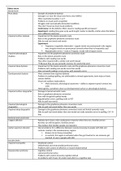
Literate brain
Pure alexia - Example of peripheral dyslexia
- Damage in or near the visual word form area (VWFA)
- Often read letter-by-letter: C-A-T
- Problems in visual word recognition
- Struggle under perceptually demanded conditions
- They don’t have low-level visual problems
- Controversy: do the deficits reflect visual or reading-specific processes?
- Experiment: reading time goes up by word length, harder to identify a letter when the letters
are in different cases (Aa)
Acquired surface dyslexia - Impairment of the lexical-semantic route
- Rely on the grapheme-phoneme conversion route
- Able to read non-words and words
- Experiment:
Frequency x regularity interaction = regular words are pronounced in the regular
way, irregular words are pronounced correctly when they’re frequently used
Regularization errors = read as if regular, mostly with irregular words
Acquired phonological - Impairment of the grapheme-phoneme conversion route
dyslexia - Rely on the lexical-semantic route
- Problems with reading non-words
- They often respond with a similar real word instead
Because they can use semantic memory for words that exist
Acquired deep dyslexia - Impairment of the lexical-semantic route and the grapheme-phoneme conversion route
- Problems with reading non-words more than words
- Also real world reading is error prone, with semantic errors
Developmental dyslexia - More common than acquired dyslexia
- Problem in reading/spelling, not attributable to missed opportunity, brain injury of basic
sensory deficits
- Visual and auditory explanations:
Most dominant: phonological awareness = ability to segment speech stream into
units
- Heterogenity, sometimes clear-cut developmental surface or phonological dyslexia
Acquired surface dysgraphia - Damage to lexical-semantic route
- Rely on grapheme-phoneme conversion
- Poor with irregularly spelled words
- Regularization errors: spelling yacht as YOT
- Able to spell non-words
Acquired phonological - Damage to the grapheme-phoneme conversion route
dysgraphia - Able to spell real words better than non-words
Acquired deep dysgraphia - Damage to the grapheme-phoneme conversion route and lexical-semantic route
- Able to spell real words better than non-words but make semantic errors in spelling: CAT
dog
Emotional and social brain
Capgras delusion - Patients don’t show a skin conductance response when they see a familiar person
But they can still recognize a familiar person
- They believe that familiar people are imposters
Autism spectrum disorder - Neural evidence for a difference between neural processing in people with ASD and
controls: mainly in the somatosensory regions
Broken mirror theory/simulation
In controls, this region is activated when they get touched or see someone get
touched Less in people with ASD
Executive brain
Acquired sociopathy - Emotional control
- Orbitofrontal and ventromedial prefrontal cortex
- Problems with control of affective or reward-related stimuli
Dysexecutive syndrome - Cognitive control
- Lateral prefrontal cortex
- Problems with control of purely cognitive stimuli
- So problems with Tower of London task which is a cognitive task
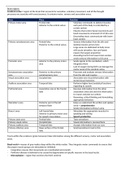
Literate brain
Pure alexia - Example of peripheral dyslexia
- Damage in or near the visual word form area (VWFA)
- Often read letter-by-letter: C-A-T
- Problems in visual word recognition
- Struggle under perceptually demanded conditions
- They don’t have low-level visual problems
- Controversy: do the deficits reflect visual or reading-specific processes?
- Experiment: reading time goes up by word length, harder to identify a letter when the letters
are in different cases (Aa)
Acquired surface dyslexia - Impairment of the lexical-semantic route
- Rely on the grapheme-phoneme conversion route
- Able to read non-words and words
- Experiment:
Frequency x regularity interaction = regular words are pronounced in the regular
way, irregular words are pronounced correctly when they’re frequently used
Regularization errors = read as if regular, mostly with irregular words
Acquired phonological - Impairment of the grapheme-phoneme conversion route
dyslexia - Rely on the lexical-semantic route
- Problems with reading non-words
- They often respond with a similar real word instead
Because they can use semantic memory for words that exist
Acquired deep dyslexia - Impairment of the lexical-semantic route and the grapheme-phoneme conversion route
- Problems with reading non-words more than words
- Also real world reading is error prone, with semantic errors
Developmental dyslexia - More common than acquired dyslexia
- Problem in reading/spelling, not attributable to missed opportunity, brain injury of basic
sensory deficits
- Visual and auditory explanations:
Most dominant: phonological awareness = ability to segment speech stream into
units
- Heterogenity, sometimes clear-cut developmental surface or phonological dyslexia
Acquired surface dysgraphia - Damage to lexical-semantic route
- Rely on grapheme-phoneme conversion
- Poor with irregularly spelled words
- Regularization errors: spelling yacht as YOT
- Able to spell non-words
Acquired phonological - Damage to the grapheme-phoneme conversion route
dysgraphia - Able to spell real words better than non-words
Acquired deep dysgraphia - Damage to the grapheme-phoneme conversion route and lexical-semantic route
- Able to spell real words better than non-words but make semantic errors in spelling: CAT
dog
Emotional and social brain
Capgras delusion - Patients don’t show a skin conductance response when they see a familiar person
But they can still recognize a familiar person
- They believe that familiar people are imposters
Autism spectrum disorder - Neural evidence for a difference between neural processing in people with ASD and
controls: mainly in the somatosensory regions
Broken mirror theory/simulation
In controls, this region is activated when they get touched or see someone get
touched Less in people with ASD
Executive brain
Acquired sociopathy - Emotional control
- Orbitofrontal and ventromedial prefrontal cortex
- Problems with control of affective or reward-related stimuli
Dysexecutive syndrome - Cognitive control
- Lateral prefrontal cortex
- Problems with control of purely cognitive stimuli
- So problems with Tower of London task which is a cognitive task