NURS 6541N Final Exam - Question and Answers
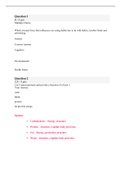
NURS 6541N Final Exam 1. An 11-year-old has been diagnosed with mild intermittent asthma. Which of the following is not a routine part of the clinical management? 2. A 14-year-old has a 3-week history of fever, anorexia, and abdominal pain. What additional symptom would cause the NP to suspect Crohn's disease? 3. A 9-year-old is diagnosed with dyspepsia without hematemesis, melena, or occult blood. The most appropriate next step is 4. Jesse, age 5, has a diagnosis of encopresis. After the diagnosis, what would be your next action? 5. The parent of a 2-year-old tells you her daughter recently started having breath-holding spells. She tells you the older sibling “did the same thing” and asks you for help. You advise her that after a breath-holding event: 6. Which adolescent would be at greatest risk for developing anorexia nervosa? 7. Kelly, your 11-year-old well visit patient, presents to the office with weight loss, polyuria, and polydipsia. Which of the following do you need to rule out? 8. An 11-year-old girl has dizziness, pupillary dilation, nausea, fever, techycardia, and facial flushing. She says she can "see" sound and "hear" colors. The agent likely to be responsible is which of the following? 9. Tracy, the mother of a 2-year-old, is concerned because her daughter walks on her toes all the time. What do you tell her? 10. The peak incidence for adolescent gynecomastia occurs at age 11. You see a 13-year-old who reports she is learning some basic geometry (areas, volume etc.). The ability to successfully master these concepts occurs during which Piaget developmental stage? 12. Newborn R.T. has a vascular lesion that will not fade as she gets older. What is your diagnosis? 13. The nurse practitioner role was initially established to 14. A common cause of in-toeing in childhood is 15. A 2-year-old presents to your office with the following symptoms: nasal congestion and rhinorrhea for 48 hours, low-grade fever, and a harsh/barky cough that is significantly worse at night. Inspiratory stridor is present and she has clear but slightly decreased breath sounds. Which of the following treatments is best? 16. All of the following is treatment for a child with phimosis except 17. Which of the following is not a feature of DiGeorge syndrome? 18. A small-for-gestational-age, dysmorphic newborn infant has microcephaly and sloping forehead, cutis aplasia (missing portion of the skin and hair) of the scalp, polydactyly, microphthalmia, and omphalocele. Which of these is the most likely diagnosis? 19. Which of the following physical stigmata are common in newborns with Down syndrome? 20. Which of the following is not associated with congenital adrenal hyperplasia? 21. You diagnose a 16-year-old with acute otitis media and need to prescribe an antibiotic with beta-lactamase coverage. What do you choose? 22. An 8-month-old baby arrives to the office with his mother with a complaint of decreased left arm movement. He is a product of a normal term pregnancy, has had no medical problems, and was in good health when his mother dropped him off at the daycare center. Upper arm radiographs show a left humerus spiral fracture. Which of the following is the most appropriate next step in management? 23. A 12-year-old male states he noticed an enlargement of his testes and scrotum. When counseling him about the next step in pubertal development, you state: 24. A differential diagnosis for child abuse would include all of the following except. 25. A 3-year-old presents with macrocephaly, developmental delay, coarse facial features, large tounge, kyphosis, hip dislocation, tonsillar and adenoidal hypertrophy, and hepatomegaly. She is receiving early intervention services without improvement. What is the best next step? 26. Which of the following complication of strep pharyngitis cannot be prevented with antibiotics? 27. A 6-year-old male is brought in for evaluation of a painful hip. He has been limping and not wanting to walk for the past 2 days. He has no obvious injury. He feels a little better if he is given ibuprofen. He has not had a fever and does not have any other current symptoms, although he had "the flu" last week. On examination, his vital signs are normal. His right hip has some pain with internal rotation. He walks with a pronounced limp. Which of the following statements is most accurate? 28. The first sign of the onset of female puberty is usually 29. Which of the following is not characteristic of an apparent life-threatening event (ALTE)? 30. Lyme disease is most closely associated with which of the following skin lesions? 31. A head injury in which bruising or tearing of the cerebral structures occurs is a 32. Which of the following vaccines provides protection against a common type of sepsis/meningitis? 33. Which of the following is true regarding innocent murmurs? 34. Shelby is a healthy 4-week-old who presents to your office in mid-January with a 3-day history of nasal congestion with occasional cough. She started running a low-grade fever last night (T max 101.5°F). Now she is refusing to nurse and has paroxysmal coughing and noisy/labored breathing. Physical exam reveals an ill-appearing infant with lethargy and tachypnea, intercostal retractions, expiratory wheezes, and occasional rales. She does not attend day care but has a 3-year-old sibling who does and who recently had a “cold.” What is the MOST LIKELY cause of Shelby’s illness? 35. Individuals with chronic adrenal insufficiency often have 36. During a domestic health assessment, the CDC recommends screening every refugee child for which of the following diseases? 37. Which of the following injuries is most likely to be caused by abuse of a toddler? 38. A 3-week-old male infant with 2 days of projectile, nonbilious vomiting and constant feeding. Which of the following is the most likely etiology? 39. Conductive hearing loss can be caused by 40. A 2-day-old infant has significant nasal and rectal bleeding. He was delivered by a midwife at home; the pregnancy was without complications. His Apgar scores were 9 at 1 minute and 9 at 5 minutes. He has breastfed well and has not required a health care professional visit since birth. Which of the following vitamin deficiencies might explain his condition? 41. The mother of a 4-year-old tells you he likes to "play with himself" while playing and watching television. You advise the mother to 42. Which of the following strategies would not be appropriate to include as part of your treatment plan of an 8-year-old boy who is obese? 43. Luke, a 17-month-old, failed treatment with amoxicillin for otitis media. At the two-week recheck, his TM was still erythematous and you cannot see the landmarks. He has persistent nasal congestion, he is not sleeping at night, and he has a 101°F fever. What is the next best step for Luke? 44. When Jason, age 12, slid into homeplate while playing baseball, he injured his ankle. You are trying to differentiate between a strain and a sprain. You know that a sprain 45. What method can be safely used to remove cerumen in a 15-month-old child's ear? 46. The following clinical description best matches which genetic disorder? A tall, thin 14-year-old boy has no signs of puberty. He was delayed in his speech development and always has done less well in school than his siblings. He is shy, and teachers report his activity is immature. Physical examination reveals breast development, and long limbs with a decreased upper segment/lower segment ration. He has small testes and phallus. 47. The most common cause of primary amenorrhea is 48. Seborrhea dermatitis is common for both infants and adolescents. Which is not correct for this condition? 49. Role-play with equipment during the course of the physical exam would be the most beneficial with which age group? 50. An 8-year-old female has an edematous, mildly erythematous right upper eyelid for 2 days with a fever of 102.9 (F). Which important eye assessment do you need to consider? 51. Which of the following symptoms are most suggestive of pneumonia in a young child? 52. During the 2-year-old well-child visit, the child's mother shows you a picture from the birthday party. You notice only one eye has a red reflex on the picture. When you do the exam, in the right eye, you notice leukocoria. What is your diagnosis? 53. A 3-week old presents to the office in January with a 1-week history of nasal congestion and occasional cough. On the night prior to the visit in infant developed a fever 102ºF rectally, was difficult to breastfeed, and had paroxysmal coughing and noisy, labored breathing. On exam, you note an ill-appearing infant who is lethargic with wheezing, tachypnea, and intercostal retractions. The infant is home with the mom at this time; however, has a sibling who is 4-years-old and is in daycare and recently had cold symptoms. Based on the clinical presentations, what is the most likely cause of the infant’s illness? 54. A 15-day-old infant has respiratory distress. A quick observation suggests she has slight cyanosis, hepatosplenomegaly, and features consistent with Down Syndrome. The cardiac examination demonstrates a loud first heart sound, a low-pitched, mid-diastolic murmur at the lower left sternal border, and a harsh apical holosystolic murmur in the mitral area. Which of the following cardiac conditions most likely explains her heart findings? 55. Which of the following objective data are associated with significantly better long-term outcomes in children born with open spina bifida? 56. Unilateral wheezing is a finding suggestive of 57. Which of the following is not a sign or symptom of congenital hypothyroidism? 58. A 7-year-old has just been diagnosed with attention deficit hyperactivity disorder (ADHD). Her parents report that she is doing poorly in school and is disruptive in the classroom. They ask you what they can do. Your best response is: 59. Antibiotic therapy is one of the mainstays of treatment for which of the following causes of wheezing? 60. Which of the following is a priority nurse practitioner role to help children and adolescents to have healthy sexual development? 61. A healthy 8-month-old infant presents with diarrhea but no dehydration. What is the best advice to give to the parents? 62. You see a 6-month-old for a well-child visit and the mother tells you the child’s grandmother recommends that she give the infant whole milk and eggs when he starts solids. What should you tell the mother? 63. The father of a 3-year-old is concerned because the child stutters. What should your approach be? 64. Which of the following is not found in an adolescent with untreated Graves' disease? 65. A child's head circumference is routinely measured on each well visit until what age? 66. During a track and field meet, a 16-year-old male pole-vaulter falls to the ground screaming in pain. He complains of intense pain in his right scrotum. He vomits twice while waiting for the ambulance. He most likely has 67. In mild to moderate attacks of acute asthma, Albuterol should be given every 4-6 hours prn and routine medication should be 68. A common presenting symptom of inflammatory bowel disease is 69. A teenage female who is overweight has moderate acne on the face and chest, and irregular menses. Elevation of which laboratory test provides the test evidence of polycystic ovarian syndrome? 70. Parents bring their 6-month-old son to see you. He is symmetrically less than the 5th percentile for height, weight and head circumference. He was born at 30 weeks’ gestation and weighed 1000g. He was a planned pregnancy, and his mother’s prenatal course was uneventful until an automobile accident initiated the labor. He was ventilated for 3 days in the intensive care unit but otherwise did well without ongoing problems. He was discharged at 8 weeks of life. Which of the following is the most likely explanation for his small size? 71. A 2-year-old child weighs 34 lb. What type of car seat should the child use? 72. Drew is a 6-month-old with newly diagnosed sickle cell disease. His mother brings him to the office for a well-baby visit. Which of the following should you do on this visit? 73. The most common presentation of Hirschprung disease is which of the following? 74. The most common congenital heart defect in children as 75. The organism that causes hand, foot, mouth syndrome is what virus? 76. Head and chest circumferences should be equal at: 77. The most common trigger for an acute asthma episode in the very young child is 78. Which malignancy is associated with genitourinary anomalies? 79. Tommy has bloody diarrhea. His family eats fast-food four to five times each week. Which organism may have caused the diarrhea? 80. You see a healthy 18-month-old for a well-child visit. At the 12-month visit he received the diphtheria, tetanus, and acellular pertussis (DTaP) third dose; hepatitis B second dose; measles, mumps, and rubella (MMR) first dose; injected poliovirus (IPV) second dose; pneumococcal conjugate (PCV13) fourth dose; and Haemophilus influenzae type B (Hib) fourth dose. Which of the following do you order today? 81. An essential test in the evaluation of a 2-year-old being managed for Kawasaki disease is 82. What does shift to the left mean in a white blood count? 83. John, age 12, injured his spinal cord by diving into a shallow lake. He is in a wheelchair but can self-transfer. He can use his shoulder and extend his wrist, but has no finger control. At what level of the spinal cord was the damage? 84. A 14-year-old girl from another state was followed for 7 years for a history of insulin-dependent diabetes mellitus. Her hemoglobin A1C is 14.9%. This laboratory test indicates which of the following? 85. A 14-year old has ataxia. He is brought to the local emergency department, where he appears euphoric, emotionally labile, and a bit disoriented. He has nystagmus and hypersalivation. Many notice his abusive language. Which of the following agents is most likely responsible for his condition? 86. FIRST-LINE therapy for preschoolers (4-5 years of age) diagnosed with attention-deficit hyperactive disorder is: 87. You see a 5-month-old who is fussy, has interrupted sleep, and is drooling. You note large lower lateral incisor bulges. You recommend: 88. An adolescent who has tall stature, increased arm span, laxity of joints, pectus excavatum, and abnormal echocardiogram woudl be expected to have 89. The parents of an 8-year-old Down Syndrome boy arrive for his annual well-child visit. He wants to participate in sports, including the Special Olympics. Until further examination can be completed, which of the following sports would you suggest as being safe? 90. A 4-year-old female with profuse vomiting, sweating, lacrimation, and diarrhea, who seizes in the emergency room. Which of the following is the most likely etiology? 91. Which of the following is the primary diagnostic tool used in the evaluation of seizure disorders? 92. What is the primary treatment for testicular torsion? 93. Kawasaki disease is most common in 94. Which fo the following foods would be most appropriate for a child with celiac disease? 95. Six months after being diagnosed with what appears to be insulin-dependent diabetes, the 5-year-old in the case presentation has a significant decrease in his insulin requirement. Which of the following is the most likely explanation? 96. Of the following patients, which child should not receive a tuberculin skin test? 97. A new mom calls the NP on postpartum day 5. She reports her newborn wants to nurse for 30 minutes every 1-1/2 to 2 hours. Which of these is the best response? 98. You are examining Beth, age 9 months, and note a palpable right supraclavicular node. You know that this finding is suspicious for 99. Prophylactic penicillin should be started in children with sickle cell anemia by 100. Jason, age 14, appears with tender discoid breast tissue enlargement (2-3 cm in diameter) beneath the areola. Your next action would be to
École, étude et sujet
- Établissement
-
Walden University
Infos sur le Document
- Publié le
- 25 décembre 2022
- Nombre de pages
- 20
- Écrit en
- 2022/2023
- Type
- Examen
- Contient
- Questions et réponses
Sujets

Document également disponible en groupe