

CSR Lecture 1 – the tension between business and society
Friedman & friends have a neoclassical economic thinking. Example: improving employee health, who is
responsible? Every dollar the company uses to do this, will reduce investor return.
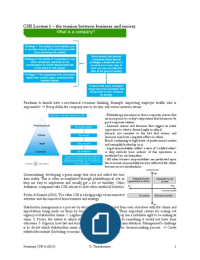
- Philanthropy encompasses those corporate actions that
are in response to society’s expectation that businesses be
good corporate citizens.
- Immoral: actions and decisions that suggest an active
opposition to what is deemed right or ethical.
Amoral: not sensitive to the fact that actions and
decisions may have a negative effect on others.
Moral: confirming to high levels of professional conduct
and exemplify leadership on it.
- Legal responsibilities reflect a view of ‘codified ethics’
as they embody basic notions of fair operations as
established by our lawmakers.
- All other business responsibilities are predicated upon
the economic responsibility because without it the others
become moot considerations.
Greenwashing: developing a green image that does not reflect the true
firm reality. This is often accomplished through philanthropical acts as
they are easy to implement and usually get a lot of visibility. Other
definition: companies take CSR-actions to hide other unethical behavior.
Porter & Kramer (2006): Too often CSR is a hodgepodge of unconnected
activities and disconnected from business and strategy.
Stakeholder management is a process by which managers reconciled their own objectives with the claims and
expectations being made on them by various stakeholder groups. Three important criteria for sorting out
urgency of stakeholder claims. 1. Legitimacy: the extent to which a group has a justifiable right to be making its
claim. 2. Power: the extent to which stakeholders can get firms to do something it would not have done
otherwise. 3. Urgency: how fast and strongly requires the stakeholder claim attention. Management’s challenge
is to decide which stakeholders merit and receive consideration in the decision-making process. Create
stakeholder matrix! (Including economic, legal, ethical, philanthropic)
Summary CSR A (2015) G. Timmermans 1
, CSR Lecture 2 – creating shared value
3 papers of Porter & Kramer are discussed (2002, 2006, and 2011).
Why are most companies currently doing CSR? Moral obligation, sustainability principle, license-to-operate,
reputation argument.
Value Chain Analysis: Inside-Out. E.g. primary activities inbound logistics, outbound logistics, operations,
marketing & sales, after-sales service. And support activities firm infrastructure, HRM, technology development,
procurement.
Diamonds Framework: Outside-In. NOZW: 1. Context for firm strategy and rivalry: the rules and incentives
that govern competition. 2. Local demand conditions: the nature and sophistication of local customer needs. 3.
Related and supporting industries: the local availability of supporting activities. 4. Factor (input) conditions:
presence of high-quality, specialized inputs available to firms.
Carefully analyzing the elements of the diamonds framework (competitive context) and identify areas of
overlap between social and economic value will enhance the competitiveness of the cluster.
Strategic philanthropy: using charitable efforts to improve the company’s competitive context
Creating shared value: creating economic value in a way that also creates value for society by addressing societal
needs and challenges. This is related to innovation w.r.t. strategy or business models. Based on the value chain
analysis and the diamonds framework, the company makes a list of all possible issues that intersect with the
business.
Three different ways a company can create economic value by creating societal value: 1. Reconceiving products
and markets. 2. Redefining productivity in the value chain. 3. Enabling local cluster development.
Consequences of CSV: better long-term performance, better societies, less government.
Example: case of Desso
CSR Lecture 3 – materiality
Issues arise from the stakeholders’ side, but
also the company’s. On which issues should
the company focus? Materiality issues are
issues that substantively affect the
organization’s ability to create value over the
short, medium, and long term. The purpose
of a materiality matrix is 1. Setting up a
dialogue with stake- and shareholders, 2.
External reporting, 3. Guiding resource
commitments from the company and the
stakeholders.
Example of materiality matrix: Nestlé
Summary CSR A (2015) G. Timmermans 2
Friedman & friends have a neoclassical economic thinking. Example: improving employee health, who is
responsible? Every dollar the company uses to do this, will reduce investor return.
- Philanthropy encompasses those corporate actions that
are in response to society’s expectation that businesses be
good corporate citizens.
- Immoral: actions and decisions that suggest an active
opposition to what is deemed right or ethical.
Amoral: not sensitive to the fact that actions and
decisions may have a negative effect on others.
Moral: confirming to high levels of professional conduct
and exemplify leadership on it.
- Legal responsibilities reflect a view of ‘codified ethics’
as they embody basic notions of fair operations as
established by our lawmakers.
- All other business responsibilities are predicated upon
the economic responsibility because without it the others
become moot considerations.
Greenwashing: developing a green image that does not reflect the true
firm reality. This is often accomplished through philanthropical acts as
they are easy to implement and usually get a lot of visibility. Other
definition: companies take CSR-actions to hide other unethical behavior.
Porter & Kramer (2006): Too often CSR is a hodgepodge of unconnected
activities and disconnected from business and strategy.
Stakeholder management is a process by which managers reconciled their own objectives with the claims and
expectations being made on them by various stakeholder groups. Three important criteria for sorting out
urgency of stakeholder claims. 1. Legitimacy: the extent to which a group has a justifiable right to be making its
claim. 2. Power: the extent to which stakeholders can get firms to do something it would not have done
otherwise. 3. Urgency: how fast and strongly requires the stakeholder claim attention. Management’s challenge
is to decide which stakeholders merit and receive consideration in the decision-making process. Create
stakeholder matrix! (Including economic, legal, ethical, philanthropic)
Summary CSR A (2015) G. Timmermans 1
, CSR Lecture 2 – creating shared value
3 papers of Porter & Kramer are discussed (2002, 2006, and 2011).
Why are most companies currently doing CSR? Moral obligation, sustainability principle, license-to-operate,
reputation argument.
Value Chain Analysis: Inside-Out. E.g. primary activities inbound logistics, outbound logistics, operations,
marketing & sales, after-sales service. And support activities firm infrastructure, HRM, technology development,
procurement.
Diamonds Framework: Outside-In. NOZW: 1. Context for firm strategy and rivalry: the rules and incentives
that govern competition. 2. Local demand conditions: the nature and sophistication of local customer needs. 3.
Related and supporting industries: the local availability of supporting activities. 4. Factor (input) conditions:
presence of high-quality, specialized inputs available to firms.
Carefully analyzing the elements of the diamonds framework (competitive context) and identify areas of
overlap between social and economic value will enhance the competitiveness of the cluster.
Strategic philanthropy: using charitable efforts to improve the company’s competitive context
Creating shared value: creating economic value in a way that also creates value for society by addressing societal
needs and challenges. This is related to innovation w.r.t. strategy or business models. Based on the value chain
analysis and the diamonds framework, the company makes a list of all possible issues that intersect with the
business.
Three different ways a company can create economic value by creating societal value: 1. Reconceiving products
and markets. 2. Redefining productivity in the value chain. 3. Enabling local cluster development.
Consequences of CSV: better long-term performance, better societies, less government.
Example: case of Desso
CSR Lecture 3 – materiality
Issues arise from the stakeholders’ side, but
also the company’s. On which issues should
the company focus? Materiality issues are
issues that substantively affect the
organization’s ability to create value over the
short, medium, and long term. The purpose
of a materiality matrix is 1. Setting up a
dialogue with stake- and shareholders, 2.
External reporting, 3. Guiding resource
commitments from the company and the
stakeholders.
Example of materiality matrix: Nestlé
Summary CSR A (2015) G. Timmermans 2

