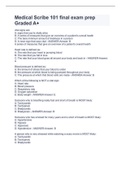
Medical Scribe 101 final exam prep Graded A+
vital signs are: A: signs that you're vitally alive B: A series of measures that give an overview of a patient's overall health C: The bare minimum amount of liveliness in a person D: A neon sign that says vital - ANSWER-Answer: B A series of measures that give an overview of a patient's overall health Heart rate is defined as: A: The rate that your heart is pumping blood B: The rate that you fall in love C: The rate that your blood goes all around your body and back in - ANSWER-Answer: A Blood pressure is defined as: A: the amount of stress that your blood is under B: the pressure at which blood is being pumped throughout your body C: The pressure at which that blood cells are made - ANSWER-Answer: B Which of the following is NOT a vital sign: A: Heart rate B: Blood pressure C: Respiratory rate D: Oxygen saturation E: Body weight - ANSWER-Answer: E Someone who is breathing really fast and short of breath is MOST likely: A: Tachycardic B: Tachypneic C: Bradycardic D: Bradypneic - ANSWER-Answer: B Someone who has smoked for many years and is short of breath is MOST likely: A: Hypertensive B: Hypoxic C: Hyperoxic D: Hypotensive - ANSWER-Answer: B A person who is very stressed while watching a scary movie is MOST likely: A: Tachycardic B: Tachypneic C: Bradycardic D: Bradypneic - ANSWER-Answer: A A sick child who has a fever for two hours likely has which temperature? A: 98.6 B: 102.5 C: 99.0 D: 97.9 - ANSWER-Answer: B Oxygen saturation is defined as: A: The saturation of oxygen in your lungs B: The saturation of oxygen in your blood C: How saturated blood is on your oxygen D: The rate of breaths per minute as measured in your fingertip - ANSWER-Answer: B True or False: Vital signs are usually measured in rate how many times a second is it happening - ANSWER-Answer: False Match the following patient complaints to the location the patient will likely be seen at: options: Urgent care clinic, Emergency Department, and Outpatient clinic 1. "I've had a sore and scratchy throat for a few days." 2. "I'm having severe chest pain and shortness of breath." 3. "I'm here for a regular check up for my diabetes." - ANSWER-Answer: 1. Urgent care clinic 2. Emergency Department 3. Outpatient clinic a 92 year old male presented to the ED without a heart rate and not breathing. He was successfully resuscitated in the Emergency Department, but he required a breathing tube( intubation) and is receiving oxygen through a ventilator. Where do you think he will go next? A: Urgent care clinic B: Inpatient C: Outpatient clinic - ANSWER-Answer: Inpatient Using your knowledge about medical terminology and prefixes, what do you think the following medical term means? Appendicitis A: inflammation of the appendix B: Draining of the appendix C: Removal of the appendix D: Pain in the appendix - ANSWER-Answer: A Using your knowledge about medical terminology and prefixes, what do you think the following medical term means? Hyperthyroidism A: Underactive thyroid B: Overactive thyroid C: Swelling of the thyroid D: Inflammation of the thyroid - ANSWER-Answer: B Which of the following would be considered Subjective? A: The physician states that the patient's eyes are red( or injected). B: There is tenderness of the left upper abdominal quadrant. C: The patient states that he has right ankle pain. D: the doctor states there is tenderness of the chest wall. - ANSWER-Answer: C Which of the following would be considered Objective? A: The patient states that she drinks a glass of wine on the weekends. B: the physician tells you that the lungs sound clear C: The patient complains of blurred vision D: The patient denies any shortness of breath. - ANSWER-Answer: B The patient tells you that he has been experiencing pain in his right lower abdomen for several days. When your physician presses on the abdomen, however, he reports that there is no tenderness. Which piece of information would be documented in the objective section of the chart? A: Pain in the right lower abdomen B: No abdominal tenderness on exam C: Tenderness of the right lower abdomen - ANSWER-answer: B under which section of the chart would you document the following information : The patient denies substance abuse. She is a non-smoker, and works as an accountant A: Past Medical history (PMHx) B: Past Surgical history (PSHx) C: Social history (SHx)) D: Family history (FHx) E: Allergies - ANSWER-Answer: C Which of the following would be considered a part of the patient's family history (FHx) A: the patient had childhood asthma. B: The patient is a smoker. C: The patient's mother has COPD. D: The patient is allergic to Aspirin - ANSWER-answer: C Which description best matches that of a scribe? A: an individual that has obtained a doctoral degree in medicine, and is able to diagnose/treat patients. B: Trained individuals that assist with medical care, procedures, administering medicine, and so much more. C: Provider that diagnoses and treats patients, under supervision of a physician. D: Unlicensed, non-clinical individuals that assist a provider by charting the patient's visit and making sure its accurate. - ANSWER-Answer: D Using your med terms knowledge, what does Tonsillitis mean? A: Tonsil infection B: Tonsil discoloration C: Tonsils visible to the eye D: Tonsil removal - ANSWER-Answer: A What does -algia stand for? A: algae B: infection C: pain D: bacterial - ANSWER-Answer: C An 8 year old patient comes in for follow up on their Diabetes, what type of Diabetes do they most likely have? A: Type l B: Type ll - ANSWER-Answer: A HTN is also known as: A: Hypertension B: Hypotension C: Hyperlipidemia D: Hyperactive bowels - ANSWER-Answer: A The layman's term "High cholesterol" translates to which medical abbreviation? A: HLD B: HDL C: LDL D: HTN - ANSWER-Answer: A TRUE or FALSE: If you have Heart disease, that means you've also had heart attack? A: True B: False - ANSWER-Answer: B "Heart disease" is also known as: A: Coronary Artery Disease B: Coronary Arterial Deficit C: Congestive Artery Disconnect D: Myocardial infarction - ANSWER-Answer: A The prefix Hepa corresponds to which organ? A: Spleen B: Appendix C: Liver D: Diverticulum - ANSWER-Answer: C A UTI is unresolved and goes to the kidneys is known as: A: Renal Calculi B: Urinary Tract Infection C: Pyelonephritis D: Chronic Kidney Disease - ANSWER-Answer: C GPA is a measure we use to document what A: A patient's grade point average B: A patient's surgery history C: A patient's gastric surgery history D: A patient's pregnancy history - ANSWER-Answer: D While your provider is discussing the patient's past medical history, the patient reports right knee pain that began 2 years ago. Her orthopedic diagnosed her with arthritis. Is this condition considered acute or chronic? A: Acute B: Chronic - ANSWER-Answer: B The patient is here for follow up of their chronic hypertension and Type ll DM. What medical term can be used to describe the fact that this patient has multiple chronic conditions? A: Cocondition B: Comorbidity C: Comortality - ANSWER-Answer: B Yoour patient presents for a headache. She also complains of blurred vision and nausea, but denies numbness, weakness, or tingling. What are the pertinent negatives in this example? Select all that apply. A: headache B: nausea C: numbness D: blurred vision E: weakness F: tingling - ANSWER-Answer: C, E, F Your patient was diagnosed with hypertension after a blood pressure reading of 168/85. What diet change might you include in their plan? A: High magnesium diet B: Low carb diet C: Low sodium diet - ANSWER-Answer: C Label the following blood pressure readings as hypotensive, normal , pre-hypertensive, or hypertensive. 1. 100/70 2. 150/95 3. 130/85 4. 80/50 - ANSWER-Answer: 1. normal 2. hypertensive 3. pre-hypertensive 4. hypotensive The majority of DM patients have? A: Type l diabetes B: Type ll diabetes - ANSWER-Answer: B Match the patient statements below to their diagnosis: sort elements: Strep pharyngitis, Pyelonephritis, Ovarian torsion, Allergic reaction, Cellulitis, Myocardial infarction 1. "I've had a really sore throat for 3 days. Today, I noticed that I was also running a fever." 2. "I was diagnosed with a UTI at my family doctor 3 days ago, but my symptoms didn't improve with the antibiotics he prescribed. Now I have back pain and a fever!" 3. "I have severe left lower abdominal pain that started suddenly an hour ago." 4."I developed this itchy rash all over after taking a new medication." 5."This area of skin on my arm is really red and swollen. It also feels warm to the touch." 6. "My chest started hurting while I was walking my dog. I was worried, because I have a history of heart disease!" - ANSWER-Answer: 1. Strep pharyngitis 2. Pyelonephritis 3. Ovarian torsion 4. Allergic reaction 5. Cellulitis 6. Myocardial infarction sort the following surgical treatments for CAD from least invasive to most invasive: 1 - least invasive 2 - 3- most invasive - ANSWER-Answer: 1. coronary sent 2. angioplasty 3. CABG match the chronic illness to is laymen's term or description: elements: High blood glucose levels, High blood pressure, High cholesterol - specifically LDL, Narrowing of the arteries that supply the heart with blood 1. Diabetes Mellitus (DM) 2. Hypertension (HTN) 3. Hyperlipidemia (HLD) 4. Coronary artery disease (CAD) - ANSWER-Answer: 1. High blood glucose levels 2. High blood pressure 3. High cholesterol - specifically LDL 4. Narrowing of the arteries that supply the heart with blood. Why might having multiple conditions at once increase a patient's complexity? A: The treatment of one disease may affect or contradict the treatment of the second. B: if both illness affect a specific organ system, the patient is at increased risk of organ failure. C: Compounding symptoms and medication interactions may lead to poor compliance with treatment plan. D: All of the above. - ANSWER-Answer: D Abdominal tenderness belongs in which part of the chart A: HPI B: ROS C: PE D: Assessment E: Plan - ANSWER-Answer: C IT'S TOTALLY OK TO WRITE IN ALL CAPS IN THE HPI A: True B: False - ANSWER-Answer: B The HPI will have everything from the ROS - ANSWER-Answer: B The clues that make up the HPI are what we know as A: Deductions B: Evidence C: Elements D: Hints - ANSWER-Answer: C SOAP stands for: A: A clean chart B: Suspect Object Apprehend and Parephrase C: Subjective Objective Assessment and Plan D: Subjective Object Answers and Plan - ANSWER-Answer: C Who is usually telling us subjective information? A: The providers B: The patients C: The nurse D: The scribe - ANSWER-Answer: B Who is usually telling us objective information? A: The patient B: The provider C: The nurse D: The scribe - ANSWER-Answer: B ROS stands for A: Review of symptoms B: Review of Systems - ANSWER-Answer: B True or false, it is ok to frequently put patient statements within quotes A: True B: False - ANSWER-Answer: B The most important part about the HPI is that tells the story of the. A: ROS B: Onset C: Patient's history
Document information
- Uploaded on
- December 22, 2022
- Number of pages
- 15
- Written in
- 2022/2023
- Type
- Exam (elaborations)
- Contains
- Questions & answers