

Chapter 4: Supply chain
strategies
Pg 57-76 in textbook
1. Strategy
Strategy?
= Planning and configuring the organization for the future in accordance with certain stakeholders
expectations
= A long term plan for success
• This part: not focused on corporate strategy but more on link between strategy and both
logistics & SCM
• Top-down approach
- Corporate level
- Business unit level (companies divided into different sub-units)
- Functional level = departmental level, e.g. marketing, IT, SCM,…
• Bottom-up approach
- More weight possible for certain department as input for corporate strategy
• Break the silo-structure!
• Strategy implementation is the hardest part
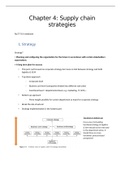
Top down vs bottom up
Focus area: formulating
functional strategy of logistics
& SCM should not be restricted
to the department alone. It
should focus on cross-
functional, process-based
perspective!
, 2. The evolution of manufacturing
See the arrow
from craft
production, via
mass production,
lean production
and now mass
customisation
Balance between customer
service & costs!
Satifying customer demand
Producing large volumes
and benefit from
economies of scale
Prior to industrial revolution, skilled artisans produced goods customized for individual customer needs
= craft production
Satisfied customer demand but comes at high costs
One of the most exciting advancements in the early twentieth centure was the widespread development
of mass production => Henry Ford
Economies of scale: Model T
3. Lean production
= Lean production and logistics is focused on eliminating waste using a set of proven standardized tools
and methodologies that target organizational efficiencies while integrating a performance
improvement system utilized by everyone
The origins of lean production and logistics can be traced back to the car company Toyota and its
Toyota Production System (TPS)
System not focused on efficiency of
individual machines, rather on total
flows through a system
Pull rather than psuh
strategies
Pg 57-76 in textbook
1. Strategy
Strategy?
= Planning and configuring the organization for the future in accordance with certain stakeholders
expectations
= A long term plan for success
• This part: not focused on corporate strategy but more on link between strategy and both
logistics & SCM
• Top-down approach
- Corporate level
- Business unit level (companies divided into different sub-units)
- Functional level = departmental level, e.g. marketing, IT, SCM,…
• Bottom-up approach
- More weight possible for certain department as input for corporate strategy
• Break the silo-structure!
• Strategy implementation is the hardest part
Top down vs bottom up
Focus area: formulating
functional strategy of logistics
& SCM should not be restricted
to the department alone. It
should focus on cross-
functional, process-based
perspective!
, 2. The evolution of manufacturing
See the arrow
from craft
production, via
mass production,
lean production
and now mass
customisation
Balance between customer
service & costs!
Satifying customer demand
Producing large volumes
and benefit from
economies of scale
Prior to industrial revolution, skilled artisans produced goods customized for individual customer needs
= craft production
Satisfied customer demand but comes at high costs
One of the most exciting advancements in the early twentieth centure was the widespread development
of mass production => Henry Ford
Economies of scale: Model T
3. Lean production
= Lean production and logistics is focused on eliminating waste using a set of proven standardized tools
and methodologies that target organizational efficiencies while integrating a performance
improvement system utilized by everyone
The origins of lean production and logistics can be traced back to the car company Toyota and its
Toyota Production System (TPS)
System not focused on efficiency of
individual machines, rather on total
flows through a system
Pull rather than psuh


