Summary Policy, Management and Organisation
Chapter 1 The Health Policy Framework
• Understand the framework for analysing health policy used in this book to define the
following key concepts:
o policy
o context
o actors
o process
• Describe how health policies are made through the inter-relationship of context, process and
actors .
• Understand a related way of looking at policy making that sees it as occurring through the
ongoing interaction among interests, ideas and institutions.
Policy: the decisions taken or not taken by those with responsibility for a particular policy area.
Public policy: policies made by the state or the government and/or by those in the public sector (e.g.
in agencies of government).
Health policy covers courses of action (and inaction) that affect the set of institutions, organizations,
services and funding arrangements of the health care system (both public and private).
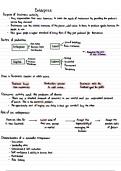
The Health Policy Framework:
Actors are influenced by the context within which they live and work; context is affected by many
factors such as political instability, history and culture. The process of policy making – how issues get
on to policy agendas– is affected by actors, their position in power structures, their own values and
expectations. And the content of policy reflects some or all of these factors.
Actor may be used to denote individuals (a particular statesman – Nelson Mandela, the ex-President
of South Africa, for example), organizations such as the World Bank or multinational companies such
as Shell, or the state or government.
Context refers to systemic factors – political, economic and social, local, regional, national and
international – which may have an effect on health policy
Process refers to the way in which policies are initiated, developed or formulated, negotiated,
communicated, implemented and evaluated. Process of policy making:
• Problem identification and issue recognition
• Policy formulation
• Policy implementation
• Policy evaluation
,You can use the health policy triangle to help analyse or understand a particular policy or you can
apply it to plan a particular policy. The former can be referred to as analysis of policy, the latter as
analysis for policy. Analysis of policy is generally retrospective and explanatory. Analysis for policy is
usually prospective.
Governance is about the formal and informal rules that distribute roles and responsibilities among
governments, providers and beneficiaries and that shape the interactions among them.
Governance encompasses authority, power, and decision making in the institutional arenas of civil
society, politics and public administration.
→ in parallel to the formal divisions of roles and responsibilities between organisations taking part in
health systems governance, relations of power create informal links…
Chapter 2 Power and the policy process
• Define power
• Understand theories on the distribution of power in society
• Conceptualize the political system, and understand how political systems may influence
access to decision making power.
• Differentiate between dimensions of power.
• Understand theories on decision making in a policy context based on the appreciation of the
role of power in relation to rationality.
Power: the ability to achieve a desired outcome. Or: a matter of getting people to do what they
would not have done otherwise (Dahl, 1957). Dimensions of power:
• Power as decision making: focuses on acts of individuals and groups which influence policy
decisions.
• Power as non-decision making: power as agenda-setting, powerful groups control the agenda
to keep threatening issues out of sight.
• Power as thought control: power can be a function of the ability to influence others by
shaping their initial preferences. A gains B’s compliance through subtle means. This could
include the ability to shape meanings and perceptions of reality which might be done
through the control of information, the mass media or through the processes of socialization.
We differentiate hard and soft power: hard power corresponds to the carrot and the stick and soft to
the hug.
• Hard power: Intimidation and coercion (stick)
• Hard power: Productive exchanges involving mutual gain (carrot)
• Soft power: Obligations, loyalty, commitment (hug)
Forms of authority (Weber):
• Traditional authority exists where obedience is based on custom and the established way of
doing things (e.g. sultan/king)
• Charismatic authority is based on intense commitment to a leader and their ideology or
other personal characteristics (e.g. Nelson Mandela)
• Rational–legal authority is based on rules and procedures. In this case, authority is vested in
the office as opposed to the attributes of the particular office holder (e.g. secretary of
ministry of health/police)
• Technical/expertise authority is when patients respect the advice of their doctors (for the
most part) on the basis of the technical knowledge that doctors are thought to possess.
, Pluralism: there is an equal distribution of power among groups in society. Protected by political
rights to vote and to free speech. Individuals have the right and ability to organize in groups and
associations, who then compete over power.
• Power is diffused throughout society
• State is neutral: does not defend the interests of one class or group, nor shows marked bias
towards particular interests.
• Although society has elite groups, no elite group dominates at all times.
Criticism against pluralism:
• Interest groups are not equally powerful
• The state is not neutral
• Ignores external powers
• Does not explain power dynamics in non-democratic societies
Elitism: alternative theory to pluralism
Political elite = only open to members of dominant economic classes.
• Policy choice is dominated by elites
• Primary function of the state is to ensure dominance of these elites: continuation of status
quo.
• Interest groups exist but they are not all equally powerful and do not have equal access to
the policy making process.
Criticism against elitism:
• Overstates capacity of elites to wield power
• Non-elites do challenge elites: change happens
• There are multiple groups competing for attention on specific issues
Politics: who gets what, when, and how.
Easton’s political systems model
• Inputs
o Demands: communication through interest groups, lobbyists, protests.
o Supports: paying taxes, voting, complying with the law
• Easton provided relatively few details on how the conversion process takes place and
therefore government decision making is considered a ‘black box’.
• The outcome depends on the power balance between individuals and groups involved (and
the rules by which their struggle is organised).
Criticism: the model fails to explain why governments may employ repression and coercion, as many
have at some time, to curb demands. It appears as if the state is neutral, while in reality it isn’t.
Chapter 1 The Health Policy Framework
• Understand the framework for analysing health policy used in this book to define the
following key concepts:
o policy
o context
o actors
o process
• Describe how health policies are made through the inter-relationship of context, process and
actors .
• Understand a related way of looking at policy making that sees it as occurring through the
ongoing interaction among interests, ideas and institutions.
Policy: the decisions taken or not taken by those with responsibility for a particular policy area.
Public policy: policies made by the state or the government and/or by those in the public sector (e.g.
in agencies of government).
Health policy covers courses of action (and inaction) that affect the set of institutions, organizations,
services and funding arrangements of the health care system (both public and private).
The Health Policy Framework:
Actors are influenced by the context within which they live and work; context is affected by many
factors such as political instability, history and culture. The process of policy making – how issues get
on to policy agendas– is affected by actors, their position in power structures, their own values and
expectations. And the content of policy reflects some or all of these factors.
Actor may be used to denote individuals (a particular statesman – Nelson Mandela, the ex-President
of South Africa, for example), organizations such as the World Bank or multinational companies such
as Shell, or the state or government.
Context refers to systemic factors – political, economic and social, local, regional, national and
international – which may have an effect on health policy
Process refers to the way in which policies are initiated, developed or formulated, negotiated,
communicated, implemented and evaluated. Process of policy making:
• Problem identification and issue recognition
• Policy formulation
• Policy implementation
• Policy evaluation
,You can use the health policy triangle to help analyse or understand a particular policy or you can
apply it to plan a particular policy. The former can be referred to as analysis of policy, the latter as
analysis for policy. Analysis of policy is generally retrospective and explanatory. Analysis for policy is
usually prospective.
Governance is about the formal and informal rules that distribute roles and responsibilities among
governments, providers and beneficiaries and that shape the interactions among them.
Governance encompasses authority, power, and decision making in the institutional arenas of civil
society, politics and public administration.
→ in parallel to the formal divisions of roles and responsibilities between organisations taking part in
health systems governance, relations of power create informal links…
Chapter 2 Power and the policy process
• Define power
• Understand theories on the distribution of power in society
• Conceptualize the political system, and understand how political systems may influence
access to decision making power.
• Differentiate between dimensions of power.
• Understand theories on decision making in a policy context based on the appreciation of the
role of power in relation to rationality.
Power: the ability to achieve a desired outcome. Or: a matter of getting people to do what they
would not have done otherwise (Dahl, 1957). Dimensions of power:
• Power as decision making: focuses on acts of individuals and groups which influence policy
decisions.
• Power as non-decision making: power as agenda-setting, powerful groups control the agenda
to keep threatening issues out of sight.
• Power as thought control: power can be a function of the ability to influence others by
shaping their initial preferences. A gains B’s compliance through subtle means. This could
include the ability to shape meanings and perceptions of reality which might be done
through the control of information, the mass media or through the processes of socialization.
We differentiate hard and soft power: hard power corresponds to the carrot and the stick and soft to
the hug.
• Hard power: Intimidation and coercion (stick)
• Hard power: Productive exchanges involving mutual gain (carrot)
• Soft power: Obligations, loyalty, commitment (hug)
Forms of authority (Weber):
• Traditional authority exists where obedience is based on custom and the established way of
doing things (e.g. sultan/king)
• Charismatic authority is based on intense commitment to a leader and their ideology or
other personal characteristics (e.g. Nelson Mandela)
• Rational–legal authority is based on rules and procedures. In this case, authority is vested in
the office as opposed to the attributes of the particular office holder (e.g. secretary of
ministry of health/police)
• Technical/expertise authority is when patients respect the advice of their doctors (for the
most part) on the basis of the technical knowledge that doctors are thought to possess.
, Pluralism: there is an equal distribution of power among groups in society. Protected by political
rights to vote and to free speech. Individuals have the right and ability to organize in groups and
associations, who then compete over power.
• Power is diffused throughout society
• State is neutral: does not defend the interests of one class or group, nor shows marked bias
towards particular interests.
• Although society has elite groups, no elite group dominates at all times.
Criticism against pluralism:
• Interest groups are not equally powerful
• The state is not neutral
• Ignores external powers
• Does not explain power dynamics in non-democratic societies
Elitism: alternative theory to pluralism
Political elite = only open to members of dominant economic classes.
• Policy choice is dominated by elites
• Primary function of the state is to ensure dominance of these elites: continuation of status
quo.
• Interest groups exist but they are not all equally powerful and do not have equal access to
the policy making process.
Criticism against elitism:
• Overstates capacity of elites to wield power
• Non-elites do challenge elites: change happens
• There are multiple groups competing for attention on specific issues
Politics: who gets what, when, and how.
Easton’s political systems model
• Inputs
o Demands: communication through interest groups, lobbyists, protests.
o Supports: paying taxes, voting, complying with the law
• Easton provided relatively few details on how the conversion process takes place and
therefore government decision making is considered a ‘black box’.
• The outcome depends on the power balance between individuals and groups involved (and
the rules by which their struggle is organised).
Criticism: the model fails to explain why governments may employ repression and coercion, as many
have at some time, to curb demands. It appears as if the state is neutral, while in reality it isn’t.