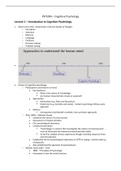
PSY1004 – Cognitive Psychology
Lecture 1 – Introduction to Cognitive Psychology
• What is the mind - break down mind into facility of thought
o Perception
o Attention
o Memory
o Language
o Emotions
o Decision making
o Problem solving
•
• History of cognitive psychology
o Philosophers and theories of mind
• Key questions
▪ What is the nature of 'knowledge'
▪ Are human characteristics innate or acquired?
• Approaches
▪ Rationalism (e.g. Plato and Descartes)
▪ Empiricism (e.g. Aristotle and Locke) - modern psychology follows same
approach
• Method
▪ Introspection (not Wundt's method, more armchair approach)
o After 1800s - Wilhelm Wundt
• Looked at the nature of consciousness
• Assessment of mental activities
• First psychological laboratory
• Created structuralism
▪ "Psychology is a science that investigates the nature of consciousness" -
must be dissected into elements (mental periodic table)
▪ To do this, studied sensory experience though recording response times
and introspection
• Established the first psychological laboratory in 1879 in Leipzig - mostly made up
of physicists
• Also established the approach of psychophysics
o William James 1842 - 1910
• 1890 - "Principles of Psychology"
• Interested in how the mind functions
, • First functionalist
▪ Looked at processes of conscious activities
▪ Looked at mental operations over mental elements
o Behaviourism - a reaction against unobservable mental process, and against Wundt - LEC
NOTE - DON'T NEED TO LEARN IN DETAIL
• J Watson (1878 - 1958); Only study observable behaviour
• I Pavlov (1849 - 1936); Classical conditioning
• B.F. Skinner (1904-1990); Operant conditioning
•
o 1950ies - Cognitive Revolution - reaction against Skinner's extremist behaviourism
• Spurred on by creation of computer - first Binary Computer built in 1949
• Two paradigms were created by A. Newell (1927-1992) and H.A. Simon (1916-
2001):
▪ Mental activity can be seen as an info-processing problem
▪ Mental representations depend on internal computations
• First cognitive psychology textbook - Cognitive Psychology by Ulric Neisser in
1967
•
• Concepts in cognitive psychology - any mental activity is seen as an information processing
problem
o Mental representations
o Transformations of mental representations
, •
o How does the mind manipulate representations = mental operations.
• How can we measure mental operations?
o Issues with studying mental process:
• They cannot be measured directly
• There is always ambiguity about the source of the performance measures
• Methodology: two classic studies of mental process
o Both use experimental psychology approach - controlled lab studies
o Subtractive method (1868)
• Created by F. Donders (1818-1989)
• Looked at how we measure the speed of internal thought processes - mental
chronology
• His basic idea is that we could use behaviour to infer mental process
• Invented simple reaction time measurements (RT)
▪ Used stimulus (light) and ppt had to press a button when detected.
▪ Timed between stimulus turning on, and behavioural response being
detected
▪ Took ppt 250ms
• Then created choice reaction times (RT)
▪ Used two lights, one of which was brighter
▪ Ppt had to press a button depending on which was brighter
▪ Took ppt 350ms
• Because of this, he found that the first task took 250ms (detection), and the
second took 350ms. As 350-250 = 100, we can infer that the second process
(discrimination) took 100ms.
•
o Memory Search (1966)
• S. Sternberg
, • Research question - "are mental operations performed in a sequence (serial
processing) or simultaneously (parallel processing)?"
• He found the more items in a memory set, the longer the reaction time
• He inferred four mental operations
•
Lecture 1 – Introduction to Cognitive Psychology
• What is the mind - break down mind into facility of thought
o Perception
o Attention
o Memory
o Language
o Emotions
o Decision making
o Problem solving
•
• History of cognitive psychology
o Philosophers and theories of mind
• Key questions
▪ What is the nature of 'knowledge'
▪ Are human characteristics innate or acquired?
• Approaches
▪ Rationalism (e.g. Plato and Descartes)
▪ Empiricism (e.g. Aristotle and Locke) - modern psychology follows same
approach
• Method
▪ Introspection (not Wundt's method, more armchair approach)
o After 1800s - Wilhelm Wundt
• Looked at the nature of consciousness
• Assessment of mental activities
• First psychological laboratory
• Created structuralism
▪ "Psychology is a science that investigates the nature of consciousness" -
must be dissected into elements (mental periodic table)
▪ To do this, studied sensory experience though recording response times
and introspection
• Established the first psychological laboratory in 1879 in Leipzig - mostly made up
of physicists
• Also established the approach of psychophysics
o William James 1842 - 1910
• 1890 - "Principles of Psychology"
• Interested in how the mind functions
, • First functionalist
▪ Looked at processes of conscious activities
▪ Looked at mental operations over mental elements
o Behaviourism - a reaction against unobservable mental process, and against Wundt - LEC
NOTE - DON'T NEED TO LEARN IN DETAIL
• J Watson (1878 - 1958); Only study observable behaviour
• I Pavlov (1849 - 1936); Classical conditioning
• B.F. Skinner (1904-1990); Operant conditioning
•
o 1950ies - Cognitive Revolution - reaction against Skinner's extremist behaviourism
• Spurred on by creation of computer - first Binary Computer built in 1949
• Two paradigms were created by A. Newell (1927-1992) and H.A. Simon (1916-
2001):
▪ Mental activity can be seen as an info-processing problem
▪ Mental representations depend on internal computations
• First cognitive psychology textbook - Cognitive Psychology by Ulric Neisser in
1967
•
• Concepts in cognitive psychology - any mental activity is seen as an information processing
problem
o Mental representations
o Transformations of mental representations
, •
o How does the mind manipulate representations = mental operations.
• How can we measure mental operations?
o Issues with studying mental process:
• They cannot be measured directly
• There is always ambiguity about the source of the performance measures
• Methodology: two classic studies of mental process
o Both use experimental psychology approach - controlled lab studies
o Subtractive method (1868)
• Created by F. Donders (1818-1989)
• Looked at how we measure the speed of internal thought processes - mental
chronology
• His basic idea is that we could use behaviour to infer mental process
• Invented simple reaction time measurements (RT)
▪ Used stimulus (light) and ppt had to press a button when detected.
▪ Timed between stimulus turning on, and behavioural response being
detected
▪ Took ppt 250ms
• Then created choice reaction times (RT)
▪ Used two lights, one of which was brighter
▪ Ppt had to press a button depending on which was brighter
▪ Took ppt 350ms
• Because of this, he found that the first task took 250ms (detection), and the
second took 350ms. As 350-250 = 100, we can infer that the second process
(discrimination) took 100ms.
•
o Memory Search (1966)
• S. Sternberg
, • Research question - "are mental operations performed in a sequence (serial
processing) or simultaneously (parallel processing)?"
• He found the more items in a memory set, the longer the reaction time
• He inferred four mental operations
•