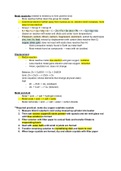
Metal reactivity (related to tendency to form positive ions)
- More reactive further down the group for metals
- Outermost electron further away from nucleus as no. electron shell increases; more
easy to lose electron
- Group I > Group II > Group III
- K > Na > Li > Ca > Mg > Al > C > Zn > Fe > Sn (tin) > Pb > H > Cu > Ag > Au
(based on reaction with water and dilute acid under room temperature)
- Potassium, sodium, lithium, calcium, magnesium, aluminium; extract by electrolysis
zinc, iron, tin, lead; extract by displacement with carbon (less reactive than C)
copper, silver, gold; does not react with acids (less reactive than H)
- Gold (unreactive metal); found in Earth as metal itself
- Most metals found as compounds → react with air (oxidise)
Displacement
- Redox reaction
- More reactive metal lose electron and gain oxygen; oxidation
- Less reactive metal gains electron and lose oxygen; reduction
- Anion; spectator ion; does not change
Balance; Zn + CuSO4 —> Cu + ZnSO4
Ionic; Zn + Cu2+ —> Zn2+ + Cu
(ionic equation; shows elements that change physical state)
Half
- Zn → Zn2+ + 2e- (oxidised)
- 2e- + Cu2+ —> Cu (reduced)
Metal and Acid
- Metal + acid —> salt + hydrogen (redox)
- Metal oxide + acid —> salt + water
- Metal carbonate + acid —> salt + water + carbon dioxide
**Required practical; make dry copper sulphate crystals
1. Measure 40cm3 sulphuric acid using measuring cylinder into beaker
2. Then add excess copper(II) oxide powder with spatula and stir with glass rod
until blue solution is formed
3. Filter solution with filter paper to conical flask and transfer filtrate to
evaporating basin
4. Heat with water bath until small crystals are formed
5. Transfer remaining solution to crystallising dish and leave to cool
6. When large crystals are formed, dry and obtain crystals with filter paper
- More reactive further down the group for metals
- Outermost electron further away from nucleus as no. electron shell increases; more
easy to lose electron
- Group I > Group II > Group III
- K > Na > Li > Ca > Mg > Al > C > Zn > Fe > Sn (tin) > Pb > H > Cu > Ag > Au
(based on reaction with water and dilute acid under room temperature)
- Potassium, sodium, lithium, calcium, magnesium, aluminium; extract by electrolysis
zinc, iron, tin, lead; extract by displacement with carbon (less reactive than C)
copper, silver, gold; does not react with acids (less reactive than H)
- Gold (unreactive metal); found in Earth as metal itself
- Most metals found as compounds → react with air (oxidise)
Displacement
- Redox reaction
- More reactive metal lose electron and gain oxygen; oxidation
- Less reactive metal gains electron and lose oxygen; reduction
- Anion; spectator ion; does not change
Balance; Zn + CuSO4 —> Cu + ZnSO4
Ionic; Zn + Cu2+ —> Zn2+ + Cu
(ionic equation; shows elements that change physical state)
Half
- Zn → Zn2+ + 2e- (oxidised)
- 2e- + Cu2+ —> Cu (reduced)
Metal and Acid
- Metal + acid —> salt + hydrogen (redox)
- Metal oxide + acid —> salt + water
- Metal carbonate + acid —> salt + water + carbon dioxide
**Required practical; make dry copper sulphate crystals
1. Measure 40cm3 sulphuric acid using measuring cylinder into beaker
2. Then add excess copper(II) oxide powder with spatula and stir with glass rod
until blue solution is formed
3. Filter solution with filter paper to conical flask and transfer filtrate to
evaporating basin
4. Heat with water bath until small crystals are formed
5. Transfer remaining solution to crystallising dish and leave to cool
6. When large crystals are formed, dry and obtain crystals with filter paper