Relative atomic mass (Ar)
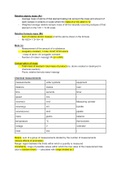
- Average mass of atoms of that element taking into account the mass and amount of
each isotope it contains on scale where the mass of a 12C atom is 12
- Weighted average relative isotopic mass of all the naturally occurring isotopes of that
element on the 12C = 12.00 scale.
Relative formula mass (Mr)
- Sum of relative atomic masses of all the atoms shown in the formula
- Mr H2O= 1*2+16= 18
Mole (n)
- Measurement of the amount of a substance
- Avogadro constant; 1 mole =6.02*10^23 atoms
- mass of atom= Ar/ avogadro constant
- Number of moles= mass(g)/ Mr (n= m/Mr)
Conservation of mass
- Total mass of reactant= total mass of product (no. atoms created or destroyed in
chemical reaction)
- Prove; relative formula mass/ mass(g)
Chemical measurements
measurements units/ symbols equipment
distance metres ruler
time seconds timer
speed m/s /
volume(l) cm3 Measuring cylinder
volume(g) m3 burette
volume(conc) dm3 pipette
mass grams balance
temperature °C thermometre
voltage V voltmeter
mole mol /
Means- sum of a group of measurements divided by the number of measurements
(reduce effects of anomalies)
Range- region between the limits within which a quantity is measured
Uncertainty- range of possible values within which the true value of the measurement lies
(due to random errors) → calculated with range divided by 2
- Average mass of atoms of that element taking into account the mass and amount of
each isotope it contains on scale where the mass of a 12C atom is 12
- Weighted average relative isotopic mass of all the naturally occurring isotopes of that
element on the 12C = 12.00 scale.
Relative formula mass (Mr)
- Sum of relative atomic masses of all the atoms shown in the formula
- Mr H2O= 1*2+16= 18
Mole (n)
- Measurement of the amount of a substance
- Avogadro constant; 1 mole =6.02*10^23 atoms
- mass of atom= Ar/ avogadro constant
- Number of moles= mass(g)/ Mr (n= m/Mr)
Conservation of mass
- Total mass of reactant= total mass of product (no. atoms created or destroyed in
chemical reaction)
- Prove; relative formula mass/ mass(g)
Chemical measurements
measurements units/ symbols equipment
distance metres ruler
time seconds timer
speed m/s /
volume(l) cm3 Measuring cylinder
volume(g) m3 burette
volume(conc) dm3 pipette
mass grams balance
temperature °C thermometre
voltage V voltmeter
mole mol /
Means- sum of a group of measurements divided by the number of measurements
(reduce effects of anomalies)
Range- region between the limits within which a quantity is measured
Uncertainty- range of possible values within which the true value of the measurement lies
(due to random errors) → calculated with range divided by 2