Lecture 8; ch 5, motor systems, the organisation of action
key: motor is hierarchical
lower level: brainstem & spinal cord
upper level: cerebral cortex
moditory influences from: cerebellum & basal ganglia
TOP LEVEL:
motor programs (goals)
set of commands to initiate a sequence of movements
> leads to motor invariance
= ability to execute the same motor actions with different parts of the body
provides evidence for these motor programs, not dependent on which muscle you use.
LOWER LEVEL:
motor execution (muscles)
elementary behaviour units activate individual muscle fibres
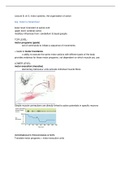
Simple muscle contractions are directly linked to action potentials in specific neurons
INTERMEDIATE PROCESSING STEPS
Translate motor programs > motor execution units
, 1. Highest level: SMA, premotor, prefrontal cortex : goals and planning of sequences of
movement
2. Primary motor cortex M1: partially involved in planning of movement, partially in
activating specific (groups of) muscles
3. Basal ganglia : selecting and (dis)inhibiting motor actions, simple learning (relay
station)
4. Cerebellum : sensory-motor coordination
5. Brainstem: relaying motor signals and adjusting posture
6. Spinal cord : direct activation of single muscle fibres and taking care of reflexes
Cortical motor structures
! M1 is located in the PRE CENTRAL GYRUS
SMA & premotor cortex are more anterior/rostral to the M1
,M1 > Brainstem > medulla pyramid (where the change sides) (end of the medulla) > spinal
cord > lateral corticospinal tract
Topographical maps of the body : somatotopic
Adjacent body parts are projected adjacent in the M1
, Those areas where you exercise fine motor control, are overly represented
Also found in macaque monkey (SMA = M1)
Subcortical regions: all subregions of the basal ganglia also topographic maps
Even thalamus & cerebellum !!!
Interesting
Maps of M1
Movement (not muscle) maps in M1
- Stimulation of M1 neurons can lead to simple muscle contractions
- But can also produce complex (coordinated, multijoint) movements
- This makes sense as M1 projects to lower motor regions (brainstem, spinal cord) and
sends motor program commands (what to do and how to do it) rather than to the
lower motor neurons themselves
Finding: direction & force of movement are coded in M1
But: does not directly produce muscle contractions: its role is planning of movements rather
than directly activating the muscles
Also true for voluntary eye movements produced by FEF (part of SMA)
Upper motor systems difene what to do and how to do it.
Lower motor systems perform the actual execution.
Coding movements by the activity of neuronal population
key: motor is hierarchical
lower level: brainstem & spinal cord
upper level: cerebral cortex
moditory influences from: cerebellum & basal ganglia
TOP LEVEL:
motor programs (goals)
set of commands to initiate a sequence of movements
> leads to motor invariance
= ability to execute the same motor actions with different parts of the body
provides evidence for these motor programs, not dependent on which muscle you use.
LOWER LEVEL:
motor execution (muscles)
elementary behaviour units activate individual muscle fibres
Simple muscle contractions are directly linked to action potentials in specific neurons
INTERMEDIATE PROCESSING STEPS
Translate motor programs > motor execution units
, 1. Highest level: SMA, premotor, prefrontal cortex : goals and planning of sequences of
movement
2. Primary motor cortex M1: partially involved in planning of movement, partially in
activating specific (groups of) muscles
3. Basal ganglia : selecting and (dis)inhibiting motor actions, simple learning (relay
station)
4. Cerebellum : sensory-motor coordination
5. Brainstem: relaying motor signals and adjusting posture
6. Spinal cord : direct activation of single muscle fibres and taking care of reflexes
Cortical motor structures
! M1 is located in the PRE CENTRAL GYRUS
SMA & premotor cortex are more anterior/rostral to the M1
,M1 > Brainstem > medulla pyramid (where the change sides) (end of the medulla) > spinal
cord > lateral corticospinal tract
Topographical maps of the body : somatotopic
Adjacent body parts are projected adjacent in the M1
, Those areas where you exercise fine motor control, are overly represented
Also found in macaque monkey (SMA = M1)
Subcortical regions: all subregions of the basal ganglia also topographic maps
Even thalamus & cerebellum !!!
Interesting
Maps of M1
Movement (not muscle) maps in M1
- Stimulation of M1 neurons can lead to simple muscle contractions
- But can also produce complex (coordinated, multijoint) movements
- This makes sense as M1 projects to lower motor regions (brainstem, spinal cord) and
sends motor program commands (what to do and how to do it) rather than to the
lower motor neurons themselves
Finding: direction & force of movement are coded in M1
But: does not directly produce muscle contractions: its role is planning of movements rather
than directly activating the muscles
Also true for voluntary eye movements produced by FEF (part of SMA)
Upper motor systems difene what to do and how to do it.
Lower motor systems perform the actual execution.
Coding movements by the activity of neuronal population